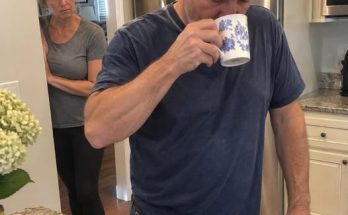
A year after that Monday morning, I found the black mug at the back of a kitchen cabinet.
The words BEST HUSBAND had faded along one edge.
I turned it over in my hands.
I thought about throwing it away.
Instead I set it on the table.
Objects don't carry guilt by themselves.
We give them meanings, then sometimes change those meanings as we live.
By then, Brad and I had spent months in separate homes.
We had completed difficult counseling sessions.
We had reviewed our accounts and signed a temporary financial agreement with professional guidance.
We had gone to dinner several times.
Some evenings were awkward.
Others reminded me why I'd once loved his company.
The question of our marriage had not been settled by one apology or one pleasant meal.
We had to look at what continuing together would require.
We wrote down our boundaries.
Financial decisions above an agreed amount would be discussed in advance.
Neither of us would conceal debts or obligations.
Personal relationships at work would respect professional boundaries.
Neither of us would use silent treatment or retaliation to control the other.
If conflict escalated, we would stop and resume after a defined break.
We would continue individual counseling as long as it was useful.
And neither of us would treat reconciliation as a reason to ignore the seriousness of the past.
One Sunday, Brad came over to help install shelves in the laundry room.
He brought a measuring tape and a level.
I brought the screws and a pencil.
We disagreed about where the top shelf should go.
He wanted it higher.
I wanted to reach it without a stool.
For a second his expression tightened.
My own voice grew sharp.
We both noticed.
“Can we try that again?” Brad asked.
I took a breath.
“I want to be able to use the shelf. That's important to me.”
He measured the wall again.
“All right. Show me where.”
We marked a lower line.
He drilled the holes.
I held the shelf in place.
Nothing about the exchange would have interested an outsider.
To us, it was evidence of a new skill.
Later we sat at the kitchen table and talked about where we would live.
Brad wanted to come home eventually.
I was open to it, but not immediately.
Our counselors had encouraged us to move at a pace that respected both people's safety.
We agreed to revisit the decision in three months.
Until then, we would keep our separate living arrangements.
Margaret had changed too, though not into a completely different person.
She still commented on my curtains.
She still asked questions that were too personal.
But she no longer requested money through Brad without discussing her own budget and professional advice.
She had taken on a small volunteer role at the community garden near her apartment.
On warm mornings she helped water young plants.
She said she liked having something useful to do that didn't require buying anything.
One afternoon she invited me to see the garden.
I went because I wanted to, not because I felt obligated.
We stood beside a raised bed of herbs.
She looked at me for a long moment.
“I was unkind to you,” she said.
I waited.
“I made you feel like you were outside the family. And I put pressure on Brad to hide things.”
“Yes,” I said.
She nodded.
Before that final year passed, there had been a Saturday when I nearly told Brad we should give up.
We had arranged to meet for lunch at a café halfway between our homes.
He arrived late because his car had a flat tire.
He sent a message as soon as it happened, but I still sat at the table watching the door.
An old familiar feeling returned.
He's lying.
He's with someone else.
He's making a fool of me.
I stared at my phone.
For several minutes, I was certain the fear meant I knew something.
Then I called Nora.
“Can you help me check a thought?” I asked.
She listened as I described the delay.
“What do you know?”
“He has a flat tire. That's what he said.”
“What else?”
“He sent a picture of the car and said he called roadside assistance.”
“Do you have another fact?”
“No.”
“Then maybe you can be upset about waiting without deciding what it means.”
I watched a server place fresh water on another table.
“I hate that this is still so hard.”
“I know.”
By the time Brad arrived, forty minutes late, I had finished my tea.
He apologized and showed me a receipt from the roadside service without being asked.
“I didn't need a receipt,” I said.
“I thought it might help.”
“It does a little.”
He sat down.
“Should we order?”
I almost said I wanted to leave.
Instead I told him what I'd felt while waiting.
He listened.
Then he said, “I understand why you worried. But I need us to handle delays without treating them as proof of betrayal.”
I knew he was right.
It was difficult to hear from the man whose earlier lies had trained me to doubt his explanations.
We ordered sandwiches and talked until the tension eased.
Afterward, I was glad I hadn't stormed out.
Not because every suspicion would always be mistaken.
But because I had asked for a moment to understand mine before acting.
Another evening, Brad told me he'd been frightened when a colleague offered him an after-work drink.
He declined and came straight home to his apartment.
“I don't want to make normal friendships impossible,” he said.
“Then don't,” I replied. “Just keep appropriate boundaries and be honest.”
He nodded.
We were learning not to build a new marriage out of surveillance.
Trust could not mean constant reports of every conversation.
It had to mean enough transparency, consistency, and mutual respect that ordinary life could feel ordinary again.
The next counseling session was difficult.
We disagreed about what returning to the same house would mean.
Brad wanted to move his clothes back first.
I wanted a trial period with clear expectations.
We left without a decision.
For once, neither of us treated that as failure.
At our next meeting, we returned to the topic with more specific questions.
How would we share chores?
What would happen during an argument?
How would we preserve personal space?
What expenses would require advance discussion?
We wrote down the answers.
A relationship was not repaired because we could imagine a beautiful future.
It was repaired, if at all, through the details of how we intended to live tomorrow.
“I can't undo it.”
“No.”
“I hope we can get along better.”
“We can try. But I need you to respect our decisions even when you dislike them.”
“I'll work on that.”
It wasn't a perfect speech.
It was specific enough to begin with.
Chloe remained out of our lives.
I had heard through Brad that she was working in another department.
I didn't seek updates.
Her apology had been received.
There was nothing more I needed from her.
The money took longer to repair.
Our emergency fund grew a little each month.
We postponed the coastal trip.
We planned a smaller weekend away instead, only after the budget made room for it.
The roof no longer leaked.
Margaret paid her own rent.
Brad kept records of the money he contributed to our household.
These weren't exciting victories.
They were the practical evidence that life could become steadier.
One evening Brad joined me for dinner at home.
I made soup.
He brought bread from the bakery near his apartment.
Afterward, we washed the dishes together.
He noticed the black mug on the counter.
“I thought that was gone,” he said.
By spring, we had a new arrangement for ordinary visits.
Brad would ask before coming over.
I would say yes or no without needing a complicated excuse.
Sometimes we cooked together.
Sometimes we went for a walk and parted at the corner.
Once we argued about a missed payment reminder, stopped, and returned to the question the following evening.
No one disappeared for days.
No one threatened to leave simply to win the argument.
We didn't call every peaceful evening progress.
We kept showing up and doing the work.
That was the future we could choose, one honest conversation at a time.
“I found it in the back.”
He picked it up carefully.
“I don't think I earned that title.”
I dried my hands.
“Neither of us behaved like the person we wanted to be.”
He set the mug down.
“Do you think we can?”
“Sometimes,” I said. “If we keep choosing it.”
He reached for my hand but stopped halfway.
“May I?”
I looked at him.
Later that night, I put the black mug in the cupboard with the other cups.
I didn't want it displayed as a warning or hidden like evidence of a shameful secret.
It was simply part of our history.
The following morning I made a shopping list and called Ruth about next week's reading program.
Life kept asking us for ordinary decisions.
I was ready to make them carefully.
“Yes.”
His hand was warm.
It was a simple gesture, offered rather than assumed.
We sat together for a while.
Eventually Brad left for his apartment.
I watched him walk to the car and wave before driving away.
The house was quiet afterward.
I didn't feel abandoned.
I didn't feel compelled to check his phone or imagine what he might be hiding.
That didn't mean trust was fully restored.
It meant we were living with the truth instead of trying to outrun it.
I knew there would be hard days again.
Promises mattered only if we kept them when the day was difficult.
That was the future I was willing to try.
The next morning I made coffee for myself.
I used a plain white cup.
I sat by the window with my calendar open and the week's errands written down.
There were appointments, library programs, bills, and a note about calling the roofer for a routine follow-up.
There was also a dinner with Brad on Thursday.
I smiled when I saw it.
Not because everything had turned out exactly as I'd once dreamed.
But because the next choice was still ours to make.
THE END
The End
Read more original stories on Feel Every Story.
The Morning I Tried to Punish My Husband Ended With His Phone on Our Floor
Part 12 of 12