"I'm at the children's hospital," I told Mr. Reynolds.
"Then we can arrange this without asking you to abandon your son's bedside."
He spoke like someone who had seen enough family money disputes to recognize danger in the first few sentences.
He explained that the branch could not discuss all details by telephone until its identity checks were complete.
I could come in, authorize a lawyer to act for me, or schedule a secured video appointment.
There was no need to drive across town immediately.
I thanked him for that more sincerely than he probably expected.
Then I called my friend Nina, who had been bringing clean clothes to the hospital.
Nina answered while loading groceries into her car.
"Do you need food?"
"I need someone to listen while I explain something I don't fully understand."
She sat in her parked car for twenty minutes while I told her about the fifty cents, the bank visit, and the papers concerning Dad.
"First," she said, "stop trying to manage this alone. Second, tell the hospital social worker what's happening. Third, I know a lawyer who handles estates."
My first impulse was to decline.
Lawyers cost money.
Caleb had follow-up appointments, therapy visits, medication costs, and deductibles waiting for us.
Nina seemed to hear my hesitation.
"A consultation is not a lifetime commitment. You can ask what it costs before you agree to anything."
She gave me the name of an attorney, Maya Chen.
Maya didn't promise to rescue me in one dramatic afternoon.
She asked for the documents I possessed and whether my father had left a will.
"I saw a copy after his funeral," I said. "Patricia handled the estate. I was overwhelmed with Caleb and work."
"Were you a beneficiary?"
"I thought so."
"That's the first thing we need to establish, not assume."
Maya explained that estate assets, personal checking accounts, and trust accounts have different owners and rules.
A threat about "the account" could mean several things.
A forged signature on a document would be important.
An accurate but misunderstood account authorization would be a different problem.
"Bring what you can find," she said. "And don't accuse anyone publicly until we have records."
I promised.
At three that afternoon, Denise introduced me to the hospital social worker, Ms. Alvarez.
She didn't ask for a grand explanation of why my family disappointed me.
She asked whether I had a reliable ride when Caleb was discharged.
Whether we had food at home.
Whether anyone with access to our house was making me feel unsafe.
Whether I needed help with leave paperwork.
Her questions were practical.
They made me realize how much energy I had wasted trying to make Patricia understand feelings she already knew about.
Ms. Alvarez helped me identify two people I could call.
Nina was one.
My neighbor, Mrs. Bell, was another.
Neither had raised Caleb.
Neither was obligated to help.
Both had appeared at the hospital with useful supplies while his grandmother stayed away.
The next afternoon, I joined a secure meeting with Mr. Reynolds and a compliance officer named Leah Ross.
Maya attended with my permission.
They confirmed that the account I used for expenses had been restricted against the recently issued cards.
Patricia had demanded access in person, but the bank had not released money to her that morning.
Then Leah described the second matter.
A savings account had been opened years earlier under an arrangement connected to my father's estate administration.
The bank's records indicated it was still titled to the estate, not to Patricia personally.
A distribution request had been submitted using a paper that purported to show my consent as one of the interested parties.
Leah did not give me the balance over the phone.
She sent the documents through the bank's secure process after identity verification.
I opened the file while Maya remained on the call.
During the secure bank appointment, I asked Leah what she meant by interested parties.
She drew a simple distinction on the screen.
A person could be named in an estate document without owning a particular bank account.
An executor might have authority to gather assets for the estate without having personal ownership of them.
A beneficiary could have rights to information and distribution that depended on the estate's administration.
"We can tell you what our bank's records show," she said. "Questions about legal rights under the will belong with your lawyer and the court."
It was the clearest explanation I had received since Dad's funeral.
Back then, Patricia had handed me papers to initial while we were standing in her kitchen.
I remembered a chipped mug, a stack of condolence cards, and Vanessa complaining that the funeral flowers had been too plain.
I had been exhausted.
Caleb was three and frightened by adults who kept crying.
I signed what Patricia presented, believing a mother would not ask me to give away something important without explaining it.
Now Maya asked whether I retained copies.
I also asked Leah whether any new authorization could be submitted without another review.
She explained only the safeguards relevant to my own accounts and encouraged me to maintain contact through the secured channel.
I thanked her and stored the case reference where I could find it quickly.
For the moment, there was a process, and I knew whom to call.
"I don't know," I said.
"That's all right. We'll request what exists rather than rely on memory."
I was embarrassed by how relieved I felt.
The bank review required me to document which cardholder had used each card, where possible.
I found a notebook in the gift shop and made three columns.
PERMISSION GIVEN.
PERMISSION REVOKED.
NEEDS INVESTIGATION.
The representative had emphasized that a payment made while a person was authorized wasn't automatically an unauthorized charge.
I wrote that down too.
There were things I wished I had refused earlier.
Regret wasn't the same as evidence.
At four, Mr. Reynolds called again to confirm that the disputed estate instruction remained unprocessed.
"Can Patricia go somewhere else and get the money?" I asked.
"We can speak only to accounts we hold," he said. "Your attorney may want to check the estate's other institutions."
I wrote that on my notepad.
When I finished the call, the hospital chaplain approached while doing routine rounds.
I wasn't sure I wanted to talk.
She said she could sit quietly or leave.
I invited her to sit.
For ten minutes, we watched the parking garage through the window.
Then I said, "I keep thinking if I explain myself correctly, my mother will suddenly care."
The chaplain didn't argue with my feelings.
"What would caring look like right now?" she asked.
"She would ask how he is. She would say she's coming. She would bring him the little drawing he made her."
We sat quietly again.
"Those are modest hopes," she said.
I nodded.
That was what made their absence hurt.
I hadn't asked Patricia to pay for surgery or manage my entire household.
I had asked her to come sit in a chair.
As the chaplain left, Caleb woke and wanted the curtains open.
I stood up and pulled them back.
The afternoon was bright enough to hurt my eyes.
He squinted, then pointed to a truck below.
"That one looks like Grandpa's."
I followed his finger.
It did.
For the first time that day, I thought of Dad without thinking of his bank account.
There was my name.
There was a date from the previous week.
And beneath a paragraph of legal language, there was a signature that looked approximately like mine.
I checked the authorization form twice before ending the call.
Leah confirmed it would remain part of the bank's preserved record.
I wrote her name and the time in my notebook.
Then I emailed Maya the notes while the details were fresh.
I wasn't trying to win an argument with Patricia.
I was trying to prevent my tired memory from becoming the only evidence of what happened.
It slanted too sharply.
The middle initial was one I'd stopped using on legal documents after marrying Caleb's father and later retaining Whitaker as my surname.
I hadn't signed it.
"I did not execute this," I said.
Maya asked me not to close the document.
She told Leah we would respond formally and preserve the original.
Leah confirmed that the distribution had not been processed and the account was under review.
"Does this mean they've been arrested?" I asked.
"No," Leah said. "It means we have a disputed instruction that requires investigation."
She said the bank might make a report to appropriate authorities and could not discuss internal reporting decisions.
That was all.
No police bursting through doors.
No instant reimbursement.
Just paperwork, procedure, and a document bearing my name.
I thought about Dad at our kitchen table when I was sixteen.
He had taught me to balance a checkbook with a pencil.
"Never sign what you don't understand," he'd said.
I wanted to ask him whether he had meant that lesson to protect me from strangers or from his own wife.
That evening, Patricia called seventeen times.
I answered none of them.
She left a voicemail saying the banker was humiliating her and asking me to tell him everything was a misunderstanding.
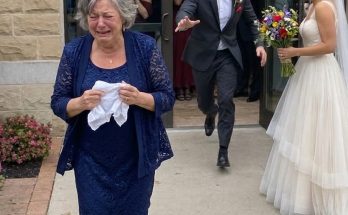
Vanessa sent a photograph of a white wedding gown.
SHE'S CRYING BECAUSE YOU RUINED HER DAY, she wrote.
For years that sentence would have sent me scrambling to repair the damage.
This time, I put the phone down and opened Caleb's medication chart.
The physician wanted him to sit in a chair for a few minutes the following morning if his recovery continued.
I found my colored pen and wrote the goal on a clean page.
SIT UP WITH CALEB.
Then, underneath it, I wrote something else.
DO NOT SIGN ANYTHING FOR PATRICIA.
The words looked stark on the paper.
They also looked possible.
When Caleb stirred, I held a cup of water to his lips.
"Mom?"
"I'm here."
"Did Grandma call?"
"She called me," I said carefully. "But right now we're working on getting you strong."
He frowned.
"Is everything bad?"
"No, sweetheart. Your surgery went well. You have people taking care of you. And I will tell you the truth about things that concern you."
He held out his fingers.
I took them.
It was the first promise I'd made all week that didn't depend on Patricia keeping hers.
Click here to continue reading: PART 3: An Old Probate Folder Revealed the Difference Between My Father’s Wishes and Patricia’s Story
The Morning Caleb Went Into Surgery, Nobody Came, but My Mother Remembered the Wedding Dress
Part 2 of 12