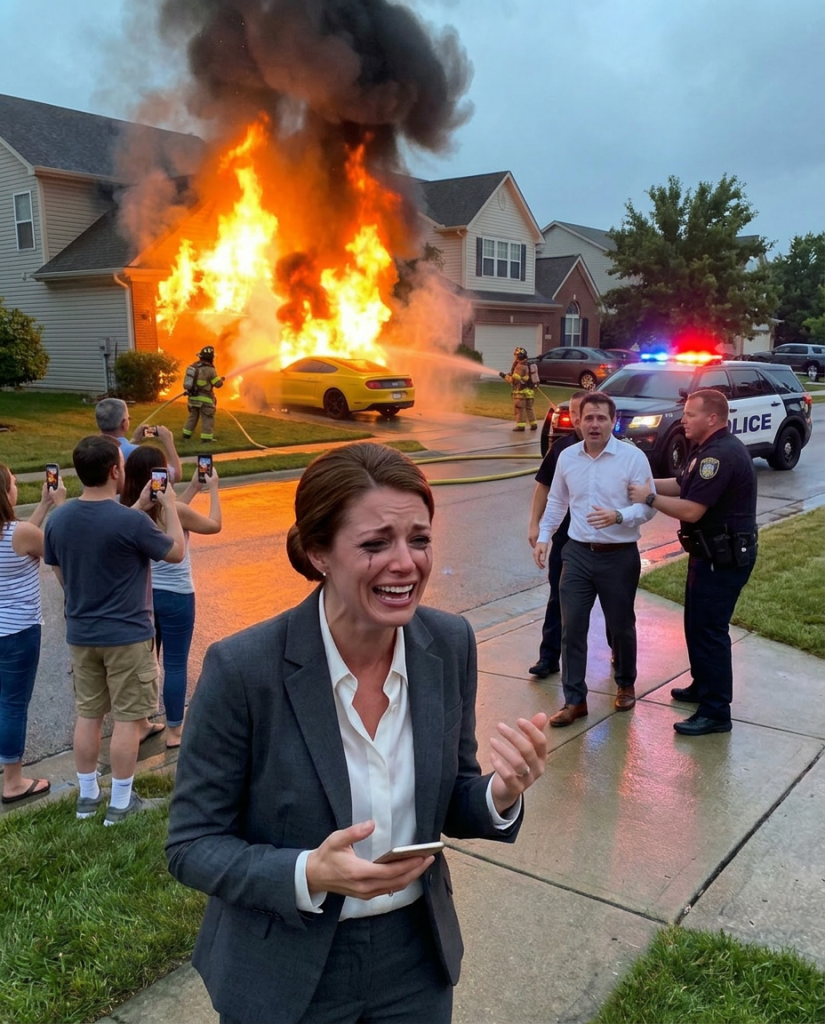
I wasn’t negotiating with a man who used fire as punishment.
I was ending the marriage.
Two days later Derek posted bail. My lawyer warned he would try to rewrite the story before it reached court.
He tried.
He called from a private number.
“Sam… can we talk? I made a mistake.”
I didn’t respond.
Instead I forwarded the voicemail to my attorney and filed for a protective order.
In court Derek tried to present himself as a husband who had “lost control for a moment.” The judge watched the porch footage and signed the order without hesitation.
After that Derek shifted from apologies to demands.
He emailed my work claiming I “owed” him for “allowing” me to have a career. He demanded I pay his legal fees and insisted on a “fair split” of assets he never helped build.
But we had a prenup.
Derek had once signed it with a grin, joking that he was “marrying me, not my parents.”
Now he acted as if my family had cheated him out of a life he deserved.
When my father offered to buy me a new house, I surprised him.
“I want my own place,” I told him. “Somewhere that’s mine because I chose it.”
So my parents helped in the ways I truly needed: they paid for smoke cleanup and hired a security company to replace the locks and install cameras that I controlled.
For the first time, their wealth felt like protection instead of pressure.
A week later I finally picked up the Lamborghini from the dealership.
I expected to feel triumphant.
Instead I felt calm.
The car was beautiful—but the real gift was the reminder that I didn’t need to shrink myself just to make someone else comfortable.
I drove it to my new apartment, parked in the secured garage, and stepped into a quiet space that finally felt like oxygen.
No waiting up.
No criticism.
Just my life.
The criminal case moved faster than the divorce.
Once investigators confirmed Derek’s same-day insurance coverage change, the insurance company joined the case. Between the footage, his texts, and the email about claim timing, his lawyer pushed for a plea deal.
Derek pled guilty to arson-related charges and attempted insurance fraud.
He avoided prison, but not consequences: probation, restitution, mandatory counseling, and a permanent criminal record.
He tried one last time to punish me by posting online that I had “ruined his life.”
Someone shared the security footage in a neighborhood group.
The comments shut him down faster than I ever could.
For once, he couldn’t control the narrative.
The divorce itself was quieter—documents, disclosures, signatures. Because of the prenup, Derek walked away with exactly what he brought into the marriage—minus the debts he created.
The judge finalized everything on a rainy Tuesday.
When I stepped outside the courthouse, my hands trembled—not from fear, but from relief.
That night I had dinner with my parents. We talked about my promotion, my plans, and a charity project I had postponed while living in survival mode.
My mom squeezed my hand.
“I’m proud of you,” she said.
Not because I pretended to be happy.
Because I chose myself.
Sometimes I still remember Derek’s laugh on the phone, the way he thought destruction would make me obedient.
Then I remember my own laughter in the driveway.
Now I understand what it was.
It was the sound of a spell finally breaking.
If you’ve ever faced a partner’s entitlement, share your story—and tell me what justice looks like for you today.