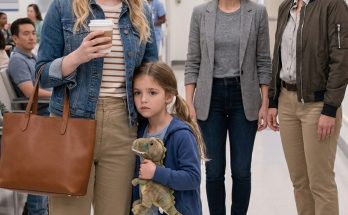
My mother left for Europe on a Thursday morning with two hard-shell suitcases, a fresh manicure, and twenty dollars pressed into my hand—like she was rewarding me instead of abandoning me.
“Be good,” she said at the door of our Newark apartment, already wearing her sunglasses, her perfume lingering in the air. “I’ll be back before you know it.”
I was eleven.
I remember staring at the bill and the crumpled fives beneath it, confused. My backpack was still on because she had pulled me out of school the day before, promising we’d spend “special time” together before her trip. There was no special time—just her packing late into the night while I sat quietly in the hallway watching TV, afraid to ask questions because she snapped whenever I did.
“What about food?” I asked.
She sighed, irritated. “There’s macaroni. Peanut butter. You’ll manage.”
“For how long?”
“A few weeks.”
A few weeks.
Even then, I knew something was wrong. Not just bad—wrong. Kids on TV had someone to stay with when parents left. My mother didn’t bother with arrangements. My father had been gone for years. My grandmother had died the year before. And my mother kept saying she “deserved a break.”
Apparently, Europe was that break.
Before leaving, she adjusted my collar with forced gentleness. “You’re smart, Tessa. Lock the door. Don’t tell anyone I’m gone. People take advantage. And don’t embarrass me.”
Then she kissed my forehead, grabbed her suitcases, and walked away.
I stood there, listening to her footsteps fade.
For the first two days, I followed her instructions. I locked the door. I rationed food. I ate cereal and peanut butter sandwiches and drank water because the milk had already gone bad. At night, I pushed a chair against the door because the apartment felt different without her—too quiet, too big, too empty.
On the fourth day, the electricity was shut off.
That’s when fear became real.
The refrigerator went silent. The apartment felt lifeless. I sat on the kitchen floor with nine dollars left, trying to decide whether to buy candles or food.
By day six, my teacher, Mrs. Delgado, noticed something was wrong. I had worn the same sweatshirt for days.
“Where’s your mother?” she asked.
“Working,” I said, repeating the lie I’d been told.
She watched me too closely.
That afternoon, I got sick in the school bathroom. It was the first real meal I’d had in two days.
Mrs. Delgado found me.
Within half an hour, I was sitting in the nurse’s office with apple juice while police and a caseworker headed to my apartment.
Officer Karen Doyle knelt in front of me and said gently, “You’re not in trouble. Just tell me the truth.”
I hesitated—but something in her voice made me believe her.
So I told her everything. Not neatly. Just pieces. Europe. The money. The lights going out. Locking the door. Being alone.
At the apartment, the caseworker found almost nothing—bare cabinets, spoiled food, a shutoff notice. My mother’s room was mostly empty.
“She planned this,” the caseworker said quietly.
That sentence changed everything.
Until then, part of me had been hoping for an excuse—that something had gone wrong. But no.
She had chosen this.