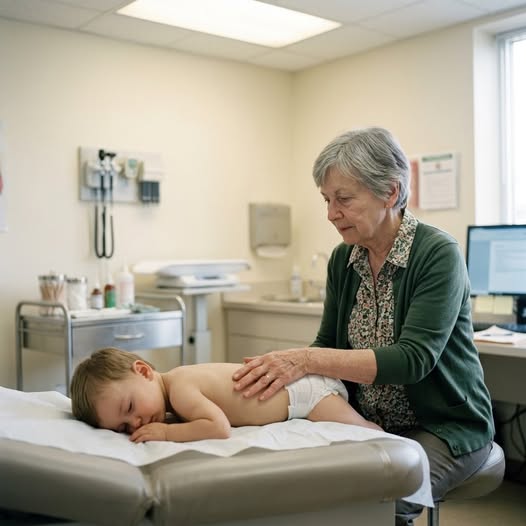
I drove straight to the hospital, praying I was wrong and terrified that I wasn’t.
The drive should have taken twelve minutes. I know that because I had done it enough times over the years—when my husband had chest pains that turned out to be acid reflux, when my mother slipped in the shower and broke her wrist, when Daniel split his chin open at eleven trying to jump his bike over our garbage cans because he’d seen someone do it on television and assumed stupidity became skill if you admired it hard enough.
That day it felt endless.
Noah’s cries filled the car in sharp, ragged bursts, each one a little knife sawing at the center of my chest. He was strapped into his rear-facing car seat behind me, too small to understand what pain was happening to him and too helpless to do anything about it except scream. Every sound he made was wrong. Not a hungry cry. Not the wet, offended cry of a baby who needs changing. Not the thin, sleepy grumble he made when he wanted rocking and shushing and the soft edge of a blanket tucked under his chin.
This cry had panic in it.
I kept glancing at him in the rearview mirror so often I was lucky I didn’t put us all into a ditch. His tiny face was red and shiny with tears, his fists clenched, his legs kicking hard against the straps. Between cries he sucked in broken little breaths that made me grip the steering wheel tighter.
“Hold on, sweetheart,” I whispered, though my own voice shook. “Hold on. Grandma’s getting help. Hold on.”
The bruise had been there under his onesie like a stain blooming where no stain had any right to be.
That was the image that kept replaying behind my eyes each time I blinked.
I had been changing him on the couch because Daniel and Megan’s nursery was a wreck of burp cloths and open drawers and all the things new parents tell themselves they’ll organize later, after they sleep, after the baby settles, after life stops feeling like a series of alarms. Noah had already been fussier than usual when I arrived that afternoon. Megan had blamed gas. Daniel had blamed overstimulation. I had blamed nothing aloud because two-month-old babies are tiny mysteries, and every adult around them is always guessing.
Then I opened his diaper, lifted his little legs, and he screamed so hard his whole body arched. Instinct made me pause. Experience made me look. And there, on the soft skin of his stomach, just above the diaper line, was a darkening bruise the size of two quarters pressed side by side.
For one second I had simply stared.
Then I picked him up, called his name even though he was two months old and my saying “Noah” could not possibly have changed the fact of pain, and something old and cold moved through me.
Because babies that young do not get bruises by accident. Not really. Not on their bellies.
I did not think in words right away. I moved. Diaper bag. Blanket. Car seat. Keys. Purse. Out the door. I shouted something into the hallway toward Megan, who had just stepped into the shower to wash the spit-up off her shirt, but I don’t think she even heard me over the water. Or if she did, she probably thought I was just stepping outside with him the way I sometimes did when he got fussy.
By the time I reached the hospital, I had rehearsed and rejected twelve possible explanations.
Maybe he had been pinched by a diaper tab.
Maybe some absurd blood-vessel thing was happening under the skin.
Maybe I was overreacting.
Maybe I was seeing a bruise because my mind had already decided there must be one.
Then he cried again from the back seat, a thin, broken wail that seemed too big for such a small body, and I knew none of those comforting lies would survive contact with a doctor.
I didn’t bother parking properly. I left the car half crooked in front of the emergency entrance, grabbed the diaper bag and unbuckled the car seat so fast I nearly jammed the release. Noah’s face crumpled harder the moment I lifted him, and he let out a sound that made the nurse at the front desk stand before I had even reached her.
“What’s wrong?”
“My grandson,” I said, breathless and half out of my mind. “He won’t stop crying and I found a bruise on him. He’s only two months old.”
Something in her face sharpened immediately.
“Come with me.”
She came around the desk and led me down a short bright hallway where the floor smelled of bleach and old wax and everything was too clean for the fear I was carrying. Another nurse met us at an exam room door and held it open while I stepped inside with Noah pressed against my chest.
The room was small and overlit, with cartoon stickers peeling slightly from one corner of the wall and a padded exam table under a paper sheet. The air-conditioning was too cold. I remember that with bizarre clarity—how cold the room felt against Noah’s overheated skin when I laid him down and the nurse gently took the blanket back.
The second her fingers touched his stomach, he screamed.
“That’s where it is,” I said. My voice was already getting shrill. “That’s where the bruise is.”
The nurse lifted his onesie.
I saw it again in the harsh fluorescent light, uglier than it had looked in the living room. Darker. More deliberate somehow. Not a vague discoloration. Not a little mark you could talk yourself around. A bruise. Blue and purple at the center, shadowing out toward yellow at the edges.
The nurse’s face changed.
It wasn’t dramatic. That’s the trouble with professionals. They learn to keep most of their alarm hidden. But I saw her mouth flatten, saw the slight tightening around her eyes, and I knew the moment she knew it too.
“I’m getting the doctor,” she said quietly.
My stomach dropped so hard I thought I might actually be sick right there on the linoleum.
Something was very wrong.
Dr. Patel arrived within minutes. He was one of those physicians whose calm does not feel performative. Middle-aged, with kind eyes and the tired posture of a man who had spent years delivering bad news without ever becoming casual about it. He introduced himself as he pulled on gloves, then looked at me in that careful way doctors do when they’re trying to gather facts and prevent people from shattering in front of them.
“When did you first notice this?”
“Ten minutes ago. Maybe fifteen.” My hands were shaking so badly I tucked them under my arms. “I was changing him. He started crying uncontrollably. I thought maybe it was the diaper or gas or—I don’t know. Then I saw the bruise.”
He nodded once and leaned over Noah, pressing with slow, precise fingers around the bruised area.
Noah screamed again, louder this time, and his whole body stiffened.
Dr. Patel’s brow furrowed.
“Has anyone else been caring for him recently?”
“Only his parents,” I said automatically.
Even as the words came out, I felt something unpleasant coil in my chest. Because “only his parents” sounds reassuring only until it doesn’t.
Dr. Patel glanced at the nurse. “We’re going to do an ultrasound right away.”
My mouth went dry. “Is he going to be okay?”
“We need to check something first,” he said gently, which was the kind of answer that means a doctor refuses to lie because he respects the question too much.
The ultrasound machine hummed softly when they wheeled it in. The technician was younger than I expected, maybe thirty at most, with a careful, neutral expression. She spread warm gel across Noah’s stomach while I stood near his head and kept one trembling hand on his hair, those damp, soft little baby hairs that still felt unreal sometimes, like something grown from breath rather than flesh.
At first the screen meant nothing to me.
Gray shapes. Black spaces. The strange, underwater texture of organs rendered as weather.
Then the technician paused.
The doctor leaned in.
“Hold there,” he said.
She froze the image.
The room went still except for Noah’s hiccuping cries and the quiet machine hum.
Dr. Patel looked at the monitor another second, then turned to me slowly.
“Ma’am,” he said carefully, “did the baby fall recently?”
“No.” My answer came out too fast, too loud. “No, he’s only two months old. He barely moves. He can’t even roll over yet.”
The doctor nodded, but it was not the relieved nod I had hoped for.
“That’s what I thought.”
My heart began to beat so hard it was visible in the hollow of my throat.
“What is it?”
He hesitated.
Then he pointed at the image.
“There’s internal bleeding.”
I heard the words. I understood the words. But for a second they had no place to land.
“What?”
“It looks like there’s trauma in the abdominal tissue. Not catastrophic, but significant. Enough that we need to treat him immediately.”
I felt the floor tilt.
“Trauma?”
He looked at Noah. Then at me.
“It appears someone squeezed him very hard around the abdomen.”
The room seemed to contract.
“Squeezed?” I repeated, because I needed the absurdity of the word said twice before I could absorb it.
“Yes.”
He turned back to the screen as if it might help to keep his eyes on something clinical.
“In infants this small, the tissues and organs are extremely vulnerable. Pressure that would not seriously injure an older child can do real damage to a baby.”
My mind went blank.
Then it filled all at once with terrible, useless things.
A hand.
A body.
Someone losing control.
Someone angry.
Someone not angry but careless in the wrong way.
“Are you saying someone hurt him?”
Dr. Patel didn’t answer directly.
He did not need to.
“We’re going to treat him right away,” he said. “And because of the injury pattern, we’re required to notify child protective services.”
That phrase sent a second wave of dizziness through me.
“Child protection?”
He nodded.
“For non-mobile infants, bruises like this are extremely rare without trauma. We have to investigate every possibility.”
My hands started shaking harder. I pressed them against my stomach to hide it and only then realized that I was doing the exact same gesture I used to do when Daniel was little and in trouble at school—holding myself closed, as if containing my own fear would somehow help the room.
“Doctor,” I whispered, “my son and his wife love that baby. They would never hurt him.”
Dr. Patel’s expression remained steady.
“I understand,” he said. “And I’m not making conclusions. But we do need to proceed carefully.”
Noah was transferred to the neonatal observation unit because, as one nurse explained in too-bright, practiced language, that was where they could monitor him most closely. They put a tiny IV in his hand. His crying finally weakened into exhausted whimpers. A pediatric resident came by. A social worker introduced herself. A hospital administrator in soft shoes explained paperwork. I signed forms without really reading them.
The bruise was still all I could see.
The social worker’s name was Cynthia. She had a voice designed to move through grief without scratching it. She asked questions in a small consult room while I sat with a cup of water I never drank.
Who had been with the baby today?
When was he last known to be well?
Any recent falls?
Any history of bleeding disorders?
Had his parents seemed overwhelmed lately?
Were there arguments in the home?
Was anyone drinking heavily?
Were there firearms?
Had either parent ever expressed frustration or hopelessness?
Every question felt like a hand gently testing a bruise in me I had not known I had.
I answered honestly.
Daniel and Megan were tired, yes. They were first-time parents, which in my experience meant living in a state of permanent apology to the universe. Megan cried more easily than before. Daniel went quiet when he got stressed, which made him seem calmer than he was. The house was messy. They were behind on laundry, dishes, sleep, every normal thing. They loved Noah in that panicked, raw way new parents often do, like every breath he took was both miracle and referendum.
I said all of that because it was true.
And because I needed it to still be true.
Two hours later, Noah was asleep in a clear-sided bassinet under a dimmer light with a tiny IV taped to his hand and a monitor beside him that translated his existence into beeps.
The doctor said they had caught the bleeding early.
He said the word recover.
I clung to that word the way drowning people grab whatever floats nearest, even if it’s splintered.
But the bruise remained.
The bruise sat in the center of everything like an accusation.
I was alone in the waiting room when my phone rang.
Daniel.
His name on the screen made my stomach lurch.
I answered immediately.
“Mom,” he said, and he was already out of breath. “We’re back home. Where are you? Megan’s freaking out because Noah’s gone.”
My throat tightened around the answer. I had left so fast, I had not left a note. I had not sent a text. I had simply taken the baby and driven.
“Daniel,” I said slowly, because if I rushed it I might lose the ability to speak at all, “I’m at the hospital.”
Silence.
Then: “What?”
“Noah was hurt.”
The panic in his voice was immediate and absolute.
“Hurt? What are you talking about?”
“There’s a bruise on his stomach,” I said. “The doctor says someone squeezed him hard enough to cause internal bleeding.”
There was a long, stunned pause. So long I thought maybe the call had dropped.
Then Daniel said, very sharply, “That’s impossible.”
“Daniel—”
“No,” he snapped. “Mom, Megan and I would never—”
“I know that,” I interrupted quickly.
And I did know it. Or thought I did. Or needed to. It was impossible to separate those things in that moment.
“But someone did.”
Another silence.
Then I heard Megan’s voice faintly in the background. “What’s wrong? What happened?”
Daniel whispered something too low for me to make out.
A second later the phone changed hands.
Her voice came through shaking.
“A bruise?” she said. “That’s not possible.”
My stomach twisted.
“Why are you so sure?”
Her answer came out in a whisper.
“Because… Noah already had that bruise yesterday.”
For a second I forgot how to breathe.
“You saw it yesterday?”
“Yes.”
“And you didn’t take him to the hospital?”
“We didn’t think it was—” she stammered. “We thought maybe it was just… a mark. Or a birthmark. Or something from the diaper.”
Her words were coming too quickly, colliding with each other.
Then she said something else.
Something that made the hair on the back of my neck rise.
“It wasn’t that dark yesterday.”
The room around me went very cold.
If the bruise had worsened today…
If it had deepened…
If something had happened after she first noticed it…
I gripped the edge of the waiting room chair.
“Who else was alone with Noah today before I got there?”
Nothing.
Just breath.
“Megan?”
When she finally answered, her voice was barely audible.
“…the nanny.”
The word seemed to reverberate.
My heart skipped.
“You hired a nanny?”
Daniel came back on the phone.
“Just part-time,” he said quickly. “Only a few hours in the mornings. Megan hasn’t been sleeping. It was supposed to be temporary.”
“When did this start?”
“About two weeks ago.”
I pressed my free hand to my forehead.
“And today? Was she with Noah before I arrived?”
Daniel hesitated. Just long enough to confirm every bad thought.
“Yes.”