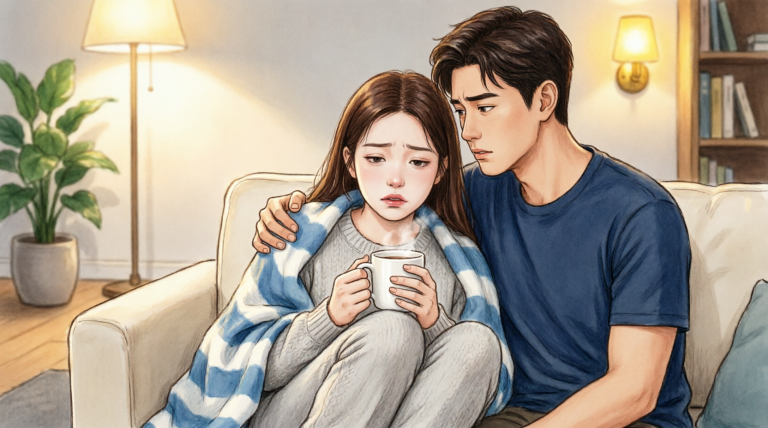
My wife was paralyzed, and we hadn’t been intimate for four months. That was the sentence I kept repeating in my head, as if saying it often enough could turn it into an excuse instead of what it really was—a confession. People think betrayal begins in a hotel room or in the backseat of a car, but it doesn’t. It begins in the small, rotting places where self-pity dresses itself up as loneliness and asks to be forgiven before the sin is even committed.
My name is Daniel, and before I became the kind of man I swore I would never be, I was just a husband with a modest life and a woman who made every ordinary day feel chosen. Hannah had that kind of warmth that could turn a cramped apartment into a home and a cheap dinner into something worth remembering. She laughed with her whole body, talked with her hands, and believed in us with a certainty that used to make me stand straighter.
We weren’t rich, and we weren’t glamorous. We were the kind of couple who clipped coupons, argued over grocery brands, and celebrated tiny victories like finding twenty bucks in an old coat pocket. Hannah used to fix my tie in the mornings before work, smoothing the fabric against my chest and grinning like she was sending a king out into the world instead of a mid-level sales manager with too many spreadsheets and not enough sleep.
Then one rainy Thursday evening, everything we called normal shattered on the interstate. A truck hydroplaned across two lanes, metal screamed, glass exploded, and when I reached Hannah in the hospital, half her body was still and the other half was trembling in shock. The doctors used careful words at first, then cruelly clear ones later, and by the end of the week we understood the shape of our new life: spinal damage, uncertain recovery, months of rehab, and a future that had just become terrifyingly expensive.
Hannah cried only once in front of me. It happened at three in the morning under fluorescent lights, when she looked down at her legs as if they belonged to somebody else and whispered, “Why can’t I feel them?” I held her hand and told her we would get through it, and in that moment I meant every word with the purity of a man who has not yet been tested by time.
For the first few weeks, love felt noble. I slept in plastic hospital chairs, argued with insurance on the phone, learned the names of medications I still can’t pronounce, and brought Hannah terrible coffee she pretended to enjoy because I had gotten it for her. We joked with nurses, made stupid plans for the future, and built a little fortress out of optimism because the truth outside it was unbearable.
Hannah was braver than I was from the very beginning. She smiled through physical therapy, bit down on pain without making a scene, and apologized every time she needed help as if dependence were an insult she was personally inflicting on me. I kept telling her not to say sorry, that I was her husband, that this was what love looked like when vows stopped sounding poetic and started costing something.
Then the hospital discharged her, and real life began. Real life was ramps, pill organizers, phone calls with specialists, rearranged furniture, mounting bills, wet towels, sore backs, and nights so long they felt like punishment. In the hospital, we had routines handed to us by professionals. At home, we had only each other, and I was far less steady than either of us had believed.
Our bedroom changed first. The side table filled with medicine bottles, ointments, water cups, and folded notes from doctors, and the air always carried the faint smell of antiseptic no matter how often I opened the window. The bed where we had once fallen asleep tangled together became a place of careful angles, pillows under her knees, blankets tucked just right, and me lying awake on the edge like a man afraid to move.
It wasn’t only the loss of intimacy, though that loss was real and sharp and humiliating to admit. It was the loss of spontaneity, of ease, of the version of us that used to exist without effort. Every touch now seemed to carry a question behind it—does this hurt, is this okay, do you need help, should I move—and somewhere along the way tenderness began to feel like work, and I hated myself for noticing.
Hannah noticed everything. She noticed when I paused too long before helping her into the chair, when my smile arrived a second late, when I answered “I’m fine” in the clipped voice of a man holding shut a door that wanted to swing open. She never accused me, not then. She only looked at me with those clear, searching eyes, and somehow her kindness made my weakness feel even uglier.
One night she reached for my face while I was buttoning my shirt for work. Her fingers moved slowly, as if even affection now had to pass through caution before it reached me. “You don’t have to be strong every second,” she said softly. “You can tell me when you’re scared.”
I kissed her forehead and lied with a tenderness I did not deserve. I told her I was just tired, that work had been brutal, that everything would settle once we found a rhythm. She nodded because she wanted to believe me, and I let her because the truth was still shapeless inside me, a selfish thing I had not yet given a name.
Christina entered my life on a Tuesday afternoon carrying iced coffee and the kind of confidence that made rooms lean toward her. She was a consultant our company had brought in for a failing account, all polished heels and bright lipstick and low, amused laughter. The first thing she said to me was, “You look like you haven’t slept since the Obama administration,” and I laughed harder than the joke deserved because it felt so good to be seen without being needed.
I told myself it was harmless. She asked about my life, and I gave her the edited version—my wife had been in an accident, things were rough, I was tired. Christina’s face softened in exactly the right places, and she touched my wrist as if compassion were something intimate and easy instead of heavy and demanding.
“You need a break,” she said one evening when everyone else had left the office. “You’re going to disappear if you keep carrying all of this alone.” The words slid into me like something medicinal, and I didn’t stop to ask why relief felt so much like temptation.
At home, Hannah was fighting for inches. She measured victory in muscle twitches, in transferring from bed to chair with less help, in making it from the bedroom to the kitchen without crying from frustration. I should have been there inside those moments with her, but more and more I found myself standing just outside them, applauding from some emotional distance I could not seem to cross.
One Friday she dropped a mug while trying to reach the counter from her chair. It shattered across the tile, and before I could say anything she burst into tears, not because of the mess but because of what the mess meant. I knelt to gather the pieces, and while she apologized through sobs, something dark and shameful moved through me—not anger at her, exactly, but panic at a life that seemed to have narrowed into damage control.
That was the night I stayed late at work on purpose. Christina found me staring at numbers on a screen I hadn’t actually been reading, and instead of offering pity, she offered escape. We got drinks at a quiet bar two blocks from the office, and for two hours no one asked me where the medication was, whether the insurance appeal had gone through, or if I thought the tingling in Hannah’s left foot meant progress.
I laughed. God help me, I actually laughed. Christina leaned in when she talked, and everything about her felt warm, uncomplicated, and dangerous in the way fire must feel to a freezing man who has stopped caring what burns.
When I got home, Hannah was awake in bed with the lamp on. The light made her look smaller somehow, as if pain had been quietly sanding away at the edges of her. “I called you twice,” she said, trying to keep accusation out of her voice and not quite succeeding. “I just wanted to know if you were okay.”
I snapped at her before I could stop myself. I said I was working, that not every missed call was a crisis, that I couldn’t breathe if every hour of my life had to be accounted for. The hurt on her face arrived slowly, like dawn over a disaster, and I hated myself so much that I became colder just to survive the moment.
She turned away and wiped her cheeks with the back of her hand. “I’m sorry,” she whispered, and those two words should have broken me right there. Instead I stood in the doorway feeling trapped by the sight of my own cruelty and too proud to kneel beside her and take it back.
After that, distance became habit. I stayed later at the office, answered my phone less often, and learned how to divide myself into two men—the one who adjusted Hannah’s blanket and picked up her prescriptions, and the one who sat across from Christina in dim restaurants pretending he had merely stumbled into emotional treason by accident. The terrible truth is that betrayal gets easier the second time, not because it hurts less, but because the conscience starts bargaining for scraps.
Christina kissed me in the parking garage after a storm. Rainwater dripped from the ceiling in slow, silver threads, and the whole concrete place smelled like oil and thunder. I should have stepped back, should have said my wife’s name like a prayer and gone home, but I kissed her back with the desperation of a man trying to erase his own reflection.
I told myself it was only physical, and then I told myself that lie again when it stopped being true. We started meeting in hotels on the far side of town, then at her condo, then wherever shame could be delayed by locked doors and soft sheets. With Christina, I did not have to be patient or noble or terrified. I could just be wanted, and for a while that felt like oxygen.
At home, Hannah grew quieter. She still asked about my day, still thanked me when I handed her water or helped her into bed, but a thin sadness had entered her voice, the kind that settles in when hope begins packing its bags. Once, while I was washing dishes, she asked me without looking up, “Do you still see me when you look at me?”
The plate slipped in my hands and cracked against the sink. I wanted to say yes immediately, to say it with conviction, to sound like the man she married instead of the one I had become. But my silence answered before my mouth did, and when I finally forced out, “Of course I do,” it sounded weak enough that even I didn’t believe it.
A week later, she reached for my hand in bed. Her palm was warm, her fingers trembling just slightly, and there was a courage in the gesture that made me feel small. “I know things are different,” she said, staring at the ceiling. “But if you’re grieving too, you can tell me. Just don’t leave me while you’re still standing next to me.”
Click Here to continuous Read Full Ending Story Part2: My wife is paralyzed…
My wife is paralyzed…
Part 1 of 2