My son had to sit on the floor to eat at a family party while everyone around him had a seat, and my mother-in-law smiled as if it were the most ordinary thing in the world. I did not argue. I did not raise my voice. I did not give them the scene they had been waiting for, the one they could point to later as proof that I was too emotional, too sensitive, too much. I simply gathered my children and left, because for the first time in a long time, I was willing to let them see what family life looked like when I stopped exhausting myself to keep it peaceful.
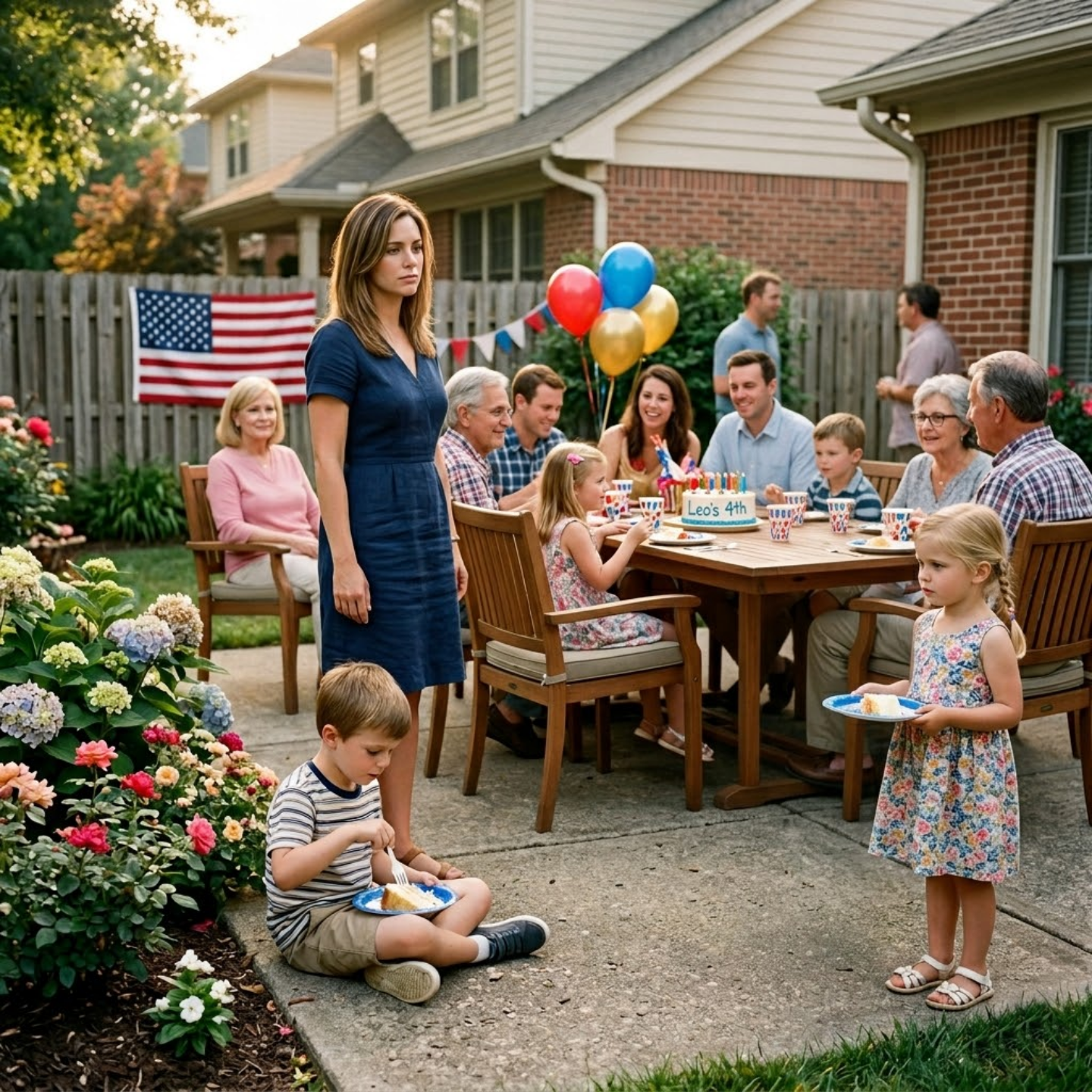
The image did not hit me all at once. It came slowly, almost mercifully, as I stepped out through the back door and onto the patio, like my own mind was trying to spare me from seeing it clearly even though it was right there in front of me in plain sight. My son was sitting on the concrete with a paper plate balanced on one knee, not near a chair, not close to the folding tables where the other children were crowded shoulder to shoulder under bunches of red and blue balloons, but off to the side in that strangely deliberate way people create when they want to pretend something just happened naturally. His little legs were folded awkwardly beneath him, sneakers flat against the warm patio, and he was eating with the serious concentration children have when they know one wrong move means their food will slide off the plate and spill into their lap.
For one second, that concentration almost disguised it. If you only glanced, if you kept moving, if you had trained yourself to overlook small humiliations because recognizing them would force you to do something, you could almost tell yourself he was fine. You could say he had chosen to sit there. You could say kids do not care where they eat. You could say there were bigger things in the world to worry about.
But I looked closer, and once I did, I could not unsee any of it. Not the empty space between him and the table. Not the way the other children were laughing with their knees tucked under white plastic chairs rented from the church down the road. Not the bright party tablecloths weighted down with plastic cups and bags of chips and trays of frosted cupcakes, decorations that stretched neatly across the yard until, all at once, they did not. There was a clear border where celebration ended and my children began.
A few feet away, my daughter stood holding her own plate. She was not sitting because there was nowhere for her to sit, and she was not trying to squeeze in because she already knew, in the quiet way girls learn far too early, when a place has been decided for them before they arrive. Her eyes moved across the table once, then away. She did not complain. She did not ask for a chair. She had always been careful like that, always reading a room before she spoke, always shrinking herself first whenever she sensed she had become inconvenient.
The contrast was what made it unbearable. The cake had come from Kroger and been touched up with extra icing flowers someone had piped on at home. The lemonade had been poured into a glass dispenser with slices of lemon floating on top, one of those details women in this family loved because it photographed well and suggested effort and warmth and abundance. There were matching napkins, matching plates, a stack of wrapped forks lined up in a basket, and a little wooden sign painted with a child’s name in cursive. Someone had thought about centerpieces. Someone had thought about candles. Someone had counted guests and bought enough hot dogs and hamburger buns and party favors and pastel tissue paper for the gift table.
And somehow, in all that planning, no one had made space for my children.
My sister-in-law, Melissa, saw me first. Her face brightened in that practiced way that never reached her eyes, and before I had a chance to speak, she gave me the explanation already waiting at the tip of her tongue.
“We ran out of chairs,” she said lightly, almost laughing, as if this was the sort of harmless inconvenience people retold later with a smile. “The kids don’t mind. They’re totally fine on the ground.”
The way she said it assumed I would accept it the way I had accepted so many things over the years. A missed invitation. A forgotten stocking at Christmas. A birthday present bought for my niece but not my daughter because, according to my mother-in-law, she had “lost track.” They had always relied on the same thing: not that I believed them, but that I would decide it was not worth ruining the day over.
My mother-in-law, Carol, did not even look up. She stood near the cake table, adjusting candles with the kind of concentration most people reserve for surgery, turning one a fraction to the left, then stepping back to examine the arrangement. She had on a floral blouse and pearl studs and the expression she wore whenever she believed she was beyond reproach. It was not a hard expression. That was what made it worse. She looked serene. Pleased, even. As though the order of things had settled exactly as she preferred and any problem visible to someone else was merely proof of their poor perspective.
I did not answer Melissa. Not because I lacked words, but because I already knew how the exchange would go. If I asked why there were chairs stacked inside the house, they would call me dramatic. If I pointed out that every other child had a place at the table, they would tell me I was reading into things. If I said what was sitting cold and sharp in my chest, that this was cruel and they knew it, they would circle together the way families like this always do and make the moment about my tone, my timing, my ingratitude, my inability to let anything go.
So I walked to my children instead.
My body felt strangely calm, and that calm scared me more than anger would have. Anger at least still wants something. Anger argues because it believes there is a point to be made, a chance to be understood, a wrong that can be corrected if only the right sentence is spoken at the right volume in the right room. This was something different. This was the cold, steady feeling of a door closing from the inside.
I crouched beside Noah first and took the paper plate from his hands before it could tip. He looked up at me, puzzled but trusting. He was seven then, all elbows and cowlicks and earnest eyes, still young enough to think adults had reasons for things. Lily, my daughter, shifted closer the minute she saw my face. She was nine, old enough to notice patterns, old enough to feel discomfort and call it by the wrong name because children will almost always assume that if something hurts, they must have caused it.
“Come on,” I said quietly. “We’re heading out.”
Neither of them protested. That was its own kind of heartbreak. Children who feel secure in a room ask questions. They say why, or can we stay, or but the cake has not been cut yet. My children put down their plates and came with me the way children do when they have learned to measure danger by their mother’s silence.
We passed the gift table, the cooler full of Cokes and Capri Suns, the aunties gathered near the fence with their paper fans and their sweet tea and their sideways glances. The laughter around us did not stop. The music did not stop. Someone in the corner was still trying to fix a Bluetooth speaker that kept skipping. A toddler in a diaper was running through the grass with a fistful of ribbon. No one said my name.
No one said, Wait.
No one said, Is everything okay?
No one said, We can bring chairs out right now.
That silence told me more than any argument could have. Had it been a misunderstanding, someone would have moved. Had it been an accident, someone would have looked embarrassed. Had there been any part of them that truly believed my children belonged there, the simple act of me walking out with both of them would have interrupted the afternoon.
Instead, not one person followed us to the driveway.
The only sound in those last few seconds was the screen door slamming behind us and the wind catching the edge of a cheap plastic tablecloth. I buckled Noah in first, then Lily. My hands were steady. My face felt numb. Inside the house behind us, I could hear a burst of laughter rise and break, and I remember thinking with a kind of detached amazement that life could continue so smoothly on the far side of a wound.
I got into the driver’s seat and shut the door. For a moment I just sat there with both hands on the wheel, staring through the windshield at Carol’s hydrangeas drooping in the late June heat. The house was the same ranch-style place it had always been, tan siding, two hanging ferns, an American flag clipped to the porch column, a cracked stepping-stone path leading to the front door. I had parked in that driveway on Thanksgivings and Easter Sundays, on birthdays and cookouts and Christmas Eves when I was still naïve enough to think effort eventually turned into acceptance. I had carried casseroles into that house with both hands. I had wrapped presents in my own living room and loaded them into this very trunk. I had sat at that kitchen table paying their utility bill online while Carol cried into a dish towel and promised she hated having to ask.
And now my son had eaten on the concrete like an afterthought while unused chairs sat inside the house.
I started the car and backed out carefully. Even then, even in that moment, some old reflex inside me wanted to leave neatly, without spinning gravel, without drawing notice, without giving anyone a reason to say I had stormed out. Years of being the reasonable one do that to a person. They teach you to package your pain politely. They teach you that if you are not careful, the story will stop being about what happened to you and become about how inconveniently you reacted to it.
We drove three miles before the first question came.
The party had been at Carol’s place outside Lexington, in one of those subdivisions built fast on former horse land where every backyard seems big enough for a trampoline and a grill but not quite big enough for privacy. The road out opened into a wider county route lined with gas stations, Baptist churches, a Dollar General, and a row of maple trees already dusty with summer. I kept my eyes on the lane ahead and told myself to get to the next stoplight. Then the next one. Then the next.
From the back seat, Lily spoke in a voice so careful it almost broke me.
“Did we do something wrong?”
There are questions children ask that split your life into before and after. Not because they are loud, but because they reveal what your silence has cost them. I knew, the instant I heard her, that no answer I gave could undo the fact that the question had occurred to her at all.
“No, baby,” I said, and my voice sounded strange to me, too even, too controlled. “No. Of course not.”
She looked at me in the rearview mirror, and I saw the exact moment she decided whether to believe me. The problem with lying to protect your children is that they often know you are doing it long before they understand why.
“They said there weren’t enough chairs,” I added, hating the sentence as it left my mouth.
Lily lowered her eyes to the paper napkin still folded in her lap. “There were chairs in the dining room,” she said after a second. “I saw them when I went to the bathroom. Like six of them. Maybe more.”
The words landed with a clarity so clean it almost felt like relief. Because pain is terrible, but confusion can be worse, and for years I had lived in a fog made almost entirely of minimization. Maybe they forgot. Maybe they did not mean it that way. Maybe I was tired. Maybe I was projecting old hurts onto ordinary moments. Maybe I just did not understand this family’s way of doing things.
But there is something almost merciful about evidence when it arrives from the mouth of a child.
There were chairs inside the house.
Unused.
And my children had been left outside to eat standing up and on the ground.
Noah spoke next, so quietly I almost missed him.
“It’s okay,” he said. “We’re used to sitting away from everybody.”
I do not think any sentence has ever entered my body more violently than that one. It did not sound like a complaint. That was the worst part. It sounded like information. A simple statement offered in the calm tone of someone explaining where the silverware goes or which cereal box is his. It had the flattened shape of something repeated so often it no longer struck the person saying it as unusual.
I pulled over onto the gravel shoulder so fast the tires crunched. I could not see the road clearly anymore. My throat had closed. My hands were locked around the steering wheel so tightly my knuckles burned.
Cars moved past us in bright strips of afternoon sun, each one full of people going about their Saturday as if the whole world had not just shifted inside my chest. A pickup hauling lumber rattled by. Somewhere in the distance a siren rose and faded. The ordinary sound of the day continued, and that made what was happening in the car feel almost unreal, like grief often does, suspended in a pocket of time the rest of the world refuses to acknowledge.
I turned halfway in my seat to look at them. Lily was staring at the back of my headrest now. Noah had one shoelace untied and did not seem to notice. They both looked small in the washed-out summer light filtering through the windows, smaller than they should have looked, as if the past hour had pressed something down inside them.
“How long?” I asked, and the question came out lower than I intended, heavy with an effort not to frighten them. “How long has that been happening?”
Lily did not answer immediately. She picked at a loose thread on her seatbelt strap and kept her eyes down. Children do not hesitate like that unless they are deciding how much truth they are allowed to say out loud.
What people who have never lived inside a family like that do not always understand is that cruelty does not begin at full volume. It begins in ways you can explain around. It begins with omissions, with little exclusions so minor that speaking them out loud makes you sound petty. It begins with one child getting the bigger slice of cake and yours getting whatever is left on the server. It begins with cousins chosen first for family photos while yours are told to stand back a minute, then somehow never called in. It begins with Christmas stockings hung for everyone except the children whose names, you are told, must have slipped someone’s mind. The harm lives in repetition. The damage lives in how often the victim is expected to swallow it and move on.
I knew that because if I was honest, I had seen pieces of it before.
Not enough to name it cleanly, not enough to accuse anyone without hearing my own voice wobble with uncertainty, but enough that certain memories returned to me there on the shoulder of that Kentucky road with a new and terrible brightness. Thanksgiving two years earlier, when the cousins sat at the dining table and my children were handed paper plates and told to eat in the den because “there’s more room in there for kids.” Easter at Carol’s church, when gift bags had been prepared for every grandchild except Noah and Lily, and Carol pressed five-dollar bills into their hands while insisting she thought Melissa was covering theirs. Last Fourth of July, when the sprinkler and water balloons appeared only after my children had been put inside for “tracking too much mud.”
At the time, I had done what women like me are trained to do. I had adjusted. I had compensated. I had bought extra gifts on the drive home and framed them as surprises. I had spread blankets in the den and called it a picnic. I had whispered to my daughter that some adults just get flustered when they host and it does not mean anything. I had worked so hard to keep insult from hardening into memory that I never once stopped to ask what it was costing them to watch me explain away the obvious.
That is the part people miss when they talk about keeping the peace. Peace is not neutral when only one person is paying for it. Peace, in a family like that, is often just another word for management. It means absorbing the sting before it can spread. It means translating disrespect into inconvenience so your children do not grow up with open conflict as the soundtrack of every holiday. It means making excuses for other people until you do not realize anymore that the person disappearing under all that effort is you.
Lily finally looked up.
“A while,” she said, and there was no accusation in her voice, which somehow hurt more. “Not every time. But sometimes. It’s usually when there’s a lot of people.”
I stared at her.
“What do you mean, sometimes?”
She swallowed. “Like if all the cousins are there. Or if Grandma’s friends are there. Or church people. Or when Aunt Melissa’s husband’s family comes too.” She glanced at Noah, then back at me. “It’s just… if there isn’t enough room, we don’t always get first pick.”
The word pick lodged in me. As if belonging were a game and they had simply lost the draw.
Noah swung one foot gently. “It’s okay,” he said again, trying to repair the damage his honesty had caused. “We can sit anywhere.”
I wanted to pull both of them into my arms right there in the front seat, but what I did instead was breathe. Slow, deliberate, the way I had taught myself after my father died and panic began showing up in my life like weather. In through the nose. Hold. Out through the mouth. Again. My children did not need me collapsing. They needed me listening.
“Has Daddy seen this?” I asked.
That was the first moment either of them looked uncomfortable in a different way. Lily’s mouth tightened. Noah studied his untied shoelace with sudden devotion. The answer came not from words but from their bodies, and a sick understanding moved through me.
Maybe Daniel had seen and not registered it. Maybe he had seen and chosen not to make a thing of it because he had grown up in that family and could no longer distinguish normal from acceptable. Or maybe, worst of all, he had noticed enough to suspect but relied on the same system I had. Let it go. Handle it later. Do not make today about this.
My husband had many good qualities. He was steady in practical matters. He packed school lunches without being asked. He knew how to calm Noah after nightmares and could braid Lily’s hair badly but with great seriousness. He worked hard, came home tired, and rarely forgot the little mechanics of family life that leave women so often carrying invisible labor alone. But when it came to his mother and sister, something in him went slack. It was as though every boundary he could hold in the outside world dissolved the minute he stepped back into the orbit of the people who had raised him.
I did not blame him for that at first. Then I blamed him less than I should have. Then one day I woke up and realized the difference between understanding someone and allowing them to keep failing you is not philosophical at all. It is practical. It lives in bank statements. Holiday schedules. The expressions on your children’s faces.
The irony is that when I met Daniel, I thought steadiness was the thing that would save me.
I grew up in a trailer park in Eastern Kentucky where steadiness was not something you inherited. It was something you built day by day out of whatever was left after rent and gas and power. The trailer where I spent most of my teenage years sat at the edge of a gravel lane outside Hazard, backed up against a patch of woods that turned black as ink after sunset. In summer, the air smelled like cut grass, hot metal, and the river. In winter, every draft made itself known. We stuffed towels under doors. We learned which floorboards let the cold through worst and avoided stepping there barefoot.
My father died when I was sixteen. A heart attack, sudden and ugly and deeply unfair in the plain way such things so often are. He had worked himself tired in body after body of work roofing, warehouse shifts, hauling whatever needed hauling because men where I came from were not raised to imagine they could be anything gentler. After he died, people brought casseroles and pie and folded bills slipped discreetly into my mother’s hand after the funeral. Then, as people always do, they went back to their own lives.
We stayed.
And survival, when you are that age, rearranges your understanding of love. It teaches you that reliability matters more than charm, that bills do not care about promises, that tenderness without follow-through is just another kind of instability. I worked after school at a diner off Highway 15, then picked up extra hours at a pharmacy in town once I graduated. I learned the exact feeling of standing in a grocery store with a calculator and deciding what could go back on the shelf. I learned how pride sounds when it says no, we are fine, though everyone involved knows that is not true.
By the time I met Daniel, I had clawed my way into something like stability. Not luxury. Not ease. Just a life with solid edges. I had finished my associate degree one class at a time. I had a job in medical billing that came with health insurance, a 401(k), and the first paid vacation I had ever seen in my life. I had a small townhouse with beige carpet and a secondhand couch I was embarrassingly proud of because it matched. My refrigerator stayed full. My tires were rotated on schedule. When the electric bill arrived, I paid it before the due date and felt, every single time, as if I had committed a private act of defiance against everything my early life had predicted for me.
Daniel felt safe from the beginning. Not exciting in the way some men are exciting when they mistake inconsistency for charm, but grounded. He remembered details. He showed up when he said he would. He listened more than he talked. On our third date he noticed my gas tank was near empty and filled it without making a performance out of it. That kind of care mattered to me more than flowers ever could have.
He told me early on that his family was close. At the time, that sounded like a blessing. I did not come from a large, functional network of people who gathered around a table and helped one another move couches and recover from surgeries and watch the kids. My mother loved me, but love and capacity are not the same thing, and she had spent so many years simply trying to stay afloat that there was not much left for ritual. I mistook Daniel’s crowded family holidays for warmth. I mistook their constant involvement in each other’s lives for support.
Looking back, I can see the evaluation happening from the very start.
Carol hugged me the first time Daniel brought me over and called me “a sweet girl” in the tone some women use when complimenting a waitress. Melissa asked where I was from and then nodded in a way I recognized later as filing information away. They were not unkind, not openly. That was never their style. They were polite in the Southern way that can cover almost anything if the smile is practiced enough. But there was an appraisal underneath it, a sense that I was being measured for usefulness before I was being welcomed for who I was.
I did not have words for that then. I only had instinct, and instinct is easy to silence when you badly want to belong.
The first time they asked for help, it came dressed as necessity. Carol’s water heater had gone out in January, and Daniel mentioned over dinner that she was in a panic because she did not have the money to replace it. We had been married less than a year. I remember stirring pasta on the stove while he talked, the smell of garlic and canned tomatoes in the kitchen, and feeling the old reflex rise in me before he had even finished. When you know what it is to be without heat, without hot water, without enough groceries to make it to payday, other people’s emergencies strike your body like your own.
We wrote the check that weekend.
Carol cried when we brought it over. She held my hands between both of hers and said she did not know what they would have done without us. Melissa called me an angel. Daniel looked relieved. For a little while, I glowed with the kind of exhausted satisfaction generous people know too well the feeling that maybe, finally, your usefulness has bought you a place no one can take away.
But gratitude, in that family, never stayed gratitude for long. It became expectation with remarkable speed.
The requests changed shape. Melissa’s car needed brakes. Carol had fallen behind on property taxes. Daniel’s younger cousin was short on tuition after switching programs at community college. Then it was not always money. Sometimes it was my time, my car, my guest room, my PTO days used to drive someone to an outpatient procedure because no one else could take off work. Sometimes it was smaller than that but somehow just as consuming, a constant slow siphoning of labor framed as love.
And every time I helped, the same thing happened. There was a flare of appreciation. Then a settling back into normal. Then, not very long after, another need would appear as if the previous one had erased itself.
I did not start keeping track right away. I am not sure any generous person does. We like to believe help given freely should not be counted. We like to believe counting corrupts the thing itself. But there comes a point when not counting is less virtue than denial. There comes a point when you realize money has memory even if people do not.
The first time I added it up, I sat at our kitchen island after midnight with a yellow legal pad and three years of online banking pulled up on my laptop. Daniel was asleep upstairs. The dishwasher hummed softly behind me. Outside, our neighborhood was quiet except for one dog barking two streets over. I told myself I was being silly. That I just wanted a rough number. That maybe seeing it on paper would help me feel less vaguely resentful because facts are easier to work with than feelings.
The number was just under fourteen thousand dollars.
I remember staring at it and feeling not outrage, not yet, but disbelief. Fourteen thousand in emergency loans never repaid, utility bills “just this once,” gas cards, groceries, back-to-school clothes, a security deposit for Melissa after her divorce, money wired to a cousin in Tennessee because his transmission had gone, a funeral arrangement Daniel had insisted his mother should not have to cover alone. Fourteen thousand dollars given not over decades but over three years.
When I showed Daniel the total, he rubbed a hand over his face and said, “I know it looks bad laid out like that.”
Looks bad.