The first time I saw the positive test, I forgot how to breathe.
I was sitting on the edge of our bathtub in a beige suburban house outside Louisville, the kind with builder-grade tile and a medicine cabinet that never shut quite right, staring at a cheap plastic stick in my shaking hand as if the little window might change its mind if I blinked too hard. I had taken the test alone because I couldn’t bear to drag Garrett into one more hopeful morning if it was going to end the way the last two had ended with me on the bathroom floor, knees to my chest, crying so hard my ribs hurt, and him beside me trying to hold me together as if love alone could convince a body not to break.
But the line stayed.
It didn’t fade. It didn’t blur. It didn’t leave room for denial, bargaining, or the kind of careful pessimism grief teaches you. It was there, bright and undeniable, and I was thirty-one years old with two miscarriages behind me, two years of trying behind me, two invisible funerals behind me, and for the first time in so long that hope itself felt dangerous, my body seemed to be saying yes.
Garrett picked up on the second ring.
“Hey, babe,” he said, distracted in that warm, tired way he always sounded when he was moving between meetings.
“I’m pregnant,” I whispered.
There was a silence so long I actually looked at the phone to make sure the call hadn’t dropped. Then I heard his breathing hitch. When he finally spoke, his voice was rough and stunned.
“I’m coming home. Don’t move. Don’t do anything. Just stay right there.”
His office was forty minutes away if traffic on I-64 behaved, and traffic on I-64 never behaved. He made it home in twenty-five. He came through the front door like a man chasing something holy before it vanished, crossed the kitchen in three long strides, and lifted me clean off the floor. He spun me once, careless with joy, and I laughed through tears, clutching his shoulders, feeling for one breathless, impossible minute as though the last two years had been some bad dream we had finally woken from.
We stood there in our kitchen for a long time after that, the coffee maker clicking off in the background, the refrigerator humming, the ordinary world carrying on while ours quietly split into a before and after. He kissed my forehead. I touched his face. We both kept looking at each other with the same stunned expression, like neither of us quite trusted this miracle to hold.
“We tell everyone,” I said at last, wiping my cheeks with the back of my hand. “I want to tell everyone.”
Garrett’s smile trembled at the edges. He rested one hand low on my stomach as though there might already be something he could protect.
“Let’s wait,” he said gently. “Just until twelve weeks. I can’t… Brooke, I can’t do the calls again. I can’t watch your face when we have to tell people…” He stopped there, swallowed hard, and looked away.
I hated that he was right. I hated that caution had become part of joy, that fear sat at the table with us before we had even begun. But I nodded, because grief had already taught us its rituals. So for twelve weeks, our secret stayed tucked between us like a small glowing coal we were both afraid to breathe on too hard.
The first trimester was both beautiful and miserable in the exact way women always say and no one fully understands until they are in it. I threw up every morning and sometimes again before lunch. I fell asleep on the couch at seven in the evening with a blanket tucked under my chin like somebody’s grandmother. I cried over dog food commercials, over a broken coffee mug, over the fact that Kroger had rearranged the cereal aisle. Garrett met all of it with a kind of tenderness that made my throat ache. He brought me ginger ale and saltines. He rubbed my back while I leaned over the toilet. He whispered, “Hang on, baby,” in that soft half-murmur that made it hard to tell whether he was talking to me or to the child inside me.
At thirteen weeks, the ultrasound tech turned the monitor toward us and let us hear the heartbeat. It sounded like a tiny horse galloping somewhere deep under water, fast and insistent and alive. I stared at the grainy black-and-white screen until my eyes burned. Garrett held my hand so tightly my fingers went numb. In that dim room with its paper-covered table and lavender air freshener that couldn’t quite cover the smell of disinfectant, I became something I had wanted to be for so long it no longer felt real.
A mother.
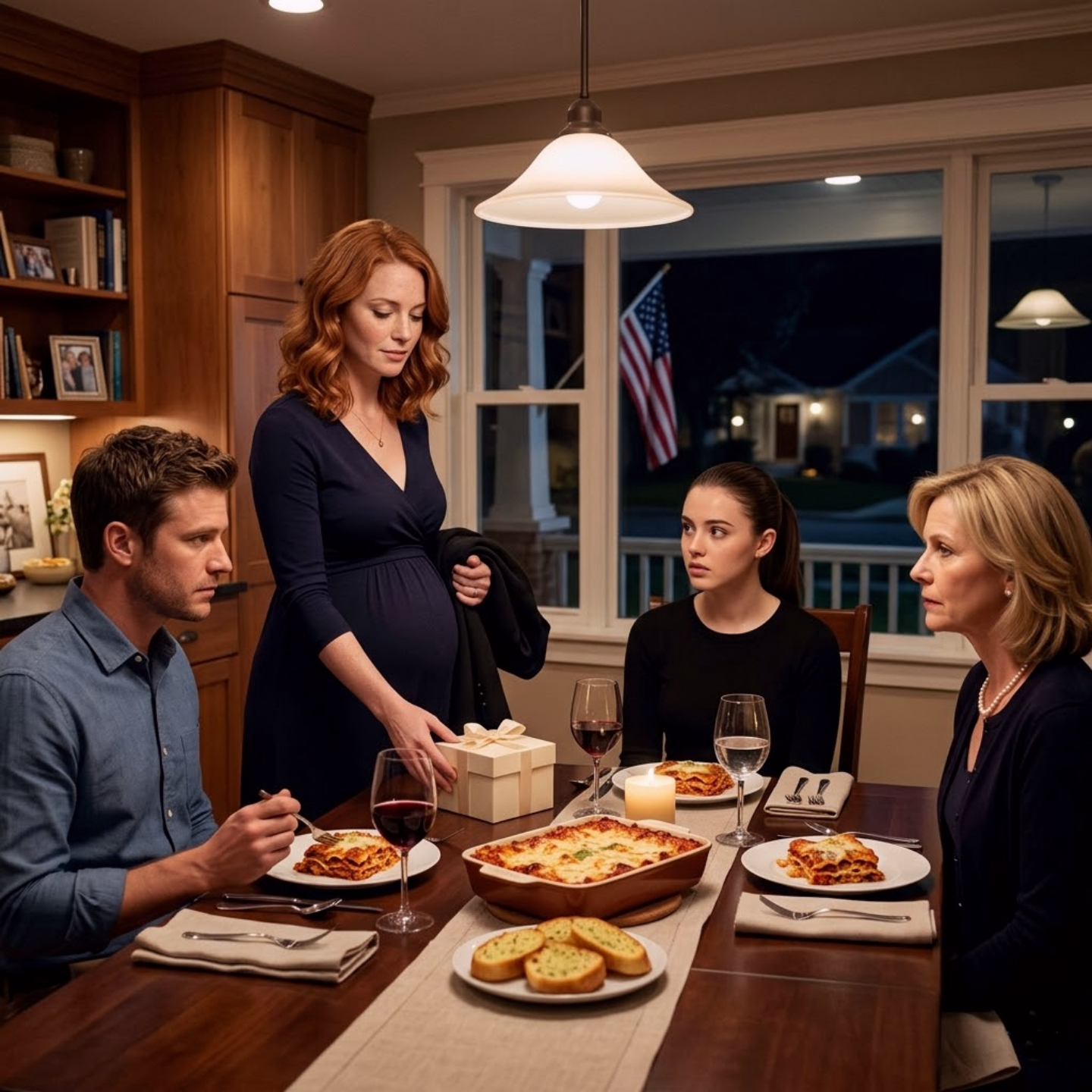
That weekend, we invited both families over for dinner so we could tell them. I made pot roast with carrots and potatoes the way my mom used to on Sundays back when I still believed food could smooth over anything. I laid out cloth napkins because I always did too much when I was nervous, and I put a little sign on the dessert table that said, Baby Coming November.
My parents arrived first. My father hugged me and said I looked healthy, which in his language was close enough to beautiful. My mother floated through the kitchen as though she were inspecting a property she might purchase, straightening a fork that didn’t need straightening, wiping an already clean counter, asking if I had been sleeping enough. Then Garrett’s family came his mother, quiet and warm as always, and his younger brother Wesley, who mostly communicated through a rotating set of shrugs and polite nods and who looked as if all family gatherings were punishments handed down by a small local court.
And then Jolene arrived, thirty minutes late and entirely unsurprised by her own lateness.
My sister had always moved through the world as if it had agreed to wait for her. She came in with a bottle of wine and an apology about traffic that was too polished to be true, kissed my mother on the cheek, hugged my father, and gave Garrett a look that lasted one beat longer than it needed to before turning to me.
“Hey,” she said. “Sorry. Crazy day.”
“It’s fine,” I said, because it always was, because somehow everyone had always learned to fold around Jolene’s chaos rather than ask her to contain it. “Come eat.”
Growing up, she had been the one strangers remembered. Teachers softened for her. Men held doors longer for her. My mother called her spirited when she was rude and sensitive when she was cruel. She was three years younger than me and effortlessly beautiful in a way I had spent years pretending not to notice. Even in leggings and a careless bun, she looked lit from within. Beside her, I had often felt assembled instead of made.
Dinner itself was ordinary, almost aggressively so. We talked about my dad’s latest football podcast obsession, Wesley’s new job, some restaurant downtown everyone but me had already tried. Garrett kept squeezing my knee under the table. My face hurt from smiling. My heart was beating too fast. When dessert came out and my mother began clearing dinner plates, I stood with my water glass in hand and said, “Okay. We have something to tell you.”
My mother’s head snapped up. “Oh my God,” she breathed. “I knew it.”
Garrett moved up beside me and wrapped an arm around my waist. I laughed because I was already crying.
“We’re pregnant,” I said. “Thirteen weeks.”
The room broke open all at once. My mother burst into tears. My dad swore softly and hugged me so hard I actually winced. Garrett’s mother covered her mouth and cried quietly. Wesley, in the most Wesley response imaginable, offered an awkward thumbs-up from the end of the table. The whole house seemed to rise into motion and noise and relief.
Everyone reacted.
Everyone except Jolene.
She sat very still, one hand curved around her wine glass, looking at me as if I had announced the house was burning down.
“Jolene?” I said, because once I noticed it I couldn’t not notice it. “You okay?”
She blinked like someone waking from underwater. Then she smiled, but it was thin and late and empty in the eyes.
“Congratulations,” she said. “That’s… great.”
She never stood. She never came to hug me. She never asked when I was due or whether I was sick all the time or whether we already had names. Twenty minutes later she claimed she had a headache and left early, her perfume lingering in the entryway long after the door shut.
When everyone else had gone home and the dishes were stacked in the sink, I stood in the quiet kitchen with one hand resting over the small swell of my still-mostly-flat stomach and tried to tell myself I was imagining things. Garrett kissed the top of my head and said maybe she was just having a hard day. But some old animal part of me had already stiffened.
The trouble was, I had spent my whole life being taught not to trust my instincts where Jolene was concerned. If she hurt me, I was sensitive. If she slighted me, I was reading too much into it. If she crossed a line, I was making drama where none existed. My whole family had trained me to second-guess the exact part of myself designed to recognize danger.
I had no idea yet what that mistake was going to cost.
For the next few weeks, Jolene became a ghost.
She stopped answering my texts except with curt, delayed replies that felt composed by someone standing in another room. When I called, it went to voicemail. When my mother hosted Sunday dinners, Jolene always had some excuse work, a migraine, a friend in town. My mother rushed to defend her every time with the brisk impatience of someone warding off annoyance.
“She’s overwhelmed,” my mother said one night while slicing pound cake in a kitchen full of yellow light. “Don’t take it personally, Brooke. You always take things so personally.”
I tried not to. Pregnancy itself had made me raw enough that I no longer fully trusted my own reactions. I told myself hormones were making me too tender. I told myself Jolene had her own disappointments, her own life, her own reasons. I told myself not everything was about me.
Still, the silence kept gnawing.
At eighteen weeks, I drove to her apartment.
It was a one-bedroom in a renovated brick building near the Highlands, the kind with exposed pipes and trendy light fixtures and rent that made no sense. Usually it was spotless, curated down to the throw pillows. That day, when she opened the door, she looked wrong. Her face was pale. There were bruised half-moons under her eyes. Behind her, the apartment looked like a place someone had been surviving in rather than living in clothes on the floor, takeout containers near the sink, a dead plant bending toward the window like it had given up asking for water.
“Brooke,” she said. “What are you doing here?”
“Can I come in?”
She hesitated only a moment before stepping aside.
We sat on the couch. I didn’t bother with easing into it.
“You’ve been avoiding me,” I said. “Ever since the announcement. Tell me why.”
She stared down at the carpet and picked at a thread in her sleeve. “It’s nothing.”
“It’s not nothing.”
She laughed once, without humor, like her body couldn’t decide whether it wanted to cry or bite. Then her shoulders began to shake.
“I was trying to get pregnant too,” she whispered.
For a second I genuinely thought I had misheard her. “What?”
“For almost a year,” she said, her voice turning papery. “And then I found out last month that I can’t. Not really. The doctor said my chances are basically zero.”
Shock washed through me so completely that for a moment it pushed everything else aside. Not jealousy, not competition, just sorrow. Real sorrow. Because however complicated she and I had always been, I knew what it was to want something so badly it rearranged your whole inner life.
“Jolene,” I said quietly, “why didn’t you tell me?”
She wiped at her eyes in a way that looked almost angry. “Because it’s humiliating. Because everybody thinks I’m the lucky one. The pretty one. The one everything comes easy to. And then the one thing I actually want…” Her throat worked. “The one thing I actually want is the one thing I can’t have.”
I reached for her arm on instinct, but she pulled away sharply.
“So when you announced it in front of everyone,” she said, staring past me, “it felt like you were rubbing it in.”
“I didn’t know,” I said. “I swear I didn’t know. Garrett and I have been trying for ”
“Don’t.” Her head snapped toward me, eyes bright with fury. “Don’t tell me how hard it’s been for you. You’re pregnant. You won. You got the prize.”
The words stung more than I wanted to admit. But beneath them I could hear grief, and grief can make people sound cruel before it makes them sound broken.
“I’m sorry,” I said, because I was. “I’m sorry you’re going through this. I wish you’d told me. I would have…”
“Would have what?” she asked. “Not announced it? Pretended you weren’t happy? Tiptoed around me while you lived the life I wanted?”
There was no answer that wouldn’t sound false in her ears. So I sat there and let the anger move through the room without trying to tidy it. Eventually her shoulders sagged as though even rage had exhausted her.
“It’s not your fault,” she muttered. “I know that. I just need time.”
When I hugged her goodbye, she returned it stiffly, more out of habit than affection. Still, as I drove home through late-afternoon traffic with the radio off and one hand resting on the steering wheel and the other over my stomach, I felt lighter. There was context now. Pain, yes, but context. I told myself that mattered.
For a little while, it almost seemed as though it did.
Jolene started showing up again. She came to family dinners. She texted me once to ask how I was feeling, and the message was so out of character it read like an apology without the courage to become one. She even came with me to a prenatal appointment, sitting beside me in the waiting room flipping through an old Southern Living magazine without turning a page, her gaze fixed somewhere far beyond the beige walls.
But something still felt off.
It wasn’t only grief. It wasn’t only jealousy. It was the way she asked about Garrett always too casually, always as if the question had wandered into the room by accident.
“How’s he doing?”
“Is he excited?”
“Working a lot?”
“Stress getting to him?”
At first I told myself she was trying to be normal. Supportive, maybe. Searching for some safe conversational ground that didn’t force her too directly against the shape of her own loss. But one day, while I was sitting in a paper gown with cold gel still drying on my stomach and the nurse had just stepped out, Jolene leaned toward me and said, in a tone that made the fine hairs on my arms rise, “He’s a good man, Brooke.”
I turned my head slowly. “Yeah,” I said. “He is.”
She smiled in that small private way of hers. “Don’t take that for granted.”
I laughed because I didn’t know what else to do. It landed wrong in the room and vanished almost immediately.
At twenty-four weeks, the truth came home before I was ready for it.
I left work early that afternoon because I felt exhausted and crampy and slightly wrong in the vague way pregnant women are always told to monitor but not panic over. My boss took one look at me and told me to go home and put my feet up. I wanted a nap, maybe toast, maybe an hour of silence.
Garrett’s car was already in the driveway when I pulled in.
That alone made me frown. He was never home before six unless he was sick or something had blown up at work. I let myself in, called his name, and got no answer. The house was quiet in an unnatural way, as though it were listening.
Then I heard voices upstairs.
Muffled. Close together. One of them laughing.
And the laugh was not mine.
I stood still for one beat too long, my hand still on the doorknob, every nerve in my body suddenly awake. Then I went up the stairs slowly, one hand on the banister, each step feeling both too loud and somehow unreal. The sound was coming from our bedroom.
The door was cracked open.
I pushed it.
There they were.
Garrett was sitting on the edge of our bed with his shirt off. Jolene was standing between his knees, bent toward him, her hands on his chest. Her mouth was on his.
For one suspended second my mind refused to interpret what I was seeing. It was as if the image itself had no language attached to it. Then Garrett looked up and all the blood left his face so quickly it was shocking. Jolene turned. Her expression froze.
No one spoke.
I didn’t scream. I didn’t throw anything. I didn’t give them the cinematic collapse betrayal is supposed to earn. I turned around, walked back downstairs, walked out the front door, got into my car, and drove.
I drove until the light changed from gold to blue to black and my gas light came on and I no longer knew exactly which county I was in. I remember fast food signs. I remember a church parking lot. I remember gripping the wheel so hard my wrists ached. More than anything, I remember the sensation that the floor of my life had dropped away without warning and my body was still trying to catch up.
When I finally came back, Garrett was sitting on the front porch with his elbows on his knees and his head in his hands.
The second he saw my headlights, he stood up.
“Brooke, please,” he said. “Let me explain.”
“Explain what?”
My own voice startled me. It was flat, almost calm, and utterly disconnected from the panic ripping through my chest.
“Explain why you were in our bed with my sister?”
“It’s not…” he started.
“Don’t.”
He dragged a hand through his hair and began pacing the porch boards. “It was a mistake. It shouldn’t have happened. It only happened once before. Today wasn’t supposed to ”
“Once before.”
He stopped talking.
“How long?” I asked.
He stared at the dark yard. “Eight months.”
The number entered me like ice.
Eight months. Long enough that it had begun before I got pregnant. Long enough that every kiss, every reassuring word, every hand he had laid over my grief after those miscarriages had existed alongside another life he was keeping in the shadows.
I walked past him without another word, locked myself in the guest room, and let the sobs come out of me so violently they felt less like crying than rupture.
I did not leave him that night.
Not because I forgave him. Not because I didn’t understand what had happened. I stayed because I was six months pregnant, terrified, and I knew my family. I knew exactly how the truth would be bent the minute I spoke it aloud. Jolene would become fragile. Garrett would become confused. I would become emotional, unstable, difficult. I had lived long enough inside that script to recognize it on sight.
So I stayed in the house with the man who had betrayed me and the child he still called ours and began planning my exit the way other women might quietly plan an escape from a storm they know the weather report won’t acknowledge.
By the time my baby shower arrived at thirty-two weeks, I was living in two realities.
In the first, the version everyone else saw, I was a glowing expectant mother surrounded by soft colors and casseroles and people saying all the right things in all the wrong voices. I wore loose sweaters. I smiled on cue. I allowed Garrett to kiss my cheek in public as if affection could cover rot.
In the second, the real one, I was documenting everything. I was shifting money into an account with my name only. I was saving screenshots, writing dates, taking mental notes, trying not to drown in the gap between what people thought my life was and what it had become.
I had told my mother I did not want a baby shower.
I told her I was tired. I told her I wasn’t up for games and pink punch and thirty people touching my stomach like it belonged to the community. But my mother, for whom appearances had always ranked just below oxygen, waved away my resistance.
“It’s tradition,” she said. “And it’ll cheer you up.”
The shower was at my parents’ house in the subdivision where we grew up, the one with dogwood trees in spring and identical mailboxes and the same women still organizing church raffles twenty years later. About thirty people came cousins, coworkers, my mother’s friends, women I barely knew who somehow still felt entitled to inspect me. There were pastel balloons, finger sandwiches, a cake decorated with fondant baby feet, and the usual stream of comments about how I was carrying, as if strangers were reading crop patterns off my stomach.
I endured it.
Then Jolene walked through the front door in a yellow sundress, perfectly composed, carrying a giant gift bag with white tissue paper spilling out the top like a department store advertisement for sisterhood. My mother rushed to greet her with the kind of visible relief that made me understand they had spoken far more than anyone had admitted.
Jolene floated through the room accepting compliments your dress, your hair, you look amazing and then stopped in front of me.
“Congratulations,” she said in the flat tone of someone acknowledging a civic award. “I hope everything goes well.”
Her eyes flicked toward Garrett for a fraction of a second. Then back to me.
She handed me the gift bag. It was heavy.
“Thanks,” I said, because apparently politeness survives things dignity does not.
Her smile was small and polished and wrong. Not warm. Not kind. Possessive, almost. Like the smile of someone looking at a life she still considered negotiable.
I excused myself to the bathroom and locked the door. My hands were shaking so badly I had to grip the sink with both of them. The woman in the mirror looked puffy-eyed and exhausted, a stranger in a paper crown of social expectations, carrying a child while trying not to collapse under the weight of what she knew.
“Hold on,” I whispered to my reflection. “Just hold on.”
When I came out, the shower rolled forward as if nothing in the room had teeth. Presents were opened. People cooed over onesies and burp cloths and diaper cream. Someone made me wear a sash. I laughed when it seemed necessary.
Near the end, I slipped into the hallway for air and heard voices in the kitchen. My mother and Jolene. Low, intimate, conspiratorial.
“Are you sure you’re okay with this?” my mother asked.
“With what?” Jolene said, calm enough to chill me.
“With helping after the baby comes. I know it’s… hard, given everything.”
Something in me went cold.
Jolene gave a soft little laugh. “It’s fine, Mom. I want to help. Brooke’s going to need it.”
My mother sighed with pride. “You’re such a good sister.”
Then Jolene said, in a voice that sounded almost dreamy, “Besides, it’ll be nice to have a baby around. Even if it isn’t mine.”
I actually tasted bile.
There it was. The plan. Made without me. Offered over my head like I was already too weak, too dependent, too replaceable to matter. My sister, who had been sleeping with my husband, was going to come into my house after I gave birth and help. Help me. Help us. Help herself to access, to proximity, to the life she still believed should have belonged to her.
I wanted to walk straight into that kitchen and tear the whole pretty arrangement open in front of everyone. But I was tired. My back hurt. My feet were swollen. My body felt like it belonged to gravity more than to me. And if I was going to blow my life apart, I wasn’t going to do it in front of a sheet cake and a table full of diaper raffle cards.
So I stayed quiet.
That night, back at the house, I began moving with a clarity that felt almost military. I opened a bank account Garrett didn’t know about and transferred small amounts into it nothing dramatic, nothing that would draw attention, just enough to build somewhere to land. I gathered my passport, my birth certificate, my Social Security card, and tucked them into an envelope in the trunk of my car. I wrote down the names of divorce attorneys and saved them in my phone under fake contacts. I began making lists the way some people pray.
Garrett noticed I had gone quieter and tried to answer my withdrawal with tenderness. He rubbed my swollen feet. He talked about paint colors for the nursery. He told me he loved me, his voice full of the kind of sorrowful sincerity men sometimes access only after they’ve already done the worst thing they are capable of doing. He behaved as though remorse itself should count as repair.
Meanwhile, Jolene started appearing more often.
My mother sent her over with casseroles, with herbal tea, with homemade muffins, with excuses. She stepped into my living room like she belonged there, smiling sweetly, speaking in soft helpful tones, acting as though my discomfort were the unfortunate side effect of her generosity.
I tried not to be alone with her. But one Thursday afternoon, Garrett was at work and Jolene appeared with lunch from a deli neither of us actually liked.
She set the paper bag on the table and sat across from me while I ate.
We made painful small talk about the weather, my mother’s newest gardening obsession, a TV show she said she had started watching. Then, as casually as if she were commenting on the paint color in the dining room, she said, “Do you ever think about what could’ve been?”
I looked up. “What do you mean?”
“If life had gone differently. If I’d been the one who got pregnant instead of you. If Garrett had chosen me.”
My hand tightened around my fork.
“Jolene,” I said slowly, “what exactly are you saying?”
She gave a delicate shrug. “I’m saying life isn’t fair. Some people get everything. Some people get nothing. And sometimes the people who deserve it most end up with the least.”
“Are you threatening me?”
The question came out softer than I intended, and that softness somehow made the moment more frightening.
She laughed, a low pretty laugh meant to humiliate the very idea of my fear. “Of course not. Don’t be dramatic, Brooke. I’m just thinking out loud.”
But the room had changed. You can feel that sometimes, the way air changes before a storm. I saw something then beneath the sweetness and the sadness and the careful performance of fragility. Something hungry. Something that did not think of me as a person standing between her and something she wanted, only as the thing in the way.
I asked her to leave.
She stood without protest, smiled that eerie small smile of hers, and walked out as though she had planted a seed and was content to wait.
That night I told Garrett what she had said.
He barely looked up from his phone. “She’s struggling,” he said. “She doesn’t mean anything by it. Cut her some slack.”
I stared at him. “Are you defending her?”
He sighed like a man inconvenienced by female emotions. “I’m trying to keep the peace.”
Peace.