He had found two more buyers who had purchased devices from Mia. One still had the box. One still had the receipt. Both matched transactions on my card.
So it was not a one-time panic purchase after all. It was not some desperate, singular lapse.
It was a small, messy operation.
I sent Mia one final text.
Three thousand still missing. Three items traced. Two buyers willing to testify. You have six hours.
No response.
Then later, just before evening settled in, my phone buzzed with a photo. An envelope. Inside it, a crumpled check for the remaining balance.
Then another message.
We’re even. Please don’t ruin my life.
Even.
I stared at that word for so long I wanted to laugh and scream at the same time. She thought money erased what she had done. That she could settle the account and leave the damage where it had landed. That the boy she tried to brand as a thief would somehow go back to being untouched because the statement balance went to zero.
I walked into Caleb’s room and held up the envelope.
“She paid it back,” I said. “All of it.”
He paused his game and looked at me with the careful expression of somebody who had learned, too quickly, that relief can be taken away if you hold it too openly. “Seriously?”
“Every dollar.”
He nodded. No big release. No smile. Just a quiet acceptance.
“I want you to come with me tomorrow,” I said. “We’re returning the MacBook to the guy who bought it. Then we’ll get burgers.”
He shrugged, then nodded. “Okay.”
The next day Daniel met us in a neutral public place and handed over the laptop without theatrics. He gave Caleb a warm, respectful nod, the kind adults too often forget teenagers can feel.
“You did nothing wrong,” he told him directly. “Adults can get messy. Evidence stays clean. You’re good.”
Caleb blinked, a little thrown by the simple certainty in that statement. “Thanks,” he muttered.
Afterward, over burgers and fries in a booth by the window of a diner off the highway, Caleb asked, “Are we done?”
“With Mia?”
He shrugged. “I guess.”
I hesitated. “We’re done letting her hurt you,” I said. “That part is over.”
Three days later my mother called in a panic.
“Mia got a letter,” she whispered, like the walls in her house had ears. “From the IRS.”
My stomach dropped. “What?”
“She opened it and turned white. Locked herself in the bathroom for hours.”
I drove over.
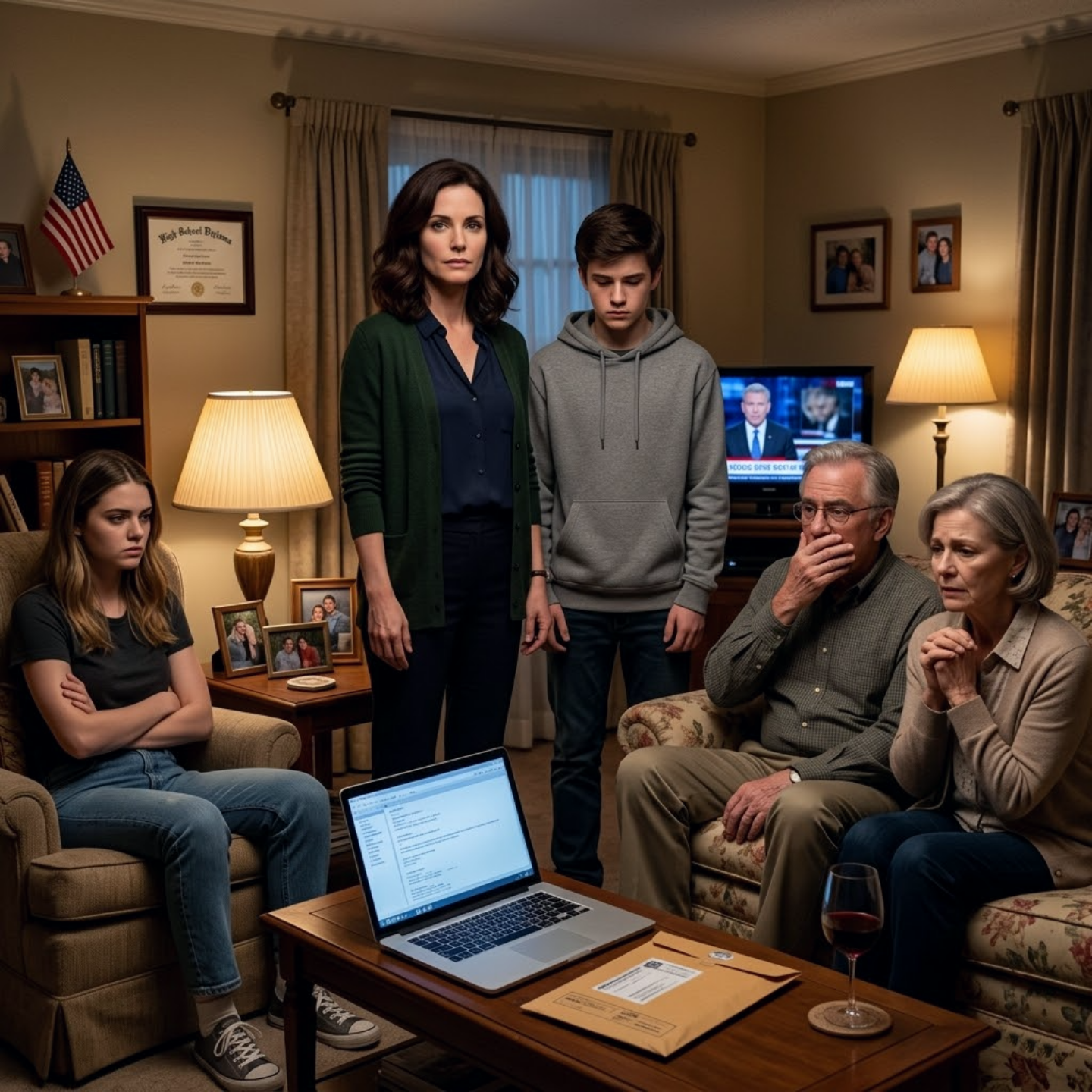
The house felt heavy the minute I stepped inside. My mother was in the kitchen holding a thin envelope like it might detonate in her hand. My father sat at the table, clasping and unclasping his fingers. Mia was on the couch in a hoodie and sunglasses, wearing them indoors as if hiding her eyes could alter federal paperwork.
My mother looked at me with glossy, frightened eyes. “What is happening?”
My father’s face had gone pale in a way that was not anger anymore. It was fear.
“Mia’s been flipping thousands of dollars in electronics,” I said, keeping my voice steady. “Cash transactions. Digital listings. Receipts. Daniel reported the transaction he bought as suspicious. That’s normal. It creates a trail.”
Mia’s shoulders went rigid. “He’s ruining me,” she hissed.
“No,” I said. “You ruined you.”
My father swallowed hard. “The IRS doesn’t play,” he said quietly, like he was reminding himself as much as anyone else.
My mother whispered, “We didn’t know.”
I looked at her, and something in me softened just enough to be honest. “You didn’t want to know,” I said. “You didn’t ask questions when it was Caleb. You just believed her.”
My mother’s face crumpled. My father stared at his hands. A phone rang in Mia’s pocket and she ignored it, looking cornered now in a way she never had when this was all still living room theater and family denial.
That was when I understood something I should probably have understood years earlier. The mood in that house had not changed because I finally raised my voice or because I threatened anybody. It had changed because reality had shown up with documents in hand, and reality is a lot harder for certain kinds of people to dismiss once the paperwork starts printing.
The first detective who called me did not sound angry or dramatic. He sounded tired, like he had already heard three versions of the truth that morning and none of them lined up.
“Ms. Harper?” he asked. “This is Detective Ruiz with the county police. I’m following up on a report involving a suspicious sale of electronics and a disputed credit card transaction.”
My kitchen suddenly felt too quiet. Caleb was at school. A mug of coffee had gone lukewarm beside me. The IRS envelope was still lingering in my head like a warning I had not fully unpacked.
“Yes,” I said carefully. “I’m the cardholder.”
“I understand one of the purchasers brought in an iPad he believes was acquired through fraud,” Ruiz said. “He provided a receipt with your name and card information. I’d like to ask you a few questions.”
The moment Mia involved Caleb, this had stopped being the kind of family crisis you could manage with private ultimatums and careful distance. It had become a safety issue. Not because I believed she would physically harm him, but because she had already shown she was willing to burn his name to keep herself comfortable.
“Ask,” I said.
Ruiz went through the basics first. When I noticed the charges. Whether anyone had permission to use the card. Whether Caleb had ever used it. Then he asked a question that told me he had already seen enough to suspect a bigger pattern.
“Has your sister done anything like this before?”
I looked out the kitchen window at the backyard, the fence line, the patch of grass Caleb used to tear up with soccer cleats when he was younger. “Not like this,” I said. “But she has a history of borrowing, lying about money, leaving other people to clean up what she starts.”
Ruiz let out a quiet breath. Not judgmental. Just confirming something. “Do you have evidence she made the purchases?”
“Yes,” I said. “Store footage. Receipts. Serial numbers. Listings with her name and number.”
“Can you bring that to the station?”
“I can.”
“Today, if possible. And Ms. Harper…” He paused for a second. “I know this is family. But if a minor was accused as part of the cover story, that matters. It changes how we document the case.”
When I hung up, my hands were steady, but my chest felt tight in that deep, squeezed way that comes when reality asks you to stop wishing the problem will dissolve on its own. I had not wanted to be the woman who took her sister to the police. Even after everything, some old childish part of me had still been clinging to the hope that Mia would repay the money, disappear into her own chaos, and let the rest of us pretend the worst was over.
But the IRS letter meant it was not over. The buyer reports meant it was not over. The fact that she had accused Caleb meant it was never going to be over until some outside force wrote it down.
I spent the next hour organizing the folder again, but this time I did it like I was preparing for court. I labeled everything. Made copies. Wrote out a timeline that walked from missing card to resale listings to reimbursement. Facts did not get emotional. Facts did not lose their nerve halfway through. Facts could sit in a fluorescent room across from an investigator and still hold.
When Caleb came home, I told him we were going for a drive.
He set his backpack down slowly. “Did something else happen?”
“Not to you,” I said. “But I need you to hear this from me, not from Grandma.”
We sat at the kitchen table. Sunlight was slanting in through the blinds in those long late-afternoon stripes that make ordinary rooms feel briefly cinematic. I wished I did not remember details like that. I wished family betrayal lived in blurrier light.
“The police called,” I said. “They’re investigating the sales. Someone else filed a report. I’m going to give them everything I have.”
His face went blank in that teenager way that is supposed to look indifferent but is really just armor. “Are they going to talk to me?”
“Maybe,” I said. “But you won’t be alone. And you didn’t do anything wrong.”
He stared at the table. “I hate this.”
“I know.” I reached for his hand, but he pulled it back and rubbed his palms on his jeans instead, not rejecting me, just trying to contain himself. “But the truth doesn’t get smaller when you avoid it. It gets bigger. Louder. I’m not letting her keep telling stories about you.”
He swallowed, eyes glossy. “They really believed her.”
It was not a question.
“No,” I said. “They did.”
His mouth tightened. “So what happens now?”
“Now we protect you.”
The police station smelled like copier toner, old coffee, and the damp chill of overworked air-conditioning. Detective Ruiz met me in a small interview room and sat down across from me with the calm focus of somebody who had seen enough mess to stop being impressed by anyone’s excuse for it. He was younger than I had expected, with tired eyes and a clipped professionalism that somehow made him easier to trust.
I slid the folder across the table.
He went through it page by page, his expression barely changing. He nodded at the receipts. Slowed at the Marketplace screenshots. Raised his eyebrows when he got to the stills from the security footage.
“She didn’t even try,” he said.
“No,” I replied. “She never does.”
He asked me to sign a statement and then wanted details about Caleb. School schedule. Attendance. Whether there was any realistic chance he could have made those purchases himself.
“He was in class,” I said. “We can provide records.”
Ruiz nodded. “We’ll likely request them.”
At the door he paused and gave me the warning every parent dreads hearing but already knows is coming. “If we move forward, your sister may be facing theft by deception, fraud, and possibly identity-related charges depending on how she represented herself with the card.”
I swallowed. “Okay.”
“And your parents may be contacted. Not as suspects. As witnesses. What she told them about your son matters.”
I drove home with my hands locked around the steering wheel. By the time I pulled into the driveway, I had four missed calls from my mother.
I called her back.
“Jenna,” she whispered immediately, voice high with panic. “Mia says you’re calling the police.”
“I didn’t call them,” I said. “Someone else did. And yes, I’m cooperating.”
“She’s your sister,” my mother said, and I could hear the plea in it, not for justice, not for Caleb, but for the soft place Mia had always occupied in her heart. “You can’t do this.”
“I can,” I said. “She accused my son of stealing. She lied to you so you would punish him. She used my name on receipts. This isn’t a misunderstanding.”
My mother started crying. “She’s going to lose everything.”
“She should have thought about that before she stole from a kid.”
“She was desperate.”
“So was Caleb when you texted him that he was a thief,” I said, and my voice sharpened for the first time. “Where was your sympathy then?”
The silence that followed was so thick I could hear my own breathing.
Then my father came on the line. “We were wrong,” he said. “We know.”
“Knowing isn’t enough,” I said. “Caleb needs to hear it.”
“We’ll talk to him.”
“Not unless he wants to,” I corrected. “You don’t get access just because you’re sorry now.”
My father was quiet for a long moment. Then he asked, “What do you want us to do?”
I thought of Mia still sitting in their house, still wrapped in the protection of their denial. I thought of Caleb on my couch reading texts from people who were supposed to love him first and question later.
“I want you to stop sheltering her,” I said. “If she’s staying there while the police investigate fraud connected to stolen purchases, you’re making yourselves part of the mess.”
“She has nowhere else,” my mother said weakly in the background.
“She made that,” I said. “Not Caleb.”
That night Mia called from an unknown number.
I answered because I wanted to know what mask she would put on now that the law had entered the room. Her voice came out low and tight, stripped of its usual theatrics.
“What did you do?”
“I gave the police evidence.”
“You’re trying to destroy me.”
“You destroyed yourself.”
She laughed, bitter and thin. “You always hated me.”
For half a second I almost felt sorry for her. That had always been her mechanism: turn consequences into betrayal. Recast accountability as cruelty. Pretend she was being persecuted instead of answered.
“This isn’t about you and me,” I said. “This is about you targeting my son.”
There was a pause. Then her tone softened into syrup. “Let me talk to Caleb. I’ll explain. I’ll fix it.”
“No.”
“He needs to know I didn’t mean ”
“He doesn’t need anything from you,” I said. “Do not contact him.”
Her voice went cold. “You think you’re protecting him, but you’re teaching him that family is disposable.”
I looked out the dark kitchen window over the sink. “Family isn’t disposable,” I said. “But trust is. You spent it.”
I could almost hear her deciding whether to threaten me directly. Finally she said, “If you push this, you’ll regret it.”
I didn’t raise my voice. “Try. And I’ll add harassment to the list.”
Then I hung up and blocked the number.
Two days later the school called.
Not because Caleb was in trouble. Because rumors move faster than facts in any American high school, and suburban gossip spreads like a grass fire when adults start it first. The counselor asked if we could come in after school. She mentioned “a situation involving accusations” and said they wanted to make sure Caleb felt supported.
Caleb sat in the passenger seat on the way there, jaw tight, staring out at the strip malls and chain restaurants lining the road. “Everyone thinks I stole,” he said.
“No,” I said. “Not everyone. But enough people heard a story before the truth.”
He looked out the window. “Grandma texted my coach.”
My stomach dropped. “What?”
“She asked if I’d been missing practice to go shopping,” he said. “Coach told her to stop texting him.”
I tightened my grip on the wheel. My mother had not only believed the lie, she had reached into Caleb’s world and tried to yank at his reputation there too.
The counselor was kind but careful, the way school professionals are when they know they are standing on the edge of something legal. She asked Caleb how he was sleeping. Whether he felt anxious at school. Whether he wanted to talk to someone regularly. He gave half-shrugs to most of it until she asked one simple question.
“What would help you feel safe right now?”
He blinked, then surprised both of us.
“I want people to know the truth,” he said quietly.
The counselor nodded. “We can’t announce family legal matters,” she said, “but we can correct misinformation if it’s affecting your school experience.”
I leaned forward. “What does that look like?”
She suggested a general notice to his teachers and coach that Caleb had been the subject of a false accusation and that the matter was being formally addressed. Nothing dramatic. Just enough adult record to keep the rumor from hardening into something that could follow him.
Caleb hesitated, then nodded. “Okay,” he said. “I don’t want it following me.”
On the drive home he was quiet, but there was something different in the silence. Less collapse. More intention.
That night Ruiz called again.
“We’re moving forward,” he said. “We have statements from two buyers, your documentation, and additional footage from one of the clothing stores.”
“It’s her.”
“Yes. And I need you to know she attempted to claim your son used your card without permission.”
I sat down hard at the kitchen table. “She’s still doing it.”
“It’s not uncommon when people panic,” Ruiz said. “We’re not relying on her story. We’re relying on evidence.”
After I hung up, I sat in the dark for a long time. When you are a parent, there are certain things you can absorb without breaking shape. Someone can insult you. Blame you. Misunderstand you. But when someone tries to nail a lie to your child because it is convenient, something far older than anger wakes up in you.
That same night my father texted: We asked Mia to leave.
I stared at the message and felt relief and rage in equal measure. Relief that they had finally drawn a line. Rage that it had taken detectives, tax letters, and documented sales to make them do what should have happened the first time Caleb said he hadn’t done it.
My mother texted next: She says you poisoned us against her.
I almost laughed out loud in the dark.
The next day Caleb showed me a screenshot from a class group chat. Somebody had typed: Heard Caleb got caught stealing his mom’s credit card. Under that, another student had replied: His aunt said she saw him.
That was when I understood the full ugliness of what Mia had done. She had not just lied inside the family. She had launched a story into the world and trusted the old human habit of believing the first version you hear.
“People always believe the first thing,” Caleb muttered.
“Then we put a better thing on record,” I said.
The following morning I sent a short email to his coach, counselor, and teachers. Professional. Controlled. No melodrama. No naming Mia. Just a concise statement that Caleb had been falsely accused in a matter that was now under formal investigation and that gossip should not be allowed to affect his standing at school.
By the end of the week the tone around him shifted. Not all at once. Not perfectly. But enough. Kids stopped saying things to his face. The adults who mattered had a paper trail now, and that alone changed the air.
Facts make liars nervous.
Then Mia showed up at my work.
I was walking toward my car after my shift when I saw her leaning against the passenger side like she belonged there, hoodie up, sunglasses on, arms crossed. The parking lot was half-full, late sun flashing off windshields and the asphalt still giving off the day’s heat.
“Mia,” I said sharply. “Leave.”
She pushed away from the car. “You made Mom kick me out.”
“You did.”
She came a step closer. “You got your money back. Why aren’t you stopping this?”
“Because you’re still lying,” I said. “Because you’re still saying Caleb did it.”
Her jaw clenched. “He did steal,” she said, her voice breaking into something wild and raw. “He stole your attention. He stole everything from me. You always had to be the responsible one, and now you have the perfect kid and ”
I went still.
There it was. The truth she had not meant to tell. Not about the card. About the resentment under it. The old, rotten entitlement at the center of her life.
“Get away from my car,” I said. “And don’t come to my job again.”
She laughed. “Or what?”
I took out my phone and called security. My workplace had a guard. I did not need to argue. I did not need to perform outrage for her. The minute she realized I was not going to be drawn into a scene, her expression shifted.
“You’re cold,” she spat.
“No,” I said. “I’m a mother.”
The guard started walking our way. Mia backed off, muttering under her breath, and disappeared between rows of parked cars.
That night Caleb asked, “Is she going to jail?”
I paused before answering. “I don’t know. But there will be consequences.”
He looked down at his hands. “Good,” he said. “Because she didn’t care about me at all.”
I sat beside him on the couch and put my arm around his shoulders. “No,” I said. “She didn’t. But I do. And I’m not letting anyone rewrite who you are.”
For the first time since this began, he leaned into me without pretending he didn’t need comfort.
A week later Ruiz asked Caleb to come in.
I expected resistance. Instead Caleb surprised me again. “Let’s just do it,” he said.
The interview room was too sterile for a teenager. Ruiz kept his voice gentle. Asked Caleb to confirm his school schedule, whether he had ever used the card, whether he had ever authorized Mia to use it.
“I didn’t even know she had it,” Caleb said. “I thought my mom took it back.”
Ruiz nodded, wrote something down, and thanked him.
On the drive home Caleb looked out the window and said, “It’s weird.”
“What is?”
“Being believed.”
The words landed in me so hard I had to blink twice before I trusted myself to answer. “You deserve that,” I said. “Every time.”
That night I froze Caleb’s credit.
He looked at me like I had lost my mind. “Why?”
“Because if your aunt can steal a card from your room, she can steal a name,” I said.
So I walked him through all the boring, necessary armor no one teaches teenagers until life forces it into the room. Credit freezes. Fraud alerts. Monitoring. Why debit cards are riskier in some situations. Why you never hand over more information than a stranger needs. Why you lock things down without feeling rude about it.
He listened more closely than I had expected. “So basically,” he said, “you have to assume people will take advantage if they can.”
I hated that he had to learn that lesson from his own family. “Not everyone,” I said. “But enough that you protect yourself without guilt.”
A few days later my parents asked if they could come over.
They sat on my couch like guests in a house they were not sure they deserved to enter. My mother had brought a casserole, because people like her always reach for food when words are no longer enough. My father kept rubbing his hands together.
Caleb stayed upstairs.
“Is he mad at us?” my mother whispered.
“He’s hurt,” I said. “And he doesn’t owe you quick forgiveness.”
My father swallowed. “We should’ve asked questions.”
“Yes.”
He flinched at the simplicity of that answer.
Then he started to say, “Mia has always ”
“Don’t,” I cut in. “Do not finish that sentence.”
He went silent.
“She’s always been your favorite,” I said. “And you let that become blindness. You punished Caleb to protect her without meaning to. That still happened.”
My mother began to cry softly. “How do we fix it?”