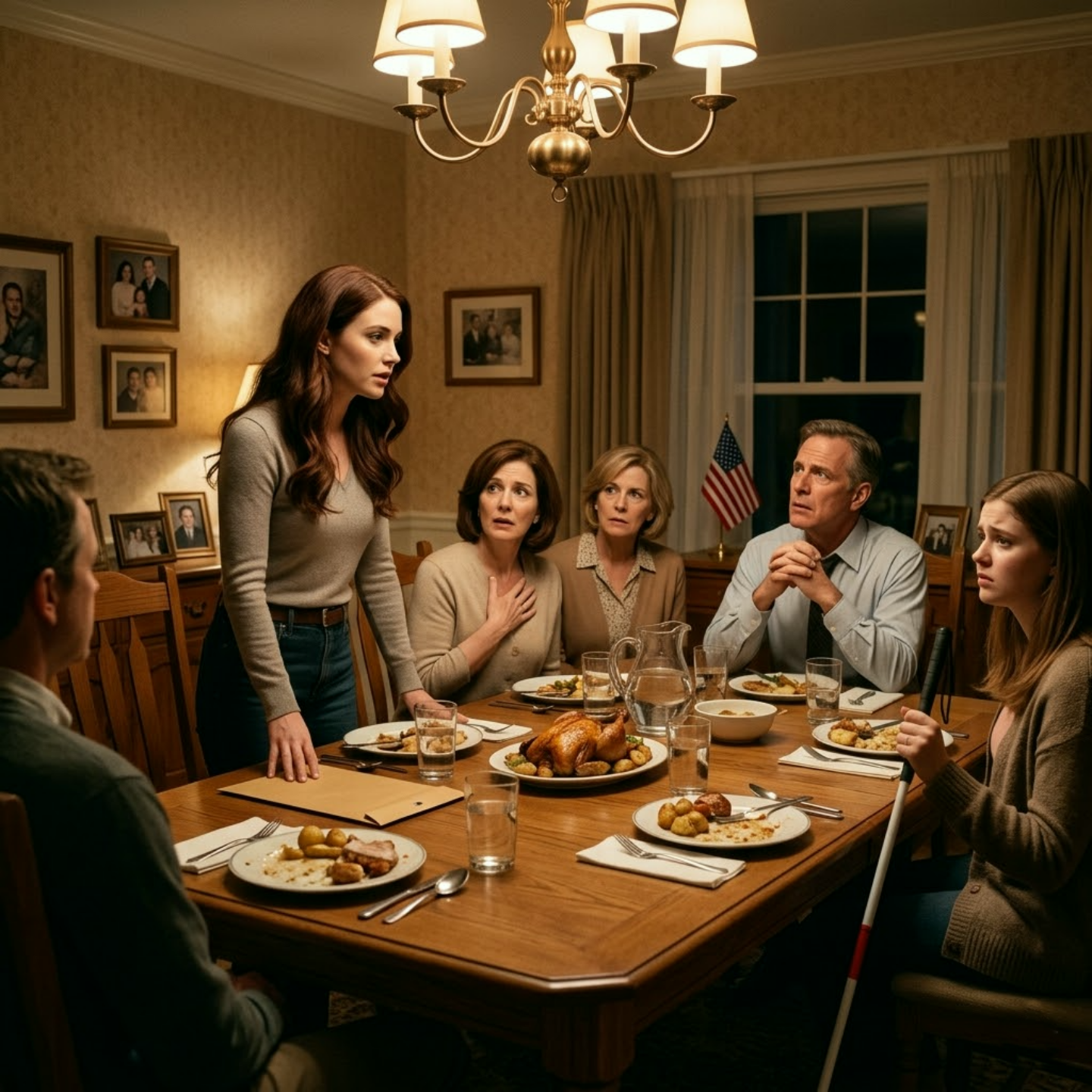
My dad called me on a gray Tuesday afternoon and said we needed to have a serious family meeting about my sister Haley’s future. The way he said it flat, formal, already decided made something tighten in my chest before I even got in the car. Haley had been losing her vision for the last three years because of a genetic condition that seemed to steal her life in quiet, ruthless increments. By twenty-six, she was completely blind. I assumed we were going to talk about care options, disability resources, maybe whether she needed to move back home for a while. I drove three hours down the interstate toward my parents’ town, past gas stations and outlet malls and those long stretches of highway where the radio starts to sound like static inside your own head, thinking I was going to be part of a hard but normal conversation.
Instead, I walked into an ambush.
My mom, my aunt Ruth, Haley, and my dad were all waiting in the living room like they had rehearsed the scene before I arrived. The curtains were half drawn even though it was still light out, and the whole room felt close and staged, like there wasn’t enough oxygen in it for me. Nobody offered me coffee. Nobody asked about my drive. My father just folded his hands, looked at me with that measured expression he always used when he had decided something was going to happen, and said Haley’s doctor had found a possible treatment that could restore her sight. Then he told me the treatment required a cornea donor who was a close genetic match, and after testing everyone in the family, I was the only one.
He said it like he was announcing good news. Like I was supposed to feel honored.
“This is your chance to give your sister her life back,” he said.
I remember staring at him for a second, waiting for the part where he told me they had exhausted every other option first. When that didn’t come, I asked the most obvious question I could think of.
“What about the donor list?”
His jaw tightened. “Haley doesn’t have time to sit on a waiting list.”
He said her condition was deteriorating fast. He said if the surgery didn’t happen within the next few months, the window would close and the outcome might not be viable anymore. My mother started crying almost immediately, the way she always did when she wanted the mood of the room to turn toward urgency instead of clarity. She talked about how hard it had been to watch Haley lose everything her job as a graphic designer, her independence, her confidence, her boyfriend, her routine, her sense of self. Haley sat on the sofa with her hands folded together, listening like someone at the center of a funeral where she was still technically alive.
I said I needed time to think and to understand exactly what the surgery would mean.
My father’s whole face changed.
There was no softness in him then, no concern, no hint that this was supposed to be about love. He told me there was nothing to think about. That this was family. That this was what siblings did for each other. He said I had two working eyes and Haley had none, and if I refused to help, it would be selfish beyond belief.
Selfish.
He said the word like it belonged to me. Like it had always belonged to me.
Aunt Ruth jumped in right on cue and said if she had been a match, she would have donated without hesitation. “Any decent person would,” she added, with that pious little shake of her head people use when they want to condemn you and still feel righteous about it.
I looked back at my father. “What happens to my vision?”
He didn’t even blink. “The doctor says you’d still see adequately with one eye.”
Adequately.
As if depth perception and peripheral vision were optional luxuries. As if the world narrowing around me would be some minor inconvenience I should absorb with gratitude. He went on about how people lived full lives with one eye all the time, how I was young enough to adapt, how the body adjusted, how the brain compensated. Every sentence reduced what he was asking me to surrender into something small enough that only a bad person would make a fuss over it.
I said I wanted to speak to the doctor myself.
He snapped back immediately. “You’re wasting time Haley doesn’t have.”
That was the moment the whole thing tipped from awful into surreal. I turned to Haley because up until then, she had said almost nothing.
“What do you want?” I asked her.
She took a breath and said, very softly, that she didn’t want to pressure me. Then she said losing her sight had taken everything from her. She said she would understand if I couldn’t do it, but she didn’t know how she was supposed to live with herself if she didn’t ask.
Before I could answer, my father cut back in.
“It’s not really asking when the answer should be obvious.”
Then he pulled out his phone and started showing me pictures. Haley before: painting in a studio, smiling in sunlit travel photos, standing in front of some mural downtown, wind in her hair, eyes bright and unthinking because she had not yet learned what it meant to lose them. Then Haley after: using a white cane, standing stiffly in a grocery store, wearing the blank, strained look people get when they are exhausted from trying to perform normalcy in a body that no longer cooperates. He swiped between those photos with prosecutorial precision and told me this this decline, this grief, this half-life would be my fault if I let it continue.
My mother, through tears, said they had already spoken to the surgeon. They had tentatively scheduled dates for next month. They had put down a deposit they couldn’t get back. They had told Haley’s friends the good news. They had even bought her new art supplies for after the recovery, as if sight were already on layaway and all that remained was for me to sign over part of my body to release it.
Everything was arranged except my consent.
I said I needed to leave.
My father stood and blocked the door.
“I’m not letting you walk out until you agree,” he said.
It still feels unreal, remembering that. The front hall behind him. The old brass lamp by the entry table. The family photos on the wall. The door just a few feet away and suddenly farther than a state line. He told me that if I walked out, I was walking out on the family forever. He said he would disown any child who could watch a sibling suffer while having the power to stop it. My mother begged. Aunt Ruth sighed like a church woman disappointed in a sinner. Haley sat there saying nothing.
I pushed past him and left.
The next three days were a kind of hell I had no language for yet. My dad called constantly. He left voicemails saying I was killing Haley slowly. My mom texted photos of Haley struggling with daily tasks as if disability itself were an accusation. Aunt Ruth posted vague little public martyrdoms online about disappointment and blood and loyalty. Relatives started calling to ask why I wouldn’t help my poor sister. It spread with the speed family stories always spread: fast, emotional, stripped of context, sharpened into moral theater before the person at the center of it has time to breathe.
Then I did something my father never expected me to do.
I called Haley’s doctor myself.
The receptionist put me through after I explained I was family and that I needed to verify details about a proposed surgery because I had concerns. I expected resistance. I expected guarded language and careful disclaimers. What I did not expect was for the doctor to sound confused almost immediately.
There was no revolutionary surgery scheduled for Haley.
She was on the normal transplant list like everyone else. Based on her case, he said, she would likely receive donor corneas within the year. He had never discussed living cornea donation with my family because that was not how cornea transplantation worked for Haley’s condition. You do not simply decide to take corneal tissue from a living person because a relative wants faster access to treatment. In non-emergency cases like this, it was not medically viable. In emergency trauma cases it was rare to the point of extraordinary and required layers of ethical review.
When I explained what my family had told me, he sounded horrified.
I sat in my car outside my parents’ house for nearly twenty minutes after that call, the engine off, my phone still warm in my hand. The porch light was on though dusk hadn’t fully settled yet. Through the curtains I could see movement in the living room. People crossing and recrossing the same narrow territory, probably waiting for me to come back inside with an apology. My own reflection in the windshield looked strange to me white-knuckled, jaw set, eyes too wide. My father called again while I sat there. I watched the screen light up and go dark and light up again.
Then I started the car and drove home.
The entire three-hour trip felt like coming out of anesthesia and going into shock at the same time. My father’s voicemails kept coming, his tone getting angrier with every message. My mother started texting around the second hour, asking where I was, saying we needed to work this out as a family, begging me to come back before things went too far. By the time I crossed into my city, my father had left eight messages and my phone looked like evidence.
I got home close to midnight and did not sleep. I opened my laptop and started searching phrases that sounded too dramatic when I first typed them: family coercion, pressure to donate organ, medical manipulation, emotional abuse by parents, guilt tactics in narcissistic families. Every page I found made me feel a little sicker and a little clearer. Manufactured urgency. False deadlines. Group pressure. Financial sunk-cost manipulation. Moral blackmail. Coercive control dressed up as love.
I sat in the dark glow of my apartment, reading article after article, and something awful began happening in me. The current crisis wasn’t just making sense. My childhood was making sense too.
Every paragraph seemed to cast backward light.
The next morning, I called my friend Travis. He had known my family for years, but not in the immersive way that lets dysfunction start sounding normal. He was close enough to understand the players, far enough not to be tangled in the script. I told him everything. When I finished, there was a long silence on the line.
Then he said, very carefully, “Your dad tried to get you to give up an eye based on a lie.”
Something in me cracked at hearing it that plainly. Not dramatized. Not softened. Not wrapped in family language. Just the fact itself. Travis came over that afternoon with coffee and his laptop, and we spent hours documenting everything. Timeline, quotes, calls, deposits they claimed to make, threats, wording, who said what and when. He found templates used by abuse documentation sites and helped me fill them out with dates and exact phrases while they were still fresh in my head. By evening I had thirty-seven missed calls, dozens of texts, and the terrible realization that my family was not spiraling emotionally. They were running a campaign.
My mother’s messages alternated between pleading and blame. My father’s were pure fury. Aunt Ruth invoked my dead grandmother in a way that would have been laughable if it hadn’t felt like being emotionally mugged. My cousin texted asking what was going on because my parents were telling people I had some kind of breakdown. I blocked my parents’ numbers for the first time in my life, and the guilt hit instantly, sharp and conditioned and old.
Travis looked at me and said, “Healthy people don’t punish you for needing space after they lied to you.”
I cried so hard I couldn’t answer him.
Two days later, I called Haley’s doctor again and asked if he would be willing to put what he had told me in writing. He did not hesitate. He said he had been worried about me since our first conversation. By the end of business that day, he emailed a formal statement confirming that he had never discussed living cornea donation with my family and that such a procedure was not medically appropriate or feasible for Haley’s condition. He also asked whether I was safe and whether my family had been harassing me.
That question did something to me.
Are you safe?
It had not occurred to me until someone outside the family asked it that what had happened might not only be wrong. It might be serious.
Travis found a legal aid clinic in my city and helped me get connected with an attorney named Mariana who handled family coercion cases. I told her everything over the phone from my kitchen table, pacing barefoot across the warped wood floor while she listened without interrupting. When I finished, she said that while prosecution in situations like this was difficult and highly fact-specific, what my family had done potentially crossed into attempted medical fraud and coercive abuse. At minimum, she said, I needed to preserve every record I had in case I ever needed a restraining order.
Mariana helped me draft a cease-and-contact letter to my parents. It stated clearly that I knew the surgery story was fabricated, that I had documentation from Haley’s actual doctor, and that all further communication needed to go through her office. The language was clean and formal and gave them nowhere to wriggle. We sent it certified mail. Two hours later, while I was standing over a pan of reheated pasta in my kitchen, my phone rang from a number I didn’t recognize.
I answered because I thought it might be Mariana calling from a different line.
Instead, I heard my father’s voice.
He had called from Aunt Ruth’s phone so I wouldn’t screen it.
The sound of him speaking through someone else’s number was so unsettling that for a second I couldn’t even process the words. He spoke slowly at first, in that low controlled tone he used when I was a kid and knew I was in trouble before he even raised his voice. He said I had been listening to the wrong people. He said outsiders who didn’t understand our family had poisoned me against them. He kept demanding to know who I had been talking to, what they had said, why I was letting strangers turn me against my own blood.
Then, like he could feel me not responding the way he wanted, he shifted.
His voice went soft. Sad. Injured.
He said he loved me. He said family was forever no matter how ugly disagreements got. He said I would regret burning bridges someday when I needed them and found them gone. He said Haley cried herself to sleep because her own sister had abandoned her. He said my mother was devastated and couldn’t understand how I had become this cruel. It was all coated in concern and all of it felt like a threat. Like a man explaining the weather while quietly opening a trapdoor beneath your feet.
Travis had told me to record any calls from my family if I could. My hands were shaking so hard I could barely get my phone settings open, but I managed to start recording. Then I said the only thing that came to mind.
“I spoke to Dr. Kavanaugh. He gave me a written statement. He said the surgery was never real.”
Silence.
Not a stumble. Not a denial. Just total, dead silence for five full seconds.
Then the call disconnected.
The next morning, somebody knocked on my apartment door while I was getting dressed for work. I looked through the peephole and saw my mother standing there in jeans and an old oatmeal-colored sweater, her shoulders folded inward, her face swollen from crying. She wasn’t supposed to have my address. I had moved since the last time she visited, which meant she had gone out of her way to get it.
She said through the door that she needed to talk. That my father didn’t know she was there. That she had driven all this way just to see me.
I should have left her standing in the hallway.
Instead, memory betrayed me. Not the recent memories, the true ones. The old ones. My mom reading to me before bed. My mom frosting birthday cakes. My mom singing along badly to the radio when she drove me to school. I opened the door.
She stepped inside and immediately asked if she could sit down, though she was already halfway to my couch before I answered. Her eyes filled up the second she looked at me. She started talking before I was even seated. They had only wanted to help Haley. Maybe they had gotten some details wrong. Maybe desperation had made everything confused. Nobody had meant to hurt me.
I asked her exactly what details they had gotten wrong.
That was when the shifting began.
First she said the doctor had mentioned transplants and they thought living donation might be an option. I told her Dr. Kavanaugh said he had never discussed living donation with them at all. Then she said maybe they had misunderstood medical terminology. I asked if the doctor had scheduled surgery dates the way they claimed. She admitted he had not. But, she added quickly, my dad had been researching surgeons who might do it. The story changed every time I asked a direct question. First it was a real surgery simplified for me. Then a misunderstanding. Then hope. Then creative problem-solving. Then love. Every answer slid sideways into a new shape before it could be held still long enough to call it a lie.
Finally, I asked the only question that mattered.
“Did you know the surgery wasn’t real when you all sat me down at the house?”
She started crying harder, like I had attacked her instead of asked her to tell the truth. She said I was interrogating her. She said I was being cruel. She said Haley was suffering and she had come here hoping I would understand how scared they had all been. Every time I tried to bring the conversation back to what she knew and when she knew it, she redirected toward Haley’s pain, my coldness, the family’s heartbreak, her own helplessness. By the time she left an hour later, saying she had tried her best and could do nothing more if I was determined to believe the worst of them, I felt like I had run a marathon in wet clothes.
That night, Travis came over again. I told him everything she had said, trying to reconstruct the conversation in a way that would make it feel less slippery.
He listened and said, “She never answered one question you asked.”
He was right.
And somehow that hurt more than if she had just admitted it.
Three days later, the false story started circulating in earnest.
My cousin Jessica called first and asked why I had changed my mind after agreeing to the surgery. She said my parents were heartbroken about the deposit they had lost. I told her there had never been a surgery and I had never agreed to anything. She went very quiet, then said that wasn’t what she’d been told. My uncle called the next day with a version where I had gotten scared at the last minute and abandoned Haley close to her procedure date. My dad’s sister called after that and said she understood I was afraid, but backing out after everything had been arranged was unbelievably selfish.
Every version was slightly different, which was how I knew exactly where it came from. The broad strokes stayed the same: I was the villain. I had promised to help. I had bailed. My poor blind sister had been left shattered because of my cowardice. Not one person mentioned that the surgery itself had been fabricated from the ground up.
Mariana and I drafted a factual email. I sent it to the relatives who seemed most likely to care about proof more than performance. I attached Dr. Kavanaugh’s statement and explained, calmly and without embellishment, that there had never been any medically viable plan involving my eyes and that I had never consented to surgery. About half the people I sent it to never replied. A few cousins and one aunt apologized. My uncle got angry at me for exposing “private family matters” and said that even if the details had been exaggerated, my parents had still been trying to help Haley. As if the intent to manipulate me out of part of my vision became noble if you held a disabled daughter in front of it like a shield.
That was when I understood something I had resisted seeing: for some people, truth doesn’t matter if it interferes with the family story they prefer.
Work became hard in the most humiliating ways. I’d be looking at a report and suddenly realize I had reread the same paragraph four times without taking in a word. I’d be in a meeting and somebody would ask for my thoughts and I’d have to scramble because my mind had drifted back to my mother’s face on my couch or my father’s silence on the phone. One afternoon, a coworker named Aiden stopped by my desk and asked if I wanted coffee. The way he asked made it obvious he had noticed something was wrong and was trying to give me a way to step outside without naming it.
We walked to the shop across the street, and over paper cups and burnt espresso, I told him a stripped-down version of the truth. My family had lied about a medical emergency to manipulate me, and now they were spreading false stories because I had refused to go along with it. He listened carefully, then told me he had gone no-contact with his own family three years earlier after years of similar coercion. His parents had used his brother’s addiction as leverage against everyone around him. He said he eventually realized the role they had assigned him was not son or brother. It was tool.
That word stayed with me.
Tool.
Aiden wrote down his therapist’s name on a napkin and said she specialized in family trauma. I called the next day and got an appointment for Thursday. Dr. Estelle Medina’s office had soft blue walls and a bowl of peppermints on the table by the door. The waiting room was quiet enough that I could hear the air vent hum. By the time she called me back and asked me to sit down, I was crying before she had even asked a real question.
I apologized for that.
She handed me tissues and said, “You don’t have to apologize for reacting to pain in a room built to hold it.”
So I told her everything.
I even told her the part I was most ashamed of: that some part of me still wondered whether I was overreacting. Whether maybe my parents really had just misunderstood things. Whether maybe I had gone nuclear when the reality was simply messy and desperate and sad.
She listened for almost the full session before she began putting language around what had happened. Gaslighting. Enmeshment. Coercive family systems. She explained how gaslighting made someone question their own perception even in the face of obvious evidence. How enmeshment trained a person to experience their own needs as betrayal if those needs conflicted with the family’s demands. She said some families organize themselves around the most fragile member, and everyone else becomes a support structure that is expected to erase itself without complaint.
I sat there on that soft office couch and felt years of confusion begin to resolve into shape.
By the third session, she asked me whether this pattern had shown up before. At first I said I didn’t know. Then memory started surfacing in clear little cuts. The scholarship I turned down because my parents said Haley needed me nearby when her vision first began to decline. The college fund redirected toward Haley’s medical costs without anyone asking me what I wanted. The semester abroad in Spain I gave up because my mother cried and said it was selfish to leave the family while Haley was struggling. For years, every time I wanted something for myself, there had been a reason Haley needed the space, the money, the time, the sympathy, the sacrifice more.
I had called it love.
Sitting there with Dr. Medina, I started to call it a pattern.
A week later, I unblocked my parents’ numbers long enough to send one message. I rewrote it three times before I got it down to what it needed to be: I knew the surgery had been fake. I had medical documentation proving it. I needed six months of no contact to process what they had done. Any further harassment would result in legal action.
My father texted back in under three minutes. No punctuation, no restraint, just a flood of rage. He said I was dead to him. He said I had chosen strangers over my family. He called me a liar and a traitor and said he hoped I lived with the guilt of abandoning Haley when I could have saved her.
I read it twice, then a third time, waiting for the familiar guilt to crush me.
It didn’t.
What I felt instead was exhausted grief. The kind you feel when somebody takes an ax to a house that was already burning and still somehow acts betrayed when you won’t run back inside.
My mother texted after that crying emojis, little bursts of pain, accusations disguised as heartbreak, photos of Haley sitting alone. I turned my phone off completely and went to bed. For the first time in weeks, I slept through the night.
Two days later, Haley texted me from her own number.
Her message was softer than our parents’, more careful, and in some ways that made it harder to read. She said she knew things had gotten complicated. She said maybe Mom and Dad had exaggerated some details because everyone had been desperate and scared. She said she was struggling so much with blindness and had believed I would want to help her if there were any chance. She hoped, as sisters, we could work through this.
It felt rehearsed.