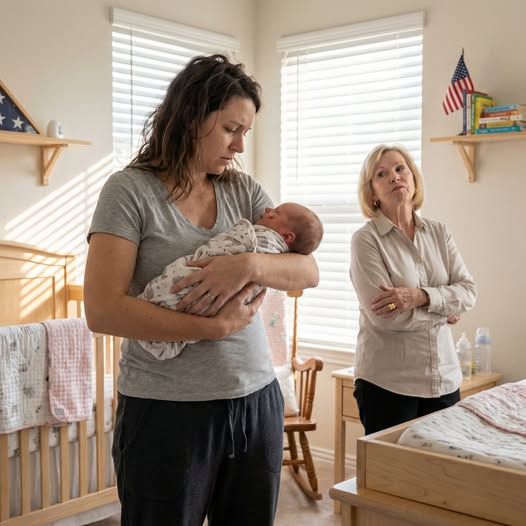
Hi there. Welcome back to my channel. Make yourself cozy, because I’ve got a story today that is going to give you hope.
The first time I knew something was wrong, my daughter had a fresh bruise on her arm, and my mother-in-law looked at me like I was the one being unreasonable.
“It was my ring,” Linda said. “I must have caught her by accident.”
Ava was only a few weeks old. She was so small that even that tiny mark looked violent on her skin. I stood at the changing table in our house in Austin, Texas, staring at her arm while Linda stood behind me, calm as ever. Daniel was at work. The room was quiet except for Ava’s weak little fussing, and I remember how loud that silence felt.
I wanted to believe Linda. I did believe her, at least for that moment. But something in me had already shifted. Tell me honestly, would that have felt normal to you?
Before Ava was born, I trusted Linda more than I trusted almost anyone. I was thirty-two, married to Daniel Mitchell, and pregnant with our first child. We lived in Austin, and by the end of my pregnancy, I was tired all the time. Linda was there through all of it. She brought food. She cleaned the kitchen without being asked. She rubbed my shoulders and told me, “You’re doing fine, Sarah. You just need support.”
That mattered to me. My guard came down because she made herself useful in quiet ways. She did not act overbearing then. She acted loving. She said she already loved Ava before she was even here. She called her my little angel and touched my stomach like she was blessing something.
Daniel smiled every time Linda came over. “See?” he told me once. “Mom’s excited. This is good.”
At the time, I thought so too.
When Ava was born, I was exhausted in a way I had never known before. My body still felt broken open. My mind never settled. Ava cried often because of her stomach. She would tense her whole body and let out those thin, desperate cries that made my chest feel tight. I kept thinking I should know how to soothe her better.
That was when Linda offered to move in for a few months.
“Only until you’re back on your feet,” she said.
Daniel answered before I did. “That would help a lot.”
In the beginning, it did help. Linda cooked. She washed bottles. She folded laundry. At night, she would step into the nursery and say, “Go lie down. I’ll take her.” Sometimes I was so tired I handed Ava over without a second thought.
Then the comments started.
“You run to her too fast,” Linda told me one afternoon when Ava had been crying for less than a minute.
“She’s five weeks old,” I said. “She needs me.”
“She needs to learn that crying doesn’t control the room.”
I looked at her, not sure I had heard her correctly. “She’s a baby,” I said.
Linda gave me a tight smile. “And you’re already spoiling her.”
At first, I brushed it aside. People say strange things about babies. I told myself Linda came from a different generation. But she kept saying it.
“You pick her up every time.”
“You’re nervous, Sarah. She feels that.”
It was never yelling. It was calm correction, over and over, until I started to hear her voice even when she was not in the room. I began to second-guess everything. Was Ava crying because of gas, or because I was holding her wrong? Was I making her worse by comforting her too quickly?
One evening, I reached for Ava when she started crying in Linda’s arms. Linda turned away from me.
“She just settled,” she said.
“She’s crying again. She’ll stop.”
I took a step closer. “Give her to me.”
Linda held Ava a second longer than she should have. Then she passed her over. Daniel walked in and looked between us.
“What’s going on?”
“Nothing,” Linda said.
I said, “She wouldn’t hand me my baby.”
Linda sighed. “I was trying to help.”
Daniel rubbed his forehead. “Sarah, she is helping.”
Maybe I was wrong, but it didn’t sit right with me.
A few days later, I found the first bruise while changing Ava’s diaper. Small, purple-blue, on her upper arm. I froze. Babies that young are not supposed to bruise.
When Linda saw my face, she came over immediately.
“What happened?” I asked.
Linda glanced down. “Oh, that must have been my ring.”
“Your ring?”
“She was squirming last night. I must have pressed too hard.”
I looked at Linda’s hand. She wore that ring every day, a gold band with a raised setting. She twisted it once, then stopped.
“I didn’t mean to,” she said.
I wanted to ask why she had not told me right away. Instead, I nodded and told myself accidents happen. But that ring stayed in my mind after that. Every time Linda lifted Ava, I looked at it first.
Then another bruise appeared.
This one was different. A small shape on Ava’s arm that looked less like pressure and more like fingers, like someone had pinched her. I stood in the nursery with the clean diaper open in my hand and felt my stomach drop. Linda came to the doorway.
“Why are you staring at her like that?”
“She has another bruise.”
Linda looked for half a second, then shrugged too quickly. “Maybe she caught herself on the crib sheet.”
“She can’t even control her hands yet.”
“Well, then maybe you held her too tight in your sleep.”
I turned and looked at her. “What are you saying?”
“I’m saying you’re exhausted.”
That landed exactly where she meant it to, because I was exhausted. So tired that when someone said maybe I had caused something without realizing it, part of me believed them.
Later that night, I showed Daniel the bruise. He frowned, but only for a moment.
“Mom said it was probably accidental.”
“This one doesn’t look accidental.”
He kept his voice low. “Sarah, nobody is hurting Ava.”
“How do you know?”
He stared at the bruise, then away from it. “Because why would my mother hurt a baby?”
That was the wrong question. The right question was why our daughter kept getting hurt while Linda was the one holding her.
I should have pushed harder then. I know that now. Instead, I stayed quiet long enough for the silence to become dangerous. Would you have stayed quiet?
After the second bruise, I stopped sleeping even when the house was quiet. I would lie in bed beside Daniel and listen for every sound from the nursery—Ava’s cry, Linda’s footsteps, the creak in the hallway floor. Sometimes Linda got to the baby before I did. Sometimes she was already in there lifting Ava out of the crib before I had even pushed the blanket back.
Still, I kept hesitating. Linda had spent months building the image of a kind woman. Daniel believed it completely, and I was a new mother, worn down enough to doubt my own instincts. That combination can trap a person. It trapped me.
One morning at breakfast, Ava started crying from her bassinet in the living room. I stood up at once.
Linda said, “Sit down. I’m getting her. She just ate. She’s uncomfortable.”
Linda did not even look at the baby. “You’re teaching her that one cry gets a reward.”
Daniel looked up from his coffee. “Mom has a point.”
I stared at him. “Ava is not training us. She’s in pain.”
Linda gave a soft little laugh. “Sarah, every noise she makes sends you into a panic.”
That sentence stayed with me all day because it was designed to do damage. Not loud enough to start a fight, just enough to make me question my own reactions. I was beginning to see there was no version of me Linda would approve of unless I stood back and let her take control.
By then, I was watching more carefully. I noticed that Ava cried harder after Linda had been alone with her. I noticed the way Linda’s jaw tightened when the crying went on too long. I noticed how often she said the same thing.
“She needs to be quiet.”
Not settled. Not soothed. Quiet.
One afternoon, I came into the nursery and found Linda standing over the crib, staring down at Ava while she cried.
“Linda?”
She looked at me without moving. “She has been doing this for twenty minutes.”
“I’ll take her.”
Linda stepped back, but slowly. “You always rescue her too soon.”
I picked Ava up. She buried her face against me and kept sobbing.
“She is five weeks old,” I said.
“And she already runs this house,” Linda replied.
That was the first time Linda spoke about Ava like she was not a baby, like she was an opponent. Maybe I was wrong, but it didn’t sit right with me.
That night, Daniel and I argued in whispers so Linda would not hear us.
“She keeps talking about Ava like she’s doing something on purpose,” I said.
Daniel sat on the edge of the bed. “Mom’s just tired too.”
“Tired people do not leave bruises on babies.”
“You still don’t know how those happened.”
I looked at him. “You really believe that?”
He did not answer right away. “Sarah,” he said at last, “Mom moved in to help us. You’re acting like she’s dangerous.”
“What if she is?”
“She isn’t.”
He said it too fast. Not like a man who had thought it through. Like a son protecting a belief he could not stand to examine.
The next few days felt wrong in small ways that kept building. Linda started correcting me in front of Daniel more often.
“She’s holding Ava wrong.”
“She feeds her too soon.”
“She gets too emotional when the baby cries.”
Daniel never fully agreed, but he never shut it down either. That silence had weight. Linda did not need to overpower me directly. She only had to keep me uncertain.
Then came the night I woke up because the house was too quiet.
Quiet should have felt like relief in a house with a newborn. But mothers learn their babies by sound. Ava cried often. Even in sleep, I was tuned to her. That night, I opened my eyes and felt something was wrong before I could name it.
Daniel mumbled, “What is it?”
I was already out of bed.
The hallway was dark except for the nursery light. The door was partly open. I could see Linda standing beside the crib, her back to me. For one second, I thought Ava had finally settled. Then I saw Linda’s shoulders—rigid, not rocking, not soothing, just standing there.
“Linda,” I said.
She turned halfway. Her face looked blank. “She wouldn’t stop,” she said.
I moved closer. “What do you mean?”
Linda looked at the crib. “I had to make her be quiet.”
Those words still live in me.
I reached the crib and saw Ava lying too still. Her face was wrong, her mouth open, her color already shifting. I touched her and felt that terrible limpness no mother should ever feel.
“Ava,” I said, then louder, “Ava.”
I lifted her and there was no cry, no breath. I screamed for Daniel. He ran into the room.
“What happened?”
“She’s not breathing,” Linda said very quickly. “I was trying to help her. I was trying to help her breathe.”
I dropped to the floor with Ava in my arms while Daniel reached for his phone.
“Call 911!” I shouted.
He was already dialing.
Linda stood near the crib, still wearing that ring, and kept saying, “She was crying. She was crying. I just wanted her to stop.”
Tell me, what would you hear in a sentence like that?
At the hospital, everything moved fast and yet not fast enough. Bright lights. Hands taking Ava from me. Daniel crying into both hands. Linda saying it was an accident. Linda saying she panicked. Linda saying she was trying to clear Ava’s airway.
Then the doctor came back.
I knew before he spoke.
Ava died at five weeks old.
The room went silent in that hard, unnatural way it does when words stop working. Daniel made a sound I had never heard from him before. Linda started crying then, but even through my shock, I did not believe her tears—because I had seen her in the nursery, because of what she said, because of the bruises, and because deep down I already knew my daughter had not died in some confused accident.
She had died because the person inside our home wanted silence more than my child’s life.
People think the worst moment is the moment your child dies. It is one of them. But there are others. Sitting through strangers explaining your daughter’s death back to you is one of them. Listening while the woman who stood over her crib calls it an accident is another.
From the beginning, Linda said the same thing. She had panicked. Ava had been crying. She had tried to help her breathe. She had lost control for a moment. That was her story, and she stayed inside it.
Daniel clung to it too, though not the way a man clings to truth. More like a man clings to whatever lets him survive the day.
Linda’s attorney stood there and turned my daughter’s death into confusion, stress, and poor judgment. He said Linda had not meant to hurt Ava. He said she was a grandmother overwhelmed by a crying baby. He made it sound ugly, but temporary. Human. Forgivable.
I sat still and listened, because if I had stood up, I would not have stopped.
The jury believed that version. Linda was convicted of involuntary manslaughter and received probation.
Probation.