I Was A Marine Sniper For 15 Years. My Son Was Dragged Into A Bathroom By 5 Seniors And Branded With A Heated Belt Buckle. The Principal Called It “A Hazing Tradition.” I Said, “My Son Has A Third-Degree Burn.” He Said, “Their Parents Are On The School Board. My Hands Are Tied.” I Said, “Mine Aren’t.” Within 10 Days, All 5 Seniors Were In The Hospital. Their Rich Fathers Tried To Sue Me. The Judge Read My File And Said, “Are You Sure You Want To Proceed?”
Part 1
Marshall Rivera came home the way he did everything that mattered: without noise.
No parade. No band at the airport. No handshake line of people who hadn’t sat with him in sand, sweat, and silence. Just two duffel bags that still smelled faintly of canvas and jet fuel, and a boy standing beside him with long legs and an unsure smile, as if he wasn’t certain he was allowed to be happy.
Cameron had been four when Marshall deployed the first time. Cameron was fourteen now—lean, bookish, shoulders still figuring out where to land. He had his mother’s eyes, wide and dark, and her habit of watching people carefully before deciding whether to speak.
Lindsay had died two winters ago. Cancer didn’t do drama. It just took what it wanted fast and clean, the way a storm snaps a branch and moves on. Marshall had made it home in time to hold her hand, to feel the last squeeze of her fingers and hear her whisper that sounded like, Take care of him. Then he stayed. Stayed for good, because there was no more running a loop around grief, no more thinking the next rotation would make things easier.
He bought a small house on Creekwood Lane in Dunmore, Pennsylvania, because it looked safe on paper. A town with a football field, a diner with cracked vinyl booths, and neighbors who waved the way people do in places where they still pretend they’re not afraid of each other. The school district brochures used words like community and tradition like they were blessings instead of warnings.
Marshall took a job with a private land surveying company. Mostly field work, mostly alone, which suited him. He wasn’t built for offices or chatter. He was built for patience, for measured steps, for the kind of attention that lets you notice the smallest shift and know what it means.
September came. Cameron started ninth grade at Dunmore High, backpack slung over one shoulder, head down like he could shrink his way through hallways. He sat near the back of his classes. He drew in the margins of his notebooks—little sketches of hands, eyes, animals that looked like they were mid-run. He laughed sometimes at dinner when he told Marshall about something he read, but the laugh didn’t come easily. It was like a door that needed oil.
They found a routine. Dinner at six. Cameron talked about books and odd facts he’d collected. Marshall listened. Sometimes they watched old westerns and let the silence do the work of company. Sometimes they just sat in the living room, two survivors sharing air.
Marshall didn’t ask about school politics. Cameron didn’t volunteer. Neither of them knew that four weeks into the year, five seniors had already marked Cameron Rivera as entertainment.
It started small, the way cruelty always does when it’s testing the ground.
A shoulder bump in the hallway. A whispered, “Hey, Freshman,” with a laugh that wasn’t friendly. A textbook knocked off Cameron’s desk in study hall, followed by a chorus of “Oops.” The teacher looked up, sighed, and told everyone to settle down like the problem was noise, not intent.
Cameron didn’t mention any of it. He came home, did homework, ate dinner, helped rinse dishes when Marshall cooked, and slept with his door half open like he had when he was a child.
Marshall noticed little things anyway. A missing pencil case. Cameron’s flinch when a car backfired down the street. A bruise on his forearm that Cameron said came from gym.
Marshall filed it away the way his mind always filed things: pattern, not panic.
Then came the Tuesday Cameron didn’t come straight home.
At 3:47, Marshall checked the clock because Cameron was usually in the driveway by 3:35. At 3:55, he checked his phone and saw no messages. At 4:10, he was in the truck, moving without hurry and without doubt.
By 4:18, he saw Cameron walking up Creekwood Lane.
The air was mild for October, but Cameron’s jacket was pulled tight. One arm was pressed against his ribs. He walked like a man trying to pretend pain was optional. Marshall knew that walk. He’d seen it in young Marines who didn’t want to admit they were hurt because admitting hurt felt like admitting weakness.
Marshall pulled over and got out slowly. Running would have scared Cameron more than stillness already had.
“Cam,” he said, voice quiet.
Cameron froze. His eyes flicked up, and something in them tightened, like he’d been holding a breath for miles.
“Let me see.”
“Dad—” Cameron tried, but the word fell apart. He swallowed. “I’m fine.”
Marshall didn’t argue. He didn’t raise his voice. He simply stood there, waiting, giving Cameron the choice to stop pretending.
After a moment, Cameron’s shoulders slumped. He lifted the hem of his shirt with shaking hands.
Marshall saw the burn and, for four seconds, the world narrowed to a single fact.
On Cameron’s left side, just above the hip, was an oval brand, about two and a half inches wide. A belt buckle frame, seared into skin in a clean, terrible outline. The tissue was wet, already weeping. The edges were angry red. The center looked pale and damaged in a way that made Marshall’s stomach go cold.
It would scar. Permanently.
Marshall breathed in through his nose, out through his mouth. He had trained himself for years to process horror without displaying it. A sniper’s requirement. Flinch at the wrong time and people die. He used that training now, not because he didn’t feel it, but because Cameron was watching his face like a drowning person watching the shoreline.
“Who,” Marshall said, as calmly as he could manage, “did this?”
Cameron’s lips trembled.
“Five seniors,” he whispered. “Carl Keller. Stanley Harden. Doug Hutchinson. Jerry Cruz. Barry Ellis.”
Marshall repeated the names in his head, not like a threat, but like coordinates.
“Where?”
“Bathroom near the gym,” Cameron said. “Lunch.”
“What happened?”
Cameron stared at the sidewalk, as if looking at Marshall might make it too real.
“They held me,” he said, voice thin. “Three of them. And… and the other two heated it. With a lighter. They—” He swallowed hard. “They laughed.”
That was the part that stayed with Marshall. Not just the injury. The laughter. The casualness. The certainty that they could do it and walk away.
Marshall stepped closer. He didn’t touch the burn yet. Touching would hurt.
“You’re coming with me,” he said. “We’re going to the hospital.”
Cameron’s eyes widened, fear flickering. “Please don’t—”
“Not about them,” Marshall said, cutting off the worry before it could grow. “About you.”
He guided Cameron into the truck with a steady hand on his shoulder. He drove to the ER in silence, but inside his mind, something old and precise had already started to move.
He’d spent fifteen years learning how systems worked. How people protected themselves. How power hid behind procedure.
He had not come home to let his son be branded like livestock.
The ER lights were harsh and white. A nurse with a soft voice and tired eyes—her badge read Melody North—led them into a room and asked Cameron to lift his shirt again.
Melody’s expression didn’t change much when she saw it, but something in her posture stiffened, like she’d stepped into familiar ground.
“I’m going to take photos,” she said gently. “For the record.”
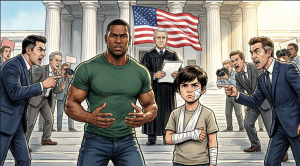
Marshall watched her hands. She didn’t rush. She documented everything with the careful precision of someone who had filled out these forms before.
While Cameron clenched his jaw as the wound was cleaned, Melody leaned toward Marshall and lowered her voice.
“You should know,” she said, “this is the fourth time I’ve seen a burn like that from Dunmore High in three years.”
Marshall stared at her.
“Fourth,” he repeated, the word tasting wrong.
Melody met his eyes. “I’m not telling you that to scare you,” she said. “I’m telling you because whatever you do next… you’re walking into something that’s been allowed.”
Marshall nodded once, the smallest movement.
Then he sat beside Cameron’s bed, held his son’s hand the way he’d held Lindsay’s, and looked at the burn until his mind stopped trying to deny it was real.
When Cameron finally whispered, “Dad, don’t do anything crazy,” Marshall squeezed his fingers, steady and warm.
“I’m right here,” he said. “That’s all you need to worry about.”
But in the space behind his eyes, the list of names stayed lit, like a map.
Part 2
The next morning, Marshall took a folder to Dunmore High.
Inside it were the ER photos Melody had printed, the intake notes, and a statement Cameron had written in his careful handwriting while the wound was being dressed: names, location, time, what was said, who held him down. No embellishment. No emotion. Just facts, like Cameron understood on some instinctive level that adults listened to paperwork more than pain.
The school office smelled like floor wax and old coffee. A secretary with bright nails and a practiced smile asked him to sign in.
“Appointment?” she chirped.
“With Principal Bentley,” Marshall said.
She glanced at his face, at the stillness in him, and her smile faltered a fraction. “He can see you in ten.”
Marshall sat in a plastic chair beside a bulletin board full of pep rally flyers and fundraiser reminders. A poster on the wall read: Dunmore High: Where Tradition Builds Character.
He stared at it until the words blurred into something uglier.
When the door finally opened, Principal Greg Bentley stood in the doorway like he was welcoming someone to a community barbecue. Sixty-one, soft around the middle, hair combed too neatly, smile attached like a mask he’d worn for decades.
“Mr. Rivera,” Bentley said, extending a hand.
Marshall didn’t take it.
Bentley’s smile flickered, then returned, polished. “Please, come in.”
Bentley’s office was decorated the way a man decorates when he wants people to trust him: framed awards, photos of him shaking hands with local officials, a small plaque that read Principal G. Bentley: Serving Our Community.
Marshall sat without being invited. He laid the folder on Bentley’s desk and opened it.
The photos did the talking.
Bentley’s eyes dropped to the burn, and for a moment his smile tightened, the corners pulling down before he caught himself. He sighed, as if burdened by other people’s mess.
“That’s… unfortunate,” Bentley said.
Marshall’s voice came out low. “It’s not unfortunate. It’s assault.”
Bentley leaned back in his chair, hands clasped over his stomach. “Now, I understand you’re upset,” he said, tone soothing. “As any parent would be.”
Marshall slid Cameron’s statement across the desk. “Five seniors,” he said. “These names.”
Bentley glanced at the paper and nodded slowly, like the names were familiar in an old, harmless way.
“Carl Keller,” Bentley said. “Stanley Harden. Doug Hutchinson. Jerry Cruz. Barry Ellis.” He exhaled. “These boys come from… involved families.”
Marshall stared at him. “So?”
Bentley lifted his eyebrows, almost apologetic. “Mr. Rivera, Dunmore is a small town. People have deep roots. And sometimes, in small towns, there are traditions.”
Marshall waited.
Bentley’s smile returned, softer now, like he was sharing wisdom. “Hazing has been part of senior culture here for decades,” he said. “A rite of passage. They don’t mean real harm.”
Marshall’s hands stayed flat on his knees. His posture didn’t change.
“My son has a third-degree burn,” he said. Each word was clean. “That’s real harm.”
Bentley’s expression tightened, then smoothed again. “We can issue detentions,” he offered. “Perhaps an apology. The boys can write an essay on respect. We can have a restorative circle.”
Marshall leaned forward slightly. “They held him down,” he said. “They heated a metal buckle until it glowed. They branded him.”
Bentley spread his hands, palms up. “I’m not defending it,” he said, and the lie sat in the air like smoke. “But I have spoken with the families. Carl Keller’s father is the board chair. Stanley Harden’s father sits on the facilities committee. The others are… deeply embedded.” He lowered his voice, as if sharing a secret. “My hands are tied.”
Marshall looked around the office again. The awards. The photos. The plaque. Proof of a man who had made peace with cowardice so long ago he forgot it had a name.
“Mine aren’t,” Marshall said quietly.
Bentley blinked. “Excuse me?”
“My hands,” Marshall repeated. “Aren’t tied.”
Bentley chuckled nervously, trying to regain control. “Mr. Rivera, please. I’m asking you to be reasonable. We don’t want to escalate this into… a bigger issue. Your son will heal. Kids move on.”
Marshall stood. He collected the photos and the statement with the same careful movements he used when packing gear.
Cameron’s burn was not a “bigger issue” to be avoided. It was already the biggest thing in their house, a wound that made Cameron turn slightly when he sat down, a scar-in-progress that made him flinch in the shower.
At the door, Marshall paused.
Bentley’s tone sharpened a fraction. “If you start making accusations, Mr. Rivera, you could damage reputations.”
Marshall turned his head just enough to look at Bentley.
“My son’s skin is damaged,” Marshall said. “Their reputations are not my concern.”
He left the office and walked down the hall past trophy cases filled with bright jerseys and smiling faces. Behind glass, the school celebrated itself.
In the parking lot, sunlight hit his eyes hard. He stood beside his truck for a moment, hand on the door handle, breathing evenly.
He thought of Lindsay in a hospital room, pale and tired, whispering, Take care of him.
He thought of Cameron on the ER bed, jaw clenched, trying to be brave.
He thought of Bentley saying tradition like it was holy.
Marshall drove home, made Cameron a late lunch, and watched his son eat with one arm held carefully away from his side.
Cameron glanced up and said, “Did he do anything?”
Marshall kept his voice steady. “No.”
Cameron’s fork paused. “Then… what now?”
Marshall looked at him. Saw the fear, not of the seniors, but of what adults might do when pushed. Saw the careful way Cameron had been raised by grief to expect disappointment.
“What now,” Marshall said, “is we make sure this never happens again.”
That night, after Cameron fell asleep, Marshall sat at the kitchen table with a notebook.
He wrote the five names again. Beneath each, he left space.
Then he wrote Greg Bentley.
Then he wrote Dunmore School Board.
In the Marines, you didn’t fix a problem by yelling at it. You fixed it by understanding it, mapping it, finding the points where pressure mattered.
Marshall had learned something else, too: people who rely on protection are fragile. They stand tall because they assume the ground beneath them will always hold.
Marshall didn’t reach for a weapon. That wasn’t the point.
The point was precision.
Over the next three evenings, he did what he did best.
Surveillance.
Not stalking, not threatening—just observing. Learning the rhythms the way you learn wind patterns. He parked on public streets and watched the school’s exits. He noted cars, license plates, who walked alone, who traveled in packs. He saw the five seniors in their natural habitat: loud, careless, certain the world belonged to them.
Carl Keller was the center. You could tell without being told. Others laughed a second after he laughed, moved when he moved.
Stanley Harden floated on inherited importance, head always tilted like he was judging the room.
Doug Hutchinson moved like a wrestler, shoulders squared, hands always ready.
Jerry Cruz performed ease—smiling, shaking hands, like he was already practicing to sell something.
Barry Ellis was speed and charm, always in motion, always surrounded.
Marshall wrote down their schedules. He didn’t need to guess.
Then he called a number he hadn’t used in years.
Nicholas Chon answered on the second ring.
“Rivera,” Nicholas said, voice sharp with surprise. “Thought you disappeared.”
“I came home,” Marshall said.
A pause. “That sounds like trouble.”
“My son was branded at school,” Marshall said. He heard the way his own voice stayed level, even when the words were not.
Nicholas exhaled slowly. “Names?”
Marshall gave them.
Nicholas didn’t ask why Marshall needed help. He didn’t ask how Marshall planned to respond. Men who’d done certain kinds of work together learned not to demand details that didn’t belong to them.
“I owe you,” Nicholas said finally. “Give me forty-eight hours.”
When Marshall hung up, he sat in the dark kitchen and listened to the house settle.
He wasn’t angry in the way people expected anger—no shouting, no smashed walls, no threats into the night.
He was something colder and clearer.
He was a man with a target list, and this time the targets were not across an ocean. They were in his own town, protected by handshakes and committee seats and the lazy belief that harm didn’t count if the right people did it.
Marshall went upstairs and stood in the doorway of Cameron’s room.
Cameron slept on his side, careful even in rest. A soft nightlight glowed on the dresser, something Lindsay had bought when Cameron was little and afraid of the dark. Marshall had never taken it away.
He watched his son breathe.
“Not again,” Marshall whispered, so quietly it might not have existed. “Not to you.”
Part 3
Nicholas delivered the file on a Thursday morning, encrypted and clean, the kind of package that didn’t leave fingerprints.
Marshall opened it in his truck before work, coffee cooling in the cup holder.
It wasn’t just the boys. It was the ecosystem.
Victor Keller, Carl’s father: school board chair, construction money, donors list as long as a sermon.
Raymond Harden, Stanley’s father: facilities committee, golf buddies with half the county’s decision-makers.
Philip Hutchinson, Doug’s father: contractor, union connections, the type of man people described as a “straight shooter” when they meant “gets away with things.”
Caesar Cruz, Jerry’s father: owned a used car dealership, sponsored the football team, always smiling in local newspaper photos.
Barry Ellis Sr.: managed a private investment firm out of Scranton, kept his name quiet but his influence loud.
Nicholas included more than resumes. There were small stories—an old DUI quietly reduced, a complaint about a coach dismissed, a settlement agreement with a teacher who’d “chosen to resign.” Patterns. Protection.
Marshall read it once, then closed the file and sat still.
A plan formed the way plans always formed for him—not as a rush of emotion, but as a structure.
He didn’t need to hit them. He didn’t need to frighten them with violence. Fear was cheap. It burned hot and fast, then disappeared.
Marshall wanted consequences that lasted.
He started with Carl Keller.
Carl drove like the world would move out of his way. Marshall followed his car on Elm Street one evening from a distance that looked accidental. He watched Carl roll through two stop signs and text with his phone held low, thumb flicking as he turned.
Marshall recorded it with a dash cam, capturing the street signs, the time, the plate.
Then he made two calls the next morning—one to the Dunmore PD traffic division, one to the state DMV complaint line—giving precise details: cross streets, timestamps, a description of the car. He didn’t mention the driver’s name. He didn’t have to.
A patrol car waited on Elm Street two days later. Carl got pulled over. License suspended. Court date set.
It was a small thing, but it was the kind of small thing that changed trajectories. Carl’s lacrosse scholarship application required a clean driving record. The flag went up the same afternoon.
Marshall didn’t celebrate. He simply drew a single line in his notebook beneath Carl’s name: first stone.
Stanley Harden came next, not because Stanley was worse, but because Stanley thought he was untouchable.
Nicholas had found convenience store footage from three months earlier: Stanley stealing two energy drinks on a dare, laughing as he shoved them under his hoodie. The store owner hadn’t pressed charges because he “knew the family.”
Marshall didn’t send it to police. Police were too easy to lean on. He sent it where consequences were quiet and personal.
Stanley had applied for a summer sports training program that required an attestation of conduct. Marshall routed an anonymous email to the program director, attaching the footage and the timestamped store record.
No threats. No commentary. Just evidence.
A week later, Stanley was removed from the program waitlist.
Stanley’s father made calls. He pulled strings. He demanded explanations. He received polite non-answers. There was nothing to argue with. No one to intimidate. Just a decision that had already been made.
Neighbors heard shouting from the Harden house that night, the kind of shouting that leaked through closed windows. Marshall heard about it from Nicholas like it was a weather report.
He felt nothing.
Doug Hutchinson was different. Doug’s power was physical, and his arrogance came from a body that solved problems by force.
Nicholas’ file mentioned rumors: a weekend fight ring behind a property on Route 6, underclassmen recruited, admission charged, bouts filmed. An illegal little enterprise hidden in the kind of place adults didn’t look.
Marshall went on a Saturday night. He wore a dark jacket and a baseball cap. He blended into the shadows like he’d done his whole life. Men running illegal events weren’t watching for fathers. They were watching for badges.
Marshall didn’t stay long. He didn’t need to. He filmed enough: Doug taking cash, Doug boasting, Doug shoving a smaller kid into position.
Then he sent the footage to the state athletic association and to the insurance carrier for Philip Hutchinson’s construction business, flagging potential liability: an unregistered event, on contested property, with a dependent listed on the policy involved.
Three days later, Doug was suspended from wrestling pending investigation.
Philip Hutchinson paid a lawyer to handle the insurance inquiry. It cost him four thousand dollars, and he hated every penny because it wasn’t about money. It was about control being challenged.
Jerry Cruz and Barry Ellis were last, because Marshall wanted to see their faces.
He found Jerry at the dealership on a Saturday afternoon, washing a display car alone. The lot glittered with polished paint and inflated prices. Jerry’s sleeves were rolled up. He looked like a kid playing at being a man.
Marshall parked, walked over, and stopped close enough that Jerry’s smile died before it could fully form.
Jerry’s eyes flicked to Marshall’s hands, as if expecting a weapon.
Marshall didn’t threaten him. He didn’t raise his voice.
He told the truth, in detail.
He described Cameron’s burn in the ER: the smell of damaged skin, the way Cameron’s body tensed when the nurse touched it, the wet shine of the wound. He described it with clinical precision, like a debrief after something worse.
Jerry’s face drained of color.
Marshall leaned in just slightly. “I want you to know,” he said, “that I know. And I want you to think about that every day.”
Then he walked away.
Jerry went home and told his father everything, not out of guilt, but out of fear. Caesar Cruz panicked, because men like Caesar didn’t care about pain until pain came with cost. He called Bentley. Bentley didn’t pick up. Caesar called Victor Keller. The families started talking.
Barry Ellis was harder to corner because Barry stayed surrounded.
So Marshall waited for Sunday.
Riverside Park was quiet early, dew on the grass, the river running slow. Barry ran his route with headphones in, pace steady, the kind of kid who thought fitness made him invincible.
Marshall jogged past him, then slowed until he matched Barry’s stride.
Barry glanced over. Recognition hit him like a slap. He’d seen Marshall once at school, a still man with a folder in his hands.
Marshall ran beside him in silence for a quarter mile, breathing easy.
Then he spoke without turning his head.
“I know what you did to my son.”
Marshall jogged ahead and vanished down the path.
Barry stopped running. He bent forward, hands on knees, then sat on a bench like his legs had forgotten how to function. He stared at the river for a long time, and the calm water didn’t help.
By the end of that week, the five boys’ lives started to unravel in ways they couldn’t explain to themselves.
Carl’s scholarship trouble sparked a fight with his father that escalated to grabbing and shoving, both of them ending up at urgent care with bruises and excuses.
Stanley’s anxiety spiked into a crisis. He ended up under observation after telling a friend he couldn’t breathe.
Doug tore his shoulder in an unsanctioned bout, desperate to prove he was still in control.
Jerry wrecked a car in a panic-driven attempt to outrun consequences that were invisible.
Barry’s blood pressure read high enough at a routine appointment that a doctor kept him overnight, concerned by stress indicators in a seventeen-year-old.
None of it was Marshall’s hand directly. All of it was his design.
And still, Cameron sat at the kitchen table, hunched over homework, burn bandaged under his shirt, pretending the world was normal because the alternative was too big to hold.
One night, Cameron looked up from his book and asked the question he’d been trying not to ask.
“Are you doing something?” he said quietly.
Marshall didn’t lie. He also didn’t give details Cameron didn’t need.
“Some things,” Marshall said.
Cameron’s throat moved as he swallowed. “Is it… legal?”
Marshall met his eyes. “I’m not hurting anyone,” he said. “I’m making sure people can’t pretend they didn’t hurt you.”
Cameron stared at the tabletop. “They’ll hate me more.”
Marshall’s voice softened, just a fraction. “They already chose who they are,” he said. “That’s not your burden.”
Cameron nodded slowly, but fear still lived in his posture.
Marshall realized then that consequences weren’t enough if Cameron still felt alone.
So the next morning, Marshall drove to the ER on purpose and asked for Melody North.
She stepped out during a break, surprised to see him.
“I need to know,” Marshall said, “about the other cases.”
Melody’s eyes sharpened. “Why?”
“Because this isn’t just my son,” Marshall said.
Melody looked down the hall, then back at him. “Meet me after my shift,” she said quietly. “Off hospital property.”
Marshall nodded once.
The system had protected itself for years.
Marshall was done respecting it.
Part 4
They met at a diner off the highway that smelled like grease and old comfort. Melody sat across from Marshall with a mug of tea and hands wrapped around it like warmth was a shield.
“I’m not supposed to talk about patients,” she said.
Marshall didn’t push. He waited.
Melody’s gaze flicked to the window, then back. “But I can talk about patterns,” she said.
She told him what she could without names. Three years, four branding burns. One kid had been branded on the shoulder. Another on the thigh. Each time, the story was the same: seniors, a buckle, laughter, a bathroom or locker room, adults who acted shocked and then did nothing.
“The kids don’t press,” Melody said. “Parents get leaned on. Or they get offered something. Money. A promise. A warning.” Her jaw tightened. “And the school keeps calling it tradition.”
Marshall listened, face unreadable.
“Why hasn’t anyone—” he started.
Melody laughed once, humorless. “Because Dunmore isn’t just a town,” she said. “It’s a web. People here don’t like outsiders tugging threads.”
Marshall thought of Bentley’s smile. Of his hands are tied.
“Someone has to,” Marshall said.
Melody studied him. “You’re not from here,” she said.
“I’m here now,” Marshall replied.
Two days later, the fathers made their move.
They didn’t come at Marshall with humility. They came with lawyers.
A sharp-suited attorney named Arnold Barker filed a joint civil suit alleging harassment, intimidation, tortious interference. The language was polished. The implication was clear: Marshall Rivera was a disturbed veteran targeting minors.
Reporters showed up outside the courthouse like the town had been hungry for a spectacle.
Raymond Harden spoke into microphones. “These families are being persecuted,” he said. “We’re dealing with a man who can’t control his impulses.”
Victor Keller stood beside him, jaw tight, eyes hard. Philip Hutchinson said nothing, which made him seem even more certain he didn’t need to.
Marshall didn’t speak to reporters. He drove home, made Cameron dinner, and watched his son’s face tighten when a news clip played on a neighbor’s TV through an open window: a headline calling Marshall a “former Marine under scrutiny.”
Cameron’s voice shook. “They’re blaming you.”
Marshall set the plate down gently. “They’re trying,” he said.
That night, Marshall met Karen Andrews.
She was small, sharp-eyed, and dressed like someone who didn’t waste money on anything that didn’t matter. She’d spent twelve years as a JAG officer before opening a private practice in Scranton.
She didn’t ask Marshall to “calm down.” She didn’t treat him like he was fragile.
She slid a legal pad toward him. “Tell me everything you did,” she said, “and everything you can prove.”
Marshall told her. It took two hours. He described dash cam footage, anonymous reports, the emails routed through servers Nicholas had set up, the fact that he’d never trespassed, never threatened, never touched anyone.
Karen listened without interrupting, pen moving.
When he finished, she looked up. “You didn’t break a single law,” she said.
Marshall nodded. “I came close.”
“Proximity isn’t contact,” Karen said, almost smiling. “It’s a good rule.”
The hearing landed before Judge Joan McKnight, a sixty-three-year-old with steel-gray hair and a reputation for hating theatrics.
Arnold Barker delivered his opening like he was performing. He used words like predatory and disturbed. He gestured toward Marshall’s service record like it was evidence of danger instead of discipline.
Karen didn’t react. Marshall didn’t react.
Judge McKnight listened, then opened the folder in front of her and read silently for a long moment.
Finally, she looked up at Barker. “Mr. Barker,” she said, “I’ve reviewed the respondent’s service record.”
Barker smiled like he’d been waiting for that. “Yes, Your Honor. We believe the respondent’s background—”
Judge McKnight raised a hand, stopping him. “Force Recon,” she said. “Two presidential unit citations.” She paused, eyes narrowing as she read another line. “And a psychological profile classified at a level I’m not reading aloud in this courtroom.”
The room went still.
Judge McKnight closed the folder. “Your clients,” she said evenly, “are suing this man for making anonymous complaints about traffic violations and for running alongside someone in a public park.”
Barker’s smile faltered.
Judge McKnight leaned forward slightly. “Are you sure,” she asked, “that you want to proceed?”
Silence stretched.
Victor Keller stared at the table like it had answers. Raymond Harden’s face twitched. Caesar Cruz whispered urgently to a second attorney who had shown up as backup.
Karen sat with her hands folded, calm as stone.
Marshall sat beside her, watching the room the way he’d watched empty fields for hours: attentive, unhurried.
Before lunch, Barker asked for a recess. After lunch, the suit was withdrawn.
Outside the courthouse, reporters tried to catch Marshall. He walked past them without a word.
But the fathers’ attempt had done one useful thing: it had brought attention.
And in that attention, cracks formed.
Three days after the hearing, the Pennsylvania Department of Education opened a formal investigation into Dunmore High following an anonymous complaint describing a pattern of covered-up abuse, corroborated by medical documentation.
Marshall didn’t ask Melody if she’d sent it. He didn’t ask Karen. He didn’t ask Nicholas.
He simply watched as the town’s protected machine started to grind against itself.
Greg Bentley was placed on administrative leave pending review.
The school board called an emergency meeting. Parents packed the auditorium. Some came angry on Cameron’s behalf. Others came angry that anyone dared question “tradition.”
Marshall sat in the back row with Cameron beside him.
Cameron’s burn was hidden under his shirt, but the weight of it sat on his body like a second spine.
A mother stood at the microphone and said, “Boys will be boys.” She said it like it was a prayer.
Another parent yelled, “That’s assault!” and the room erupted.
Victor Keller took the stage, attempting calm. “We’re investigating,” he said. “We’re addressing concerns.”
Marshall watched him and thought: men like that don’t address concerns. They bury them.
Then something unexpected happened.
A teacher stepped forward.
Ms. Rios, Cameron’s English teacher, a woman with tired eyes and ink-stained fingers, walked to the microphone.
Her voice shook, but she didn’t stop. “I’ve reported bullying at this school for years,” she said. “I’ve been told to handle it in-house. I’ve been told not to make waves.”
Gasps rippled.
Ms. Rios looked directly at the board. “A tradition of cruelty is not a tradition worth keeping,” she said.
For the first time, Cameron’s hand found Marshall’s under the seat, gripping tight.
Marshall squeezed back, steady.
After the meeting, people stared at them in the parking lot.
Some looked at Marshall like he was a hero. Others looked like they wanted him gone.
Cameron muttered, “They’re looking at me.”
Marshall glanced down at his son. “Let them,” he said. “You didn’t do anything wrong.”
Cameron’s voice cracked. “But it’s on me.”
Marshall stopped walking.
He turned Cameron gently by the shoulders so Cameron had to face him.
“No,” Marshall said, and the firmness in his tone left no room for argument. “It’s on them. And it’s on every adult who let it happen.”
Cameron blinked fast, fighting tears.
Marshall didn’t tell him to be strong. He didn’t tell him to toughen up.
He said the one thing Cameron needed.
“I’m not leaving,” Marshall said.
Cameron’s shoulders sagged like he’d been carrying a weight alone for too long.
At home that night, Cameron asked, “What if they apologize?”
Marshall didn’t answer right away.
He thought about the laughter. The buckle glowing. The principal calling it tradition.
“If they apologize,” Marshall said, “it won’t erase what they chose to do. And you don’t owe them forgiveness.”
Cameron nodded slowly, as if testing the idea like a new language.
Upstairs, after Cameron went to bed, Marshall stood at the kitchen counter and opened Nicholas’ file again.
There was a detail he hadn’t focused on before.
A note about Greg Bentley’s early career: former coach, decades in the district, known for “discipline,” rumored to have protected star athletes.
Marshall stared at the line until it sharpened into something more than a rumor.
He didn’t know exactly how deep the rot went yet.
But he could feel it.
And rot, once exposed, didn’t stop spreading just because people wished it would.
Part 5
The investigation moved with the slow, grinding pace of institutions that hated admitting they were wrong.
Greg Bentley’s administrative leave became “pending review,” which became “pending further review.” The board issued careful statements about student safety while privately calling lawyers. Victor Keller resigned “for personal reasons.” Raymond Harden followed two hours later, his resignation letter full of polite words that meant nothing.
The town split into camps.
There were the people who brought casseroles to Marshall’s house and whispered, “Thank you,” like they’d been waiting years for someone to do what they were too scared to do.
There were the people who crossed the street when Marshall walked by, faces tight, muttering about how he was ruining Dunmore’s name.
Cameron felt all of it.
He stopped eating lunch at school. He started spending study hall in the library, sitting between shelves like books could build walls. Ms. Rios quietly arranged for him to have an alternate bathroom pass so he didn’t have to go near the gym.
Marshall drove Cameron to therapy twice a week in Scranton, because trauma didn’t vanish because adults finally cared.
Cameron sat in the therapist’s office and stared at the carpet at first. Then, slowly, he started talking—not about the buckle, not directly, but about the feeling of being held down, about the sound of laughter, about the way he had felt like his body wasn’t his anymore.
Marshall waited in the car in the parking lot and gripped the steering wheel until his hands ached, forcing himself to stay still because the hardest thing he’d ever done wasn’t combat.
It was being powerless in the face of his son’s pain.
The five seniors were pulled from extracurriculars pending investigation. Their parents fought it, threatened lawsuits, demanded “due process.” The district offered a settlement to Marshall—money, quiet, an agreement to withdraw complaints.
Karen Andrews brought the offer to Marshall’s kitchen table and slid it across like it smelled bad.
“They want to buy silence,” Karen said.
Marshall didn’t touch the paper. “No,” he said.
Karen nodded once. “That’s what I hoped you’d say,” she replied.
Cameron, sitting at the table with a glass of water, asked softly, “How much is it?”
Karen told him.
Cameron’s eyes widened, then narrowed. “That’s… a lot.”
Marshall looked at his son. “It’s not worth it,” he said.
Cameron’s voice shook. “What if it helps us leave?”
Marshall paused.
Leaving had crossed his mind more than once. A different town. A different school. A place where Cameron wasn’t a headline.
But then Marshall thought of Melody saying fourth case. Of Ms. Rios finally speaking. Of all the kids who would come after Cameron.
“We can leave later,” Marshall said. “But not because they paid us off.”
Cameron stared at the water in his glass, then nodded slowly. “Okay,” he whispered, like he was choosing something hard.
Weeks passed. The burn healed into a raised scar, pale and angry at the edges. Cameron stopped wearing tight shirts. He learned how to angle his body without thinking. The scar became a new fact of his life, and facts were what Cameron understood best.
One afternoon in December, as snow started to dust the sidewalks, Cameron came home and said, “Carl Keller tried to talk to me.”
Marshall’s body went still. “What happened?”
Cameron set his backpack down. “He cornered me near the library,” he said. “He said… he said it got out of hand. He said he was sorry.”
Marshall watched Cameron’s face carefully. “And you?”
Cameron swallowed. “I told him to go away.”
A beat passed.
“He said he’d ‘make it right,’” Cameron added. “Like he’s doing me a favor.”
Marshall felt a cold, familiar focus settle. “You did the right thing,” he said.
Cameron’s shoulders loosened a fraction, relief flickering. “I didn’t know what else to do,” he admitted. “Part of me wanted to scream. Part of me wanted to… just pretend it never happened.”
Marshall stepped closer. “You don’t have to pretend,” he said. “And you don’t have to accept their version of ‘right.’”
Later that week, the district announced a disciplinary outcome: the five seniors would be transferred to an alternative program for the remainder of the year. No graduation ceremony with their class. No senior trip. No athletics. No public celebration.
Their families raged.
Victor Keller called it “an attack on our community.” Raymond Harden went on local radio blaming “outsider influence.” Caesar Cruz tried to act conciliatory, but his eyes stayed sharp with calculation.
Then the criminal side finally cracked open.
Not because the school wanted it—because someone filed a police report with documentation that couldn’t be ignored.
Melody didn’t say it was her. She didn’t have to. The evidence spoke louder than names.
Detectives interviewed Cameron. Karen sat beside him. Marshall sat behind him. Cameron’s voice shook at first, then steadied as he read from his written statement. Facts again. Clear. Unbreakable.
The five seniors were charged as juveniles, but charged. Assault. Unlawful restraint. Aggravated harassment.
It wasn’t the kind of justice that erased scars, but it was the kind that put truth into official record where it couldn’t be laughed away.
In January, the Department of Education investigators requested access to Bentleys’ office files.
And then the town got quiet in a way that wasn’t peace.
It was the quiet of people sensing something worse was coming.
Marshall got a call from Karen one evening. Her voice was different, sharpened.
“They executed a warrant,” she said.
“On Bentley?” Marshall asked.
“Yes,” Karen replied. “And Marshall… they found something.”
Marshall didn’t speak. His grip tightened around the phone.
Karen exhaled. “A locked cabinet behind a false panel,” she said. “Inside it… a box.”
“A box of what?”
Karen hesitated, then said it anyway.
“Belt buckles,” she said. “Dozens. Some labeled with years. Some with names. And photographs.”
Marshall felt a flash of nausea, hot and quick.
Karen’s voice was flat with anger now. “Bentley wasn’t just tolerating a tradition,” she said. “He was keeping trophies.”
Marshall stared at the wall, seeing suddenly how deep “tradition” could go when a man with authority fed it.
“Does Cameron—” Marshall started.
“Not yet,” Karen said, anticipating him. “And we can keep it that way until you decide how to tell him.”
Marshall swallowed, throat tight. “What happens now?”
Karen’s voice hardened. “Now,” she said, “it stops being a school issue.”
That night, Marshall sat at the kitchen table long after Cameron went to bed, staring at nothing.
He’d been angry at Bentley’s cowardice.
Now he understood it hadn’t been cowardice.
It had been complicity.
And the “hands are tied” line wasn’t about helplessness.
It was about protection.
Protection of himself.
Marshall looked at the notebook where he’d written names.
He drew a heavy line beneath Greg Bentley.
Then he wrote one more word, slow and deliberate:
Origin.
If Bentley had been the source, then what happened to Cameron wasn’t just a cruel prank.
It was a system—maintained, encouraged, and hidden—built on kids’ pain.
Marshall didn’t sleep much that night.
And when morning came, he made Cameron breakfast like always, because routines were what kept a house from collapsing.
Cameron ate quietly, then looked up and asked, “Are we… winning?”
Marshall held his son’s gaze.
“We’re getting the truth on record,” he said. “That’s the only way anything changes.”
Cameron nodded, then said something small but heavy.
“I don’t want them to ever touch anyone else,” he whispered.
Marshall reached across the table and squeezed his son’s hand.
“Neither do I,” he said.