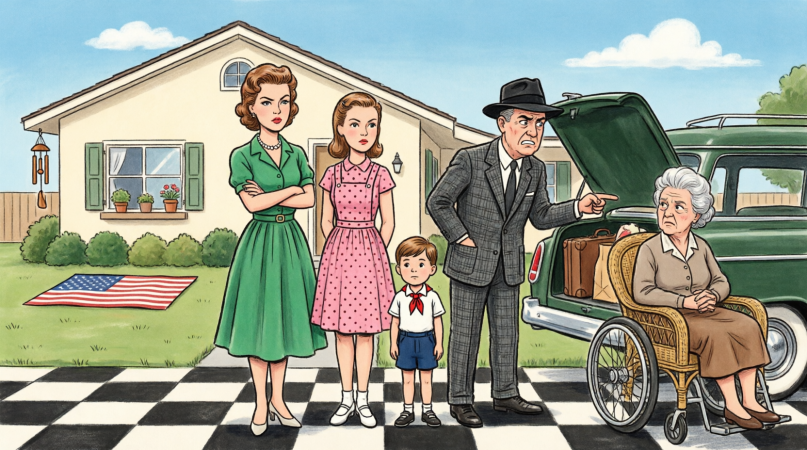
“This is ridiculous,” Ashley snapped. “Helen, whatever games you’re playing need to stop right now. Michael was trying to help you.”
“I’m saying that I think you should have thought about the consequences before you decided to have your disabled mother declared mentally incompetent so you could access her bank accounts.”
Both Michael and Ashley stared at me in shock. “That’s not what this was about,” Michael said weakly. “It was about protecting you from making bad financial decisions. You’re vulnerable, Mom. People could take advantage of you.”
“You’re right, Michael. People could definitely take advantage of a disabled elderly woman. It’s good that your father planned ahead for that possibility.”
“What do you mean?”
“I mean that my husband was a very intelligent man who understood exactly what kind of person our son really is.”
I closed the door on their stunned faces and left them standing on my porch.
The next morning brought the most satisfying phone call of my life. Victoria sounded delighted. “Mrs. Carter, First National Bank moved to foreclose on Michael’s mortgage at eight this morning. The total amount due is approximately eight hundred seventy thousand. Michael doesn’t have it. He can’t possibly raise it in two weeks. Your son’s legal case just collapsed completely.”
My doorbell rang at 10:30. This time, only Michael stood on my porch, looking like he’d aged ten years overnight. “Mom, please, can we talk? I’m losing everything. My house, my business, everything I’ve worked for.”
“That must be terrifying.”
I wheeled myself to Robert’s office and returned with one of his financial statements. Michael’s eyes widened when he saw the Pinnacle Private Banking letterhead. “Your father left me forty-seven million, Michael. Forty-seven million. He spent twenty-two years building a fortune while I worried about grocery bills. And he did it all to protect me from ending up dependent on people who might not have my best interests at heart.”
I pulled out more statements. “He also left me control of a medical foundation, restaurant chains, and various business partnerships worth millions more.”
Michael stared. “Forty-seven million? That’s impossible. If I’d known—”
“If you’d known, you would have been nice to me. You would have let me stay in your guest room. You would have treated me like family instead of a burden.”
“Mom, I’m sorry. I know I handled this wrong. But please, you have to help me. I’m going to lose everything.”
I looked at my son and felt absolutely nothing. No anger, no sadness, no maternal instinct to protect him. Just calm recognition of who he really was.
“Michael, your father spent three years setting up this situation. Every debt guarantee, every loan term, every financial arrangement was designed to give you a choice: treat me with respect and keep what you have, or come after me legally and lose everything. All you needed to do was be a decent son to your mother. That was the only requirement.”
Michael was crying now. “I’ll do anything. I’ll take care of you. I’ll move you into our house. I’ll be the son you deserve. Just help me fix this.”
“Do you know what I’m going to do with your father’s money? I’m going to expand the medical foundation. I’m going to open more restaurants that serve affordable food to working families. I’m going to help people who are struggling the way I was struggling—people whose families have abandoned them the way you abandoned me.”
“But what about me? I’m your son. I’m your family.”
I wheeled myself closer and looked directly into his eyes. “Michael, yesterday I was your family when I needed help. But today, when you need help, I’ve learned something important from your example.”
“What’s that?”
“Family is complicated.”
Six months later, I sat in my new office at the Carter Foundation, reviewing grant applications and planning expansion. The foundation now provided emergency assistance to families in crisis, funded free medical care for seniors, and operated three transitional housing facilities for elderly people who’d been abandoned by their families.
My phone buzzed with a text from Michael: “Mom, Ashley left me. I’m living in a studio apartment and working two jobs to pay minimum payments on my debts. I know I made mistakes, but I’m your son. Please call me back.”
I deleted the message without reading it completely, just like I’d deleted all the others. Because the truth was, I’d learned something profound about the difference between being someone’s mother and being their family. Being someone’s mother was an accident of biology. Being their family required love, respect, and mutual care.
Michael had been my son for thirty-eight years, but he’d never really been my family.
And now, surrounded by people who helped seniors who’d been discarded by their relatives, I’d finally found the family I deserved—the family Robert had spent three years planning for me to find.
Robert always said I was stronger than I knew. It just took losing everything to discover he was right.
“$450K Lakehouse Stolen. Fraud Exposed.”
Part 2 of 2