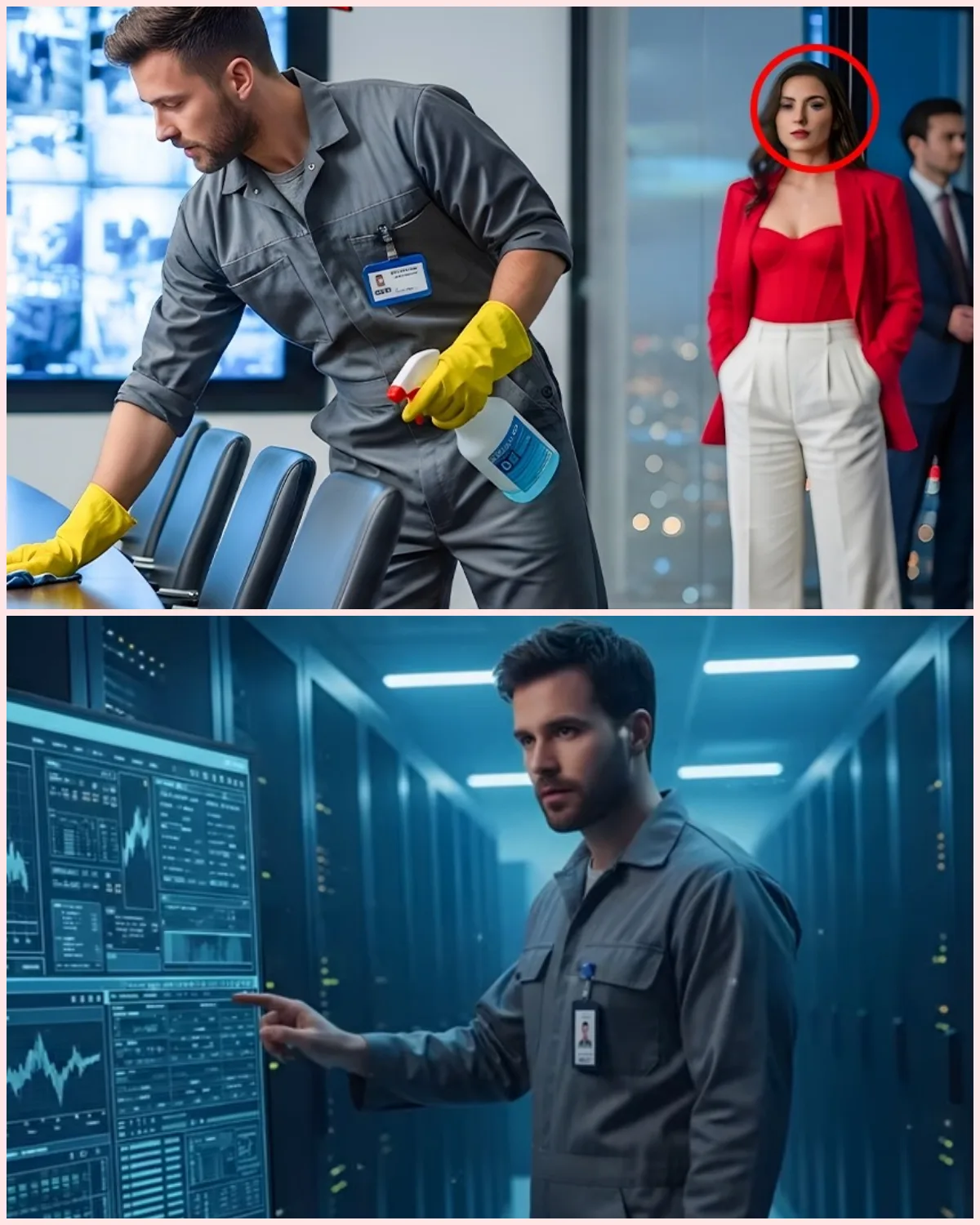
Nobody on the 47th floor paid any attention to the man mopping the hallway that night. The building had entered that strange late-hour silence that only exists in places built for urgency. Offices that had spent the day humming with meetings, alerts, deadlines, and low-level competition now sat under dimmed lights and the constant, distant breath of climate control. Beyond the glass walls of Arden Systems, downtown Seattle had already begun emptying into the cold of a mid-November night. The parking garage was half vacant. The elevators were quieter. The people who still remained in the tower belonged to the kinds of jobs that stayed invisible even inside a company built on innovation.
The man in gray coveralls pushed his cart along the corridor with practiced efficiency, pausing where he always paused, wiping what had to be wiped, emptying what had to be emptied, moving through the building with the peculiar social condition of someone everybody saw and nobody really noticed. His name was Elias Carter, and at 38, he had become the kind of person executives stepped around on their way to refill a coffee cup.
That night, however, something in the building noticed him.
As he passed the server room on 47, Elias heard a sound that made him stop. It was not loud. It was not even, to anyone without the right ear, alarming. The cooling fans inside were cycling in an irregular rhythm, not failing exactly, but hesitating. Recovering. Hesitating again. Mechanical systems had a way of communicating distress before they broke, and to Elias the pattern was as legible as speech. He stood at the slightly open door and looked through the gap.
On the far wall, a status board glowed in its grid of green and amber lights. In the lower left quadrant, a cluster of red indicators flashed with stubborn persistence.
Elias did not move for several seconds. He was holding the mop loosely in one hand, the shaft resting against his shoulder, and his face remained unreadable. But something in him had already sharpened. He recognized the shape of the problem. Not the exact system. Not the software or architecture or proprietary logic Arden had built. But the structure of the failure. It had the outline of a hardware fault and the feel of a logic error. He had seen versions of that lie before, systems that seemed to be breaking in one place because everyone was too busy looking there to notice the real fracture one layer below.
After a moment, he pulled the door back to where it had been, adjusted his grip on the mop, and continued down the hall.
He did not belong to the people authorized to solve whatever was happening in that room. At least, not anymore.
Years earlier, in Spokane, he had been the sort of boy who took apart household appliances because curiosity arrived in him as a form of restlessness. When he was 10, the family microwave had started making a grinding sound in the turntable motor. Other children might have ignored it until it failed. Elias had taken off the outer casing and spread the parts across the kitchen table, not out of mischief, but because the hidden logic of machines offended him when it remained hidden. His mother had called it a gift. His 7th-grade shop teacher had called it a vocation.
By the time Elias completed his degree in electrical engineering at the University of Washington, there were more professional words available for what he could do. Talent was one of them, though it never seemed adequate. He was not flashy, not theatrical, not one of those engineers who built their confidence out loud. His strength was quieter. Structural. He could look at a complicated system and feel where it was betraying its own design. He could read interactions between components the way some people read weather.
For 9 years he worked at Vantex Technologies, a mid-sized automation firm whose contracts stretched across industrial sites throughout the Pacific Northwest. He rose to lead systems engineer. He designed energy routing logic for complex facilities. He wrote documentation other engineers saved, reused, and quietly trusted. His work had the clean steadiness of competence that does not need admiration to function. He was good at what he did in the same unconscious way some people are good at balance or rhythm. He solved problems because he could see them clearly.
During those same years, he had also been a husband.
Rachel Carter had been a landscape architect with an expansive laugh and a habit of leaving trail maps on the kitchen counter as if wilderness were something one should always be prepared to enter at short notice. She made rooms feel larger. She filled silence without fear. She died when their daughter, Lily, was 3 years old, taken by an illness that moved too fast to allow the mind enough time to reorganize itself around reality.
After that, Elias’s life narrowed with brutal efficiency. There was no dramatic declaration, no single moment when he decided to become smaller. It simply happened. Grief compressed the world. Responsibility compressed it further. By the time Lily was 7, his life had been reduced to its most essential structure: stay employed, stay upright, keep the apartment, make dinner, answer questions, keep going.
Lily had Rachel’s eyes and Elias’s habit of looking at things as if they were puzzles worth understanding. She was observant in the way children sometimes are when life has taught them to monitor the adults around them. On drives back from after-school care, she would sit in the backseat and say things in a plain, matter-of-fact voice that landed more heavily than most adult reassurances.
“Dad, I think you’re smarter than most people,” she had once said, not offering comfort, only identifying what she believed to be obviously true.
She believed in him with the absolute confidence children reserve for forces they think are permanent.
Elias never corrected her. He also never explained the last 2 years.
What happened at Vantex had not been his fault. That fact had not protected him. A senior vice president named Garrett Moss had forced through a cost-cutting modification to a control system Elias had designed. Elias objected to the modification in writing, twice, because he knew the change would compromise system stability under stress. When the altered system failed during a client demonstration, Moss moved with the instinctive speed of a man more committed to preserving rank than truth. Reports were revised. Timelines shifted. Internal documentation no longer reflected the actual sequence of events.
By the time the investigation ended, Elias Carter’s professional record carried a misconduct notation that read, to prospective employers, like a warning label. No one ever said so directly. They simply cooled. Calls that began warmly ended without follow-up. Interviews evaporated after reference checks. Recruiters who once seemed eager stopped replying.
For 14 months, he applied anyway. Then he kept applying. He spent Rachel’s life insurance savings more slowly than panic wanted and faster than caution allowed. He moved with Lily from a 2-bedroom apartment in Capitol Hill to a smaller place in a quieter Seattle neighborhood where the rent was lower and nobody asked too many questions. He watched the household contract around necessity. He sold furniture. He sold his last suit. He learned how many kinds of humiliation could arrive politely.
The night cleaning job at Arden Systems had not been a career pivot. It had been survival.
He found the posting on a Tuesday afternoon when Lily’s shoes had become unmistakably too small and the power bill had arrived in an orange envelope that made even unopened mail look accusatory. He applied online. A hiring coordinator called that same day. By the following Monday, he was pushing a cart through 14 floors of one of Seattle’s most admired technology companies. Nobody at Arden had run an engineering background check. Why would they? He had not been hired to solve problems that mattered. He had been hired to make sure no one noticed the ones that didn’t.
Arden Systems occupied the top floors of a glass tower on Third Avenue, and from the outside it looked like exactly what the city liked to imagine its future would resemble. Polished, vertical, expensive, inevitable. Inside, the company was developing that future with a degree of ambition that had already attracted attention far beyond Seattle. Its flagship platform, Atlas, was an artificial intelligence system designed to manage thermal and load allocation across large commercial and municipal infrastructure. It was the kind of product that could transform how buildings, grids, and public systems used energy. Contracts already signed were worth more than 300 million dollars. Contracts still pending depended on one thing: a live demonstration scheduled 6 weeks away.
Every engineer working on Atlas knew what that deadline meant. By the time Elias first noticed the problem, most of them had stopped measuring their days in anything as neat as shifts. They slept in corners. They ate from takeout containers on conference room tables. They drew elaborate fault trees across whiteboards and then added to them until the diagrams stopped clarifying anything and became visual records of collective exhaustion.
The issue had emerged as what the team called a logic loop in the primary energy distribution module. Atlas’s load-balancing algorithm would trigger a safety check. The safety check would interrupt the load-balancing cycle. That interruption would retrigger the same safety condition, which would trigger the interruption again, and so on, until the system entered a recursive pattern that devoured stability instead of preserving it. Sleep-deprived engineers had begun referring to it in shorthand as the loop that ate itself.
Marcus Webb, Arden’s CTO, had brought in two consultants from a West Coast firm to review the code. After 18 hours, they recommended a full rollback to the previous stable build, a process that would take 3 weeks and almost certainly destroy the demonstration timeline. Marcus rejected the recommendation and sent them away. He was not ready to bring that outcome to Victoria Hale.
Very few people at Arden were ever eager to deliver bad news to Victoria Hale. She had founded the company 11 years earlier out of a shared workspace in Belltown with $22,000 in savings and a business plan she had revised 47 times before deciding revision was no longer useful and execution had to begin. At 42, she had the kind of presence that made some people feel steadied and others feel exposed. She was sharp-featured, deliberate, and economical in movement and speech. She wore no jewelry except a thin white-gold watch. In high-pressure moments she became even quieter, which had the unnerving effect of making everyone around her aware that she was already several steps ahead in processing consequences.
She built Arden on a simple principle: ability is real and everything else is noise.
She did not know Elias Carter existed.
On Friday night at 11:47, Elias returned to the server room. He had finished the small kitchen off the engineering bay, the conference rooms, the restrooms, and most of the hallways. The building had settled further into midnight stillness. The server room door was closed now. His janitorial badge hung from a lanyard around his neck. He pressed it to the reader, heard the latch release, and entered.
The room smelled of warm plastic, heated circuitry, and effort nearing failure. The status board looked worse than it had the night before. The red cluster had widened. Cooling fans worked harder than they should have needed to, their uneven rhythm creating a mechanical stutter under the steady fluorescent light.
Elias left his cart outside, wedged the door open with a rubber stop, and crossed to a secondary workstation in the corner. It was logged into a monitoring console, not the primary development environment. He sat down and started reading.
He did not rush. His hands remained still except when they needed to move. He worked the way he always had, not by forcing early conclusions but by following evidence laterally until the shape of the system revealed itself. Error timestamps suggested one story. Resource allocation records suggested another. The divergence between them was small enough to miss, almost designed to be overlooked by people already committed to the wrong hypothesis.
That was the thing about complex failures. Once a team agreed on the likely location of a fault, every subsequent act of analysis tended to reinforce that assumption. Elias had spent too many years watching talented people dig deeper into the wrong layer because the wrong layer was where everyone else was already standing.
The problem was not in the primary load-balancing module.
That was where the Atlas team had been staring for 72 hours, and that was why no one had found the real break. The fault lived in a secondary optimization routine introduced 6 months earlier, a performance patch meant to reduce response latency. The patch itself had been clean. Under normal operating conditions, it worked exactly as intended. Under high load, however, it entered into a timing conflict with the safety-check interval in the primary module. Two processes that should have coordinated were colliding at precisely the moment the system needed them to synchronize.
The loop was not consuming itself. It was being fed.
The realization settled over Elias with a strange calm. The solution, at least the immediate one, appeared almost as quickly as the diagnosis. He did not have administrator credentials and he knew better than to touch the production codebase. What he could access, however, was the diagnostics interface. That was enough.
He wrote a temporary routing instruction, a manual override that redirected the optimization routine’s timing call through a buffer sequence. It would not fix the architecture. It would not remove the underlying conflict. But it would prevent the two routines from stepping on each other long enough to stabilize the system.
It was not surgery. It was a splint.
He typed for 4 minutes, tested the instruction twice, then executed it.
The status board changed almost immediately. The red indicators contracted. Amber shifted to green. One segment at a time, the lower-left quadrant steadied until the entire panel was clear. The cooling fans settled into a smooth, even hum, the kind of sound server rooms were supposed to make when nothing was in danger.
Elias stayed seated for a moment longer, listening to the restored rhythm of the machines.
Then he stood, pushed in the chair, removed the rubber wedge from the door, and stepped back into the hallway. He collected his cart and continued to the 46th floor.
Above the server room door, the security camera recorded everything without judgment.
By morning, Victoria Hale would watch that footage 3 times in a row and ask a question no one on her executive team was prepared to answer.
Who is the cleaning guy?
Victoria Hale arrived at Arden Systems at 6:15 on Saturday morning, as she did every Saturday, and found Marcus Webb waiting outside her office with the expression of a man confronted by evidence his existing framework could not hold. The overnight monitoring report showed that the Atlas loop had resolved at 11:51 the previous night. No engineering staff had been logged in after 11. No authorized remote access had entered the main development environment. Yet the system was stable. More than stable, in fact. It was behaving more cleanly than it had at any point during the previous 72 hours.
Marcus did not try to decorate the situation with speculation.
“I have no explanation,” he told her.
Victoria looked at him for a moment, then said, “Get me the camera footage.”
She watched it alone with her office door closed. The first time through, she observed. The second time, she studied. The third time, she confirmed what she already suspected. The man in gray coveralls did not move like someone improvising. He did not hesitate like someone trespassing into a world above his understanding. He sat at the diagnostic terminal with the economy of a person who knew exactly what he was looking for, exactly what he had found, and exactly how much intervention was required. There was no flourish, no panic, no visible uncertainty. Then the board turned green.
Victoria pressed the intercom.
“Find the person in this footage,” she said. “Do it this morning.”
Within 40 minutes, the facilities manager had produced a name, employee number, and home address. By 9:00, a message had been left on Elias Carter’s phone instructing him to report to Arden on Monday morning, not for his usual cleaning shift, but for a meeting with the executive team.
He arrived wearing the same gray coveralls he wore every night. He had nothing else that would pass for executive-appropriate clothing. The suit he once owned had been sold 18 months earlier, one more practical sacrifice in a period of life that had reduced sentiment to a luxury.
Victoria’s office occupied a corner of the 48th floor with glass on 2 sides and a view over Elliott Bay that, on clear days, reached all the way to the Olympic Mountains. When Elias was shown in, Victoria was standing beside her desk. Marcus Webb sat to her right. Two engineers he did not recognize stood at the back of the room. No one smiled. No one invited him to sit.
Victoria examined him with the same unsentimental focus she likely brought to budget anomalies and engineering diagrams.
“Who authorized your access to that terminal?” she asked.
“Nobody,” Elias said. “My badge opens the server room for cleaning. The terminal wasn’t locked. I used what was available.”
Marcus leaned forward slightly. “You modified a live production-environment monitoring configuration on a system with $300 million in active contracts.”
“I wrote a routing buffer to the secondary optimization module through the diagnostics interface,” Elias said evenly. “I didn’t touch the production codebase. What I did was equivalent to manually adjusting a valve while the pipe is leaking. You still need to replace the pipe, but now you have time to do it without flooding the floor.”
Silence settled over the room.
Marcus looked ready to respond, but Victoria raised one finger without turning toward him. He stopped.
Something in her attention had shifted. She was still guarded, still analytical, but no longer skeptical in the easy way powerful people often are when faced with someone outside expected categories. What she had in front of her was data that contradicted the organizational story. Victoria Hale did not dismiss contradictions. She investigated them.
“You’re going to explain exactly what you did,” she said, “and why.”
She turned toward the whiteboard and handed him a marker.
For a fraction of a second, Elias stood still. It had been 2 years since he had been asked to explain anything technical to people whose opinions mattered. He had not stood before a whiteboard full of engineers since Vantex. Yet when he took the marker, his hand was steadier than he expected.
He began with the architecture of Atlas as best he could reconstruct it from the logs and monitoring data. He drew the primary load-balancing module. He mapped the secondary optimization patch and its integration point. He marked the safety-check interval. He identified the millisecond window in which the routines collided under peak-load conditions. His diagrams were clean and precise, the product of long habit. There was no fumbling search for terminology, no need to circle back and clarify the fundamentals.
The room stayed quiet.
He sketched the buffer sequence he had inserted and explained why it was structurally sound as a temporary stabilization method. Then he circled the critical point of failure in red and wrote, in block letters, This is where the actual fix lives.
When he stepped back, one of the engineers at the rear of the room, a woman in her late 30s named Sandra Okafor, was staring at the board with the kind of expression professionals wear when they recognize both a mistake and the elegance of the thing they missed.
“He’s right,” she said softly.
No one responded.
Sandra kept looking at the board. “The timing conflict is in the secondary routine. We didn’t check that layer because the patch was performance only. We assumed it was clean.” She paused, then repeated, “He’s right.”
Victoria’s gaze returned to Elias.
“Where did you learn to do this?”
“Vantex Technologies,” he said. “I was lead systems engineer for 9 years. I designed energy-routing automation for industrial facilities. Wrote the base documentation for their fault-tolerance protocol.”
Marcus spoke carefully, as though stepping onto unstable ground. “Vantex filed a misconduct notation against you.”
“Yes.”
“And you’re mopping floors.”
“Yes.”
Morning light behind Victoria made her face harder to read, but her voice had changed when she spoke again.
“I want to understand the Vantex incident,” she said.
“So do I,” Elias replied. “I have for 2 years.”
It was not a comfortable conversation. Comfort had no use in it. Elias laid out the timeline: the original system design, Garrett Moss’s cost-cutting modification, the written objections he had submitted, the cascade failure during the client demonstration, the altered internal reports, the investigation. He spoke without bitterness because bitterness did not improve causal clarity. He described events in the order they happened and the relationships that linked them. It was the way he had reviewed them privately over and over, as though enough precision might someday force the world to behave honestly.
When he finished, Victoria did not offer sympathy. Sympathy was too vague to be useful. Instead, she asked, “Do you have copies of the objection memos?”
“Yes,” he said. “On a personal drive at home.”
She turned to Marcus, then back to Elias. It took her only a few seconds to decide what many people in her position would have spent days pretending to weigh.
Victoria Hale did not mistake delay for prudence.
The real test came the following Wednesday.
By then, the story had spread through the Atlas group the way stories spread in technical teams when the facts are too strange to stay contained. Not formally. Not through announcements. Through that electric, low-level charge of people quietly comparing versions of the same impossible thing. The cleaning guy had stabilized the loop. The cleaning guy had diagrammed the fault. Sandra Okafor had said he was right.
Victoria assembled the entire Atlas team in the main development lab on 47: 14 engineers, 2 project managers, Marcus Webb, and Elias Carter in gray coveralls standing at the front without introduction. She did not waste time with framing language.
“Atlas has a permanent fix available,” she said. “Before I reassign team resources to implement it, I want to see it done in a live environment. You have the floor.”
Everyone in the room understood immediately that this was not symbolic. It was not an executive gesture designed to flatter an unusual employee. It was a consequential, unscripted test. The production system was live. The demonstration deadline was 6 weeks away. If Elias failed, no one would remember the novelty of the attempt. They would remember only the risk.
He stood at the primary workstation and looked at the screen for a long moment.
He thought about Lily.
Three nights earlier, while tucking her into bed, she had asked, “Dad, do you think your new job will get better?”
He had paused before answering because children listened carefully for the difference between hope and evidence.
“I think it might,” he told her.
She accepted that with the grave nod of someone recording a provisional but meaningful update.
Now, in front of a room full of engineers, Elias opened the Atlas codebase. His temporary stabilization had held, but the system was still being run at artificially reduced load to avoid triggering the underlying fault. That was not remotely acceptable for a platform meant to demonstrate full-performance reliability to municipal clients in just over a month.
He began where the architecture required him to begin: the optimization patch. He placed it side-by-side with the primary module and traced the timing-state communications forward from their integration point. He did not perform confidence. He simply worked. In 7 minutes he found the failure chain, nested 3 levels deep inside a conditional loop that activated only under peak-load simulation.
The permanent solution was not dramatic. Real solutions rarely are. The routine did not need to be rewritten. The system needed a synchronization checkpoint at the integration boundary, a brief, disciplined confirmation of readiness that would let the optimization routine and primary load-balancing module proceed without corrupting each other’s timing states.
It was a 10-line change.
He wrote it cleanly. He documented each line as he went because that was how he had always worked, because future clarity mattered, because systems should remain legible even after the person who fixed them steps away.
Then he ran the analysis.
40% load. Stable.
60% load. Stable.
80% load. Stable.
Full load.
The room went very quiet.
Atlas ran not just without failure, but better than it had run in months. The conflict that had been causing the logic loop had also been creating a small but measurable inefficiency under normal conditions. Once Elias’s checkpoint was in place, system response latency dropped by 11%.
He removed his hands from the keyboard and stepped back.
For several seconds, no one said anything.
Sandra spoke first. “11% latency reduction,” she said quietly. “That’s going to show in the demo metrics.”
Marcus Webb stared at the performance readout with the expression of a man being forced, in real time, to abandon a position data could no longer sustain. He had wanted Elias removed from the building on Monday. Marcus was not naturally apologetic, but he was capable of recognizing undeniable evidence when it stood in front of him.
Victoria had not moved during the demonstration. Now she walked to the monitor, examined the readout, and let the silence extend just long enough for everyone in the room to understand what had happened.
Then she turned to Elias.
“Come to my office,” she said.
The offer was already on her desk when they sat down.
Victoria believed that once a conclusion had been reached, delay only introduced noise. The document in front of Elias described a position in the Atlas division: Senior Systems Architect. The compensation was 11 times what he earned on the cleaning crew. Full benefits. Equity participation. Direct reporting line to Victoria’s office.
He read the offer twice, then set it down.
“I want the Vantex record reviewed,” he said. “I want the misconduct notation challenged.”
Victoria did not look surprised. She had anticipated the request. She had spent part of the previous evening reviewing Washington State employment law and the protocols surrounding professional misconduct notations in the engineering field.
“I have a legal team,” she said. “If your documentation supports the timeline you described, we can initiate a formal challenge. It will take months. It may not be clean.”
“I know,” Elias said. “I’ve been waiting 2 years for someone to look at the documents. That’s all I’m asking.”
She studied him.
“You could take the offer and pursue the Vantex matter privately.”
“I could. But I need to know the 2 things aren’t separate. I’m not asking you to fix it. I’m asking you to look at it. To acknowledge it’s worth looking at.”