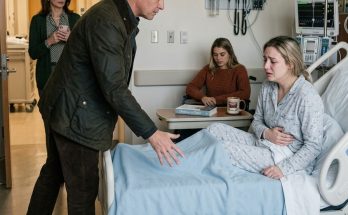
My name is Margaret Hayes, and by the time my daughter Claire pushed my wheelchair into the urgent care clinic, the bruise around my eye had already darkened into a deep, ugly purple. Another throbbed beneath my ribs, hidden under my blouse. Around my wrist, faint yellow marks lingered—finger-shaped, from two nights ago.
Claire stood beside me, polished and perfect in a tailored coat, her hand resting lightly on my shoulder like she was the picture of devotion.
The doctor glanced between my face and the chart.
“Mrs. Hayes… can you tell me what happened?”
Before I could speak, Claire smiled apologetically.
“She loses her balance a lot. I keep telling her not to move around the house without help.”
I lowered my gaze.
Silence had become my survival.
Everything changed after my husband, Thomas, passed away.
Grief made me slower. Softer. Easier to control.
Claire moved into my Connecticut home with her husband, Ethan, insisting she wanted to take care of me. At first, I believed her.
Then the small changes began.
My medications were “adjusted.”
My phone disappeared “for safety.”
My housekeeper was dismissed.
Friends stopped calling—Claire told them I was confused, forgetful… declining.
Then came the paperwork.
Forms. Transfers. Signatures.
She’d place documents in front of me, smiling sweetly.
“Just routine things, Mom.”
I signed too many before I realized what she was doing—dismantling my life piece by piece.
When I refused to sign over the house, something in her shifted.
Her kindness vanished.
The first time she shoved me, I slammed into the kitchen counter so hard I couldn’t breathe. She cried afterward, blamed stress.
The second time, Ethan just watched.
That’s when I learned the rules:
Eat when told. Sleep when told. Never resist.
But my husband hadn’t left me helpless.
Years ago, he made me memorize one number besides his—our attorney, Michael Grant.
I repeated it every night, like a prayer.
Last week, Claire left her purse open on the table. I took a receipt, scribbled Michael’s number on the back, folded it tight, and hid it in my sleeve.
So when the nurse stepped in alone, I pressed it into her hand.
She glanced down, then back at me.
“Mrs. Hayes,” she asked calmly, “do you feel safe at home?”
I heard Claire’s heels approaching in the hallway.
I looked the nurse in the eyes and whispered,
“No.”
The door opened.
Claire walked in.
Behind her were two police officers.
“Thank goodness,” she said instantly, her voice trembling like she’d rehearsed it. “She’s having another episode. I think she needs to be admitted—she’s a danger to herself.”
This was her final move.
If they believed her, I’d disappear into a facility—and no one would ever hear from me again.
But Claire made one mistake.
She thought I was completely alone.
The nurse—her badge read Emily—stepped forward.
“Officers, before anything else, you need to see this.”
She gently lifted my sleeve, exposing the bruises.
“These are not from falling,” she said firmly. “They’re defensive injuries.”
Then she handed them the note.
“This patient says she is not safe.”
Claire’s expression flickered—just for a second.