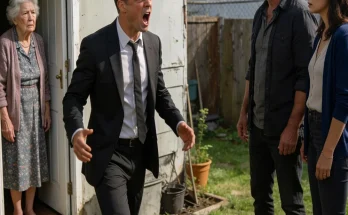
When the signal came, everything changed.
Officers moved in. The door gave way. The illusion shattered.
Marcus stood, furious, still believing his status would protect him.
“This is ridiculous!” he shouted. “Chloe had a breakdown—she hurt herself—”
“Interesting defense,” I said calmly. “Especially considering the cameras, medical reports, and the physical evidence your mother left behind.”
Sylvia stood composed, still trying to control the narrative.
“She doesn’t know what she’s doing,” she said.
“Oh, I do,” I replied. “I’m dealing with two people who thought violence could hide behind wealth.”
The room fell silent.
Evidence was collected—the golf club, blood traces, messages.
But something bigger surfaced.
Financial records. Hidden files. Proof of manipulation.
This wasn’t just violence.
It was a system built on control, image, and deception.
Within hours, everything began to collapse.
The story spread—not just for the brutality, but because people recognized something deeper.
A pattern.
A silenced woman.
A protected man.
A family built on appearances.
Chloe spoke two days later.
She didn’t cry describing the attack.
Not when she spoke about betrayal.
Only when she recalled being left at the terminal—discarded like she meant nothing.
That was Marcus’s greatest mistake.
Not the violence.
But believing she could be erased.
Charges came quickly—attempted homicide, domestic violence, kidnapping, evidence tampering, financial crimes.
Sylvia was charged as well.
Because sometimes, systems are upheld by more than one person.
Public opinion split, as it always does.
Some defended reputation.
Others saw the truth.
At trial, the evidence spoke louder than words.
And when the verdict came—guilty for both—the room seemed to breathe again.
It didn’t undo the damage.
But it mattered.
Outside, reporters waited for a final statement.
I gave them one.
“The problem wasn’t just one violent man,” I said. “It was everyone who sat at his table and chose to keep eating.”
Those words spread far—because they forced people to ask where they would have been sitting.
Beside me, Chloe stood—scarred, but unbroken.
And as we walked away, I understood this was never just about one night.
It was about truth breaking through illusion.
About a daughter who refused to disappear.
About a mother who remembered who she was.
And about a world that still struggles between comfort and justice.
Because silence has always protected the guilty.
And that morning, I remembered something I will never forget.
I was never meant to stay silent.