could.
I had almost forgotten what real anger sounded like in her voice because caregiving had forced so much of it underground.
She said, No, Riley kept it quiet because you only appear when there’s something to attach yourself to.
She said Vanessa had visited her father’s illness like an event and not a responsibility.
She said she was tired, deeply tired, of being treated like an obstacle between her daughter and some imagined future payout.
Then my father, who had spent most of the afternoon conserving energy, placed both hands flat on the table, looked at Craig, and said slowly, This house is not an asset.
It is my home.
Get out.
The room went silent after that.
Even Craig understood what it meant that the man he had been talking over was finally talking back.
He recovered quickly enough to threaten the usual things.
Lawyers.
Family disputes.
Future inheritance issues.
I let him talk himself out.
Then I told him there was no inheritance question attached to the cabin because the property was not part of my parents’ probate estate.
When both lifetime beneficiaries were gone, the remainder interest reverted to me.
I paid for it.
I structured it.
I was responsible for it.
There would be nothing for him to camp on, no future share to position for, no estate asset to leverage.
Craig’s expression went blank in a way I had never seen before.
Vanessa stared at me like I had struck her.
In truth, my parents had known that arrangement from the beginning.
We had discussed it with an attorney in plain language.
They had been relieved, not offended.
They wanted the cabin to be safe during their lifetimes.
They did not care about the fiction of equal inheritance when one child had built the thing and the other had arrived with a truck.
Craig took one more step toward confrontation and asked whether I was really going to call the police on family.
I said yes, because this was trespass, attempted coercion, and an effort to induce vulnerable adults into signing a document they did not understand under pressure.
Then I called the sheriff’s office.
The deputy who arrived forty minutes later was polite, experienced, and unimpressed by Craig’s vocabulary.
He listened to my parents separately.
He looked at the trust summary and the draft agreement.
He asked one simple question: Had my parents invited Vanessa and Craig to move belongings into the cabin or remain there as residents? Both of them said no.
That was enough.
The deputy told them to remove their property immediately and advised them that returning without permission could result in formal trespass charges.
Craig tried to leave with dignity.
That would have been easier if he hadn’t had to load his own boxed smart lock back into the truck while a sheriff watched.
The ugliest part came after they left.
Once the cabin was quiet again, I did a sweep of the house and found a copied key in Craig’s jacket pocket, which he had left draped over a chair in the scramble.
He had made it before that day, which meant this had not been a spontaneous conversation.
They had planned access.
They had planned pressure.
They had planned their version of reality before my parents even
finished lunch.
I called my contractor from the driveway.
By evening, the locks were rekeyed.
By nightfall, the side door had a new deadbolt, the gate code was changed, and the cabin’s cameras were tied to an account only I controlled.
The whole thing cost less than one of Craig’s fake management projections.
That night, after the sheriff had gone and the tools were packed away, the three of us sat at the dining table with reheated soup my mother never touched.
She kept apologizing, which broke my heart more than the truck had.
She said she should have known.
She said she should have made Vanessa leave the second the first box came through the door.
My father said he should have told me sooner that Vanessa had been asking odd questions lately about deed records, taxes, and whether the cabin was ever empty during holidays.
I told them neither of them had done anything wrong.
That is the entire point of pressure.
It works best on people who are already tired and trying to be fair.
I explained the trust again, not as a lecture but as reassurance.
The paperwork wasn’t there because I expected betrayal.
It was there because illness attracts opportunists the way light attracts insects.
Sometimes those opportunists share your last name.
We slept there that night because nobody wanted to leave.
I was up before dawn and found my father on the porch under a blanket, staring at the water.
He said he hated that he had needed to text me like that.
I told him that sending the text was the strongest thing he had done all day.
He nodded and said, I think I finally understand why you wrote everything down so carefully.
He wasn’t talking only about the trust.
He meant the whole cabin.
The door widths.
The rail placements.
The prepaid taxes.
The medication drawers.
The backup generator.
All of it was language, just in different materials.
I had built a promise in concrete, cedar, and clauses.
That morning was the first time I think he fully saw it.
The aftermath was cleaner than the confrontation because I refused to let it become emotional quicksand.
My attorney sent Vanessa and Craig a formal notice barring them from the property without advance written permission.
We documented the copied key.
We preserved the draft agreement and text messages.
We transferred the utility account alerts so I would see any access attempts immediately.
Vanessa sent me a blistering email about humiliation, favoritism, and how money changes people.
I answered once.
I told her money had not changed me.
Responsibility had shaped me, and absence had shaped her.
Then I stopped replying.
There are some family fights that improve only when you stop furnishing them.
My parents made one decision within a month that surprised me and then made perfect sense: they moved to the cabin full time.
Not because they were afraid, but because the truck day had clarified something for all of us.
Safety should not be occasional.
Peace should not be saved for weekends.
We hired a part-time home aide three mornings a week, someone my mother liked immediately because she spoke to my father directly and never over him.
I adjusted a few features in the house, added better exterior
lighting, and built a heated path section between the porch and the driveway for winter.
My father settled into a rhythm there that he had never found in the city.
Some days he could make it to the dock and sit for an hour.
On hard days, he watched the lake from the window and still seemed calmer than he ever had at home.
Vanessa did not vanish dramatically.
Real estrangements are usually duller than that.
She sent holiday texts.
She tried once, through my mother, to suggest that everyone should move past what happened.
My mother surprised us both by saying no.
Not no forever, not no theatrically.
Just no until the words apology and accountability showed up in the same sentence.
They never did.
Craig lost interest once it was clear there was no access, no leverage, and no future payday sitting behind sentiment.
The silence that followed felt less like grief than detox.
My father lived another eighteen months at the lake.
They were not easy months, but they were his.
He watched storms roll over the water from the porch swing I had nearly cut from the budget.
He held a fishing rod on the dock even on days he couldn’t cast.
He learned the pattern of light across the kitchen floor through the seasons.
My mother stopped sleeping with one ear open every single night.
Sometimes I would arrive with groceries and find them both just sitting there, not talking, each of them looking more like themselves than they ever had in the city.
Near the end, when speech tired him quickly, my father squeezed my wrist and said something I will hear for the rest of my life.
He said, You didn’t build me a cabin.
You gave your mother somewhere to breathe.
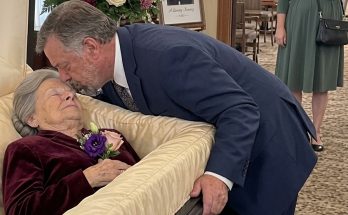
He died there in winter, with snow gathered at the edge of the porch and my mother beside him.
There is no good sentence for that kind of loss, only true ones.
He died at home.
He died somewhere quiet.
He died in a place where he had not been cornered by noise, schedules, fluorescent lights, or anyone trying to convert his vulnerability into value.
After the funeral, Vanessa asked whether she could come up to the cabin to remember him.
My mother told her remembrance was not the same thing as access, and that visits now required honesty first.
I loved her a little wildly for that.
It’s been two years since the truck.
My mother still lives at the lake.
The robe she wore that afternoon is long gone, replaced by heavy cardigans and ridiculous slippers she pretends not to like.
I go up most Sundays.
We drink coffee on the same porch where she once stood looking terrified, and sometimes we talk about my father, and sometimes we don’t.
The cabin is still what I meant it to be when I first stood on that cold acre and imagined him breathing easier.
Safety.
Dignity.
Peace with good locks.
That day taught me something my career had hinted at for years.
People think protection is dramatic.
They imagine it looks like shouting or rescue at the last second.
Sometimes protection is quieter.
Sometimes it is a deed written correctly.
A trust clause nobody notices until it matters.
A daughter
who reads the fine print before a tired mother signs it.
A father who sends three words at exactly the right time.
My sister and Craig came to the cabin believing they had found a soft opening.
What they actually found was the one place in my parents’ lives where every door, every sentence, and every boundary had already been built to hold.