After my husband’s funeral, I returned home in a black dress that still carried the day’s warmth and the lingering scent of lilies.
I pushed open the front door expecting the hollow silence that follows loss, that heavy, unreal stillness where grief is finally allowed to settle.
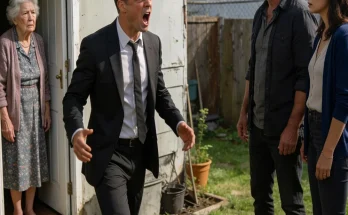
Instead, I stepped into my own living room and saw my mother-in-law orchestrating the scene while eight relatives stuffed Bradley’s belongings into suitcases.
For a moment, I honestly believed I had walked into the wrong apartment.
Closet doors gaped open.
Hangers scraped against wood.
A carry-on sat on the couch where Bradley used to read in the evenings.
Two of his cousins stood in the hallway stacking boxes.
On the dining table, beside the bowl where we kept our keys, rested a handwritten list in Marjorie Hale’s sharp, slanted handwriting: clothes, electronics, documents.
And right by the entryway, untouched yet utterly disrespected, sat Bradley’s temporary urn beside the funeral flowers.
The sight struck something deep and terrible inside me.
Not because it made me cry.
Because it showed me how quickly some people move from mourning to looting.
Marjorie turned at the sound of the door.
She didn’t gasp.
She didn’t look ashamed.
She simply lifted her chin the way she always did when she believed she was the only adult in the room.
‘You’re back,’ she said.
I remained in the doorway, my heels dangling from one hand, my head light from not eating, my entire body too drained to feel real.
‘What are you doing in my home?’ I asked.
Marjorie ignored the question.
She tapped the dining table once with two fingers and said, very clearly, ‘This house is ours now.
Everything of Bradley’s, too.
You need to leave.’
I took in the room slowly.
Fiona rifling through drawers.
Declan zipping up one of Bradley’s travel bags.
A younger cousin carrying framed photos like they were leftover decorations from a wedding.
No one looked away.
No one paused.
It was as if I had been buried alongside him.
‘Who let you in?’ I asked.
Marjorie slipped a hand into her handbag and held up a brass key.
‘I’m his mother.
I have always had one.’
That key hit harder than anything else.
Bradley had asked for it back months earlier.
He told me he suspected she still had a copy, but he wanted peace, not another argument.
Now she stood there, using that old access like it was ownership.
Fiona yanked open Bradley’s desk drawer.
Papers shifted.
Something inside me tightened.
‘Don’t touch that,’ I said.
She turned, her expression laced with a kind of cruel satisfaction.
‘And who are you now?’ she asked.
‘A widow.
That’s all.’
There are words that wound.
And there are words that clarify.
That one clarified everything.
I laughed.
It broke out before I could stop it.
Not soft, not embarrassed, not unsteady.
It was the laugh of a woman who had just realized the people in front of her had walked straight into a trap set by the one man they had underestimated his entire life.
Every head turned.
Marjorie’s expression hardened.
‘Have you lost your mind?’
I brushed beneath one eye and finally met her gaze properly for the first time that day.
‘No,’ I said.
‘You’ve all just made the same mistake with Bradley that you’ve made for thirty-eight years.
You assumed that because he was quiet, he was weak.
Because he was private, he was broke.
Because he didn’t parade his life for your approval, he must not have built one.’
Declan straightened from the suitcase.
He was Bradley’s cousin on his father’s side, always borrowing money, always carrying that faint mix of entitlement and cologne.
‘There’s no will,’ he said.
‘We already checked.’
‘Of course you did,’ I replied.
‘And of course you didn’t find one.’
What none of them knew was that six days earlier, beneath the sterile glow of hospital lights and the steady hiss of oxygen, Bradley had predicted this almost word for word.
If they come before the flowers die, he had whispered, laugh first.
Elena will handle the rest.
He had looked pale then.
So pale it seemed as though something fragile and final was glowing beneath his skin.
The monitors blinked steadily.
Rain dragged itself down the hospital window in thin silver lines.
He squeezed my hand with the last of his strength and made me repeat his instructions back to him.
Call Elena.
Do not argue.
Do not let them take anything.
And laugh first.
At the time, I thought the morphine had made him dramatic.
Bradley was not a dramatic man.
That was one of the reasons I loved him.
But then he said, more clearly, ‘They won’t come as family, Avery.
They’ll come as collectors.’
He was right.
To understand just how right, you have to understand who Bradley really was.
To his family, Bradley Hale was the difficult son.
The one who kept to himself.
The one who moved away.
The one who replied to messages late, skipped family trips, and never showed up to every manufactured emergency with an open checkbook.
To strangers, he seemed ordinary in the most trustworthy way.
Mid-thirties.
Thoughtful eyes.
A calm voice.
He rotated between the same two watches.
Preferred linen shirts, old books, and restaurants quiet enough to think.
He could disappear in a crowd if he wanted to.
Marjorie mistook that for insignificance.
She had spent his entire childhood confusing silence with submission.
Her world ran on hierarchy, performance, and debt.
There was always a cousin who needed rescuing, an aunt who needed covering, a family story that required someone else to pay for its ending.
Bradley had been useful because he was capable.
He paid bills on time.
He read the fine print.
He cleaned up problems without making a scene.
Then he met me, and something in him stopped being available.
We met in Valencia, years before St. Augustine, when I was working on translation for an archive project and he was consulting on historical asset recovery cases for a law firm.
That was how he described it at first: consulting.
A quiet word.
Neat.
Forgettable.
Only later did I understand what that work truly meant.
Bradley had a gift for tracing paper trails.
Not the kind of brilliance people make speeches about, but the frighteningly practical kind that exposes liars.
He could track shell companies, buried trusts, staged transfers, hidden ownership structures, beneficiary changes, forged estate documents.
He could look at a stack of dry paperwork and hear the outline of theft inside it.
He built that skill the hard way—first assisting lawyers, then banks, then private clients whose estates had been quietly stripped piece by piece by greedy relatives and opportunistic partners.
Over time, he began taking equity instead of fees.
Then a quiet stake in a recovery firm.
Then another in a title analytics company.
He used his middle name, Rowan, in most of those ventures, partly for privacy, partly because he already understood what his family did when they sensed money.
By the time I married him, Bradley had done something his relatives would never have believed, because belief would have required respect.
He had built wealth.
Not loud wealth.
Not yachts-in-the-harbor wealth.
Not social-media wealth.
The kind that sits behind clean structures and careful planning.
The kind held in trusts, LLCs, accounts that do not beg to be admired.
The kind that comes from patience and from understanding how other people hide things.
Once, while we were walking along St. George Street beneath old balconies draped with ferns, he told me, ‘When you spend enough years tracing greed, you either become greedy or you become private.’
He chose private.
We lived comfortably but without excess.
We rented for a time, then bought the condo in St. Augustine through a holding company that later became part of a trust structure I barely noticed because I trusted him and because he hated letting money dominate a room.
We traveled when we wanted.
Ate where we pleased.
Collected books, not status.
He paid debts early.
He donated quietly to preservation projects and scholarships.
He never once told his mother a number.
That last part enraged her.
Marjorie hated mysteries she couldn’t control.
At first, she masked her resentment as concern.
At dinners, she would ask if Bradley was still doing that small consulting job.
She would remind him that family should know in case something happened.
She would laugh too loudly and say she hoped he wasn’t trusting me with all the passwords, because women could be unpredictable when money was involved.
Bradley usually let those remarks slide.
But one night, after she left our apartment, he locked the door, pressed his forehead against it, and said very quietly, ‘My family does not love information.
They love access.’
That was the night he finally told me the worst of it.
Years before, after his father passed, Bradley uncovered that Marjorie and Declan had been leveraging estate documents to obtain short-term loans.
At first, it wasn’t anything major.
Minor frauds.
Adjusted signatures.
Temporary substitutions.
Family borrowing from the dead, convinced the living would continue forgiving them.
Back then, Bradley cleaned it up to protect his father’s reputation.
He covered some of it himself.
Legally blocked the rest.
Quietly.
Always quietly.
They mistook that for weakness.
It wasn’t weakness.
It was grief.
Later, when Bradley stopped saving them, they labeled him cold.
Ungrateful.
Changed.
Marjorie told anyone willing to listen that I had turned him against his own blood.
The truth was simpler and harsher: once he experienced a life without constant taking, he no longer volunteered to be used.
Then came the hospital.
Bradley’s collapse happened quickly.
Chest pain that was supposed to mean nothing.
A night in emergency that turned into intensive care.
A diagnosis that suddenly made every hour count differently.
He stayed clear-headed long enough to do what men like Bradley do when they know disorder is coming.
He prepared.
Attorney Elena Cruz arrived at the hospital the next morning carrying a leather portfolio and accompanied by a notary from her office.
I still remember the click of the pen.
The blue seal.
Bradley’s hand trembling once before steadying.
He signed documents I couldn’t fully grasp at the time because I was trying not to imagine a world without him.
He transferred final control of the condo and every related holding interest into the St.
Augustine Harbor Trust.
I was named sole trustee and beneficiary.
He updated beneficiaries on his investment accounts.
He revoked every family access authorization that lingered in older records.
He finalized a letter of instruction to Elena.
And then, because Bradley was Bradley, he created something he called a contingency file.
‘If they behave like human beings,’ he said, exhausted, ‘it won’t matter.’
I asked what it contained.
He looked at me with that tired, knowing smile.
‘Enough.’
He died two days later.
Now, standing in our condo with Marjorie Hale stepping over funeral flowers, I finally understood what enough meant.
My phone buzzed in my hand.
Elena: We’re downstairs.
I looked at Marjorie.
At Declan.
At Fiona still hovering near Bradley’s desk as if something valuable might be hidden beneath the paper clips.
‘You should probably put those suitcases down,’ I said.
Marjorie let out a sharp, impatient laugh.