Kamala reached into her pocket again.
And pulled out an envelope.
“I didn’t want to do this in private,” she said. “I wanted witnesses.”
Meera stepped forward, panicked.
“Dadi, please…”
Kamala’s eyes hardened.
“Sit down.”
Meera froze, then slowly stepped back, like a child being scolded.
Kamala lifted the document.
“This,” she said, “is my updated will.”
A sharp sound escaped Aunt Leela’s throat.
I didn’t know what was coming. But looking at Meera’s face, I understood something—she did. And she was terrified.
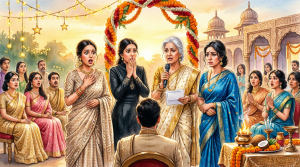
Kamala took a deep breath, unfolded the paper, and brought it closer to the microphone.
And just before she began reading, Meera screamed with a desperation that froze my blood:
“You can’t do this to us because of her!”
The entire party jolted.
And in that moment, I knew—
for them, the worst had only just begun.
PART 3
Meera’s scream hung in the air like a slap.
Grandmother Kamala slowly lowered the page. She looked at her granddaughter with a mix of exhaustion and contempt, then spoke with a calmness that was more frightening than any outburst.
“No, Meera. This is not happening because of her. This is happening because of you.”
Silence swallowed the entire garden.
Kamala lifted the document again.
“This house,” she read clearly, “the house that Aisha has cared for, cleaned, and filled with life for the past ten years, will belong to her.”
A wave of disbelief moved through the crowd.
My mother stepped forward.
“Mom, no—”
Kamala continued as if she hadn’t spoken.
“The rest of my assets will be divided equally among my children and grandchildren. Because I believe in fairness. But this house goes to the granddaughter who turned it into a home.”
Meera stood frozen, mouth open. Aunt Leela looked like she might faint.
“This is not revenge,” Kamala said, scanning the crowd. “This is balance. Aisha gave years of her life to a family that mocked her behind her back. I am simply putting things where they belong.”
Aunt Leela stood up sharply.
“This is madness! She isn’t even the real—”
Kamala cut her off with a look so sharp it stopped her mid-sentence.
“Finish that sentence, Leela. I dare you.”
Aunt Leela went silent.
Kamala’s voice dropped, but grew even heavier.
“Aisha is my blood. And even if she weren’t, she has shown more love than any of you ever did.”
Then she turned to me.
“Do you want to say something, my child?”
I looked around.
My mother was crying. Meera’s makeup was ruined, her hands shaking. Aunt Leela looked like she was deciding whether to scream or run. Several relatives avoided my gaze. Others looked away in shame, finally realizing there was no hiding place left.
I could have taken out my phone.
I could have read every screenshot aloud.
I could have repeated every cruel sentence they wrote about my divorce, my grief, my salary, my loneliness.
But it wasn’t necessary anymore.
I stepped toward the microphone.
“I have screenshots of all 847 messages,” I said calmly. “Seven years of them. But there’s no need to show them. Tonight already said enough.”
I turned to face them.
“Long ago, you decided I wasn’t part of your ‘real family.’ I’m simply respecting that decision. You excluded me first. I’m just making it official.”
Meera broke.
“You can’t do this to us!” she cried.
I looked at her without anger.
“I’m not doing anything to you. You already did it.”
My mother stepped toward me, desperate.
“Aisha, please…”
I didn’t answer.
Instead, I gently took Kamala’s arm.
“Let’s go inside, Dadi. It’s getting cold.”
She smiled softly.
“Yes, my child. Let’s go home.”
We walked away together, while behind us the party collapsed into chaos. I heard Aunt Leela arguing with her husband. I heard Meera trying to explain the unexplainable to guests who were already leaving. I heard my mother calling my name through tears.
But I didn’t look back.
Because for the first time in years, my chest felt light.
What followed came fast and brutal.
Someone at the party posted it online. Within a day, half the neighborhood knew what happened at Kamala’s 70th birthday. Meera lost thousands of followers. Her carefully curated image of the perfect granddaughter and “ideal family woman” collapsed overnight. She deleted her accounts and disappeared for weeks.
Aunt Leela didn’t just lose friends—she lost her husband. Two weeks later, he filed for divorce.
My mother changed the most. Invitations stopped. Her book club suddenly “had no space.” At church gatherings, people smiled less. In small communities, shame travels faster than gossip.
Three days after the party, I found Kamala in the garden with her black notebook on her lap.
“Are you writing about that night?” I asked, sitting beside her.
She shook her head.
“I’m writing about today. ‘Aisha came over. We planted tulips. The sun was beautiful.’”
I smiled, then glanced at her.
“Why didn’t you tell me earlier that you knew?”
She was quiet for a moment.
“Because if I told you alone, they would have convinced you it wasn’t that bad. That you were overreacting. We needed witnesses. Justice isn’t only about being done, my child. It’s about being seen.”
She was right.
My grandmother wasn’t just kind. She was brave.
Two weeks later, my mother came to my door holding an old photo album. She looked older. Dimmer.
“I don’t deserve your attention,” she said. “But I want to try. I want to be your mother again, if you ever let me.”
We talked for three hours.
She admitted things I never expected: that I reminded her too much of my father; that my independence made her feel small; that the group chat started as venting and turned into something ugly.
“I can’t undo what I did,” she said through tears. “But I want to do better.”
I looked at her for a long time before answering.
“Three months. No calls, no visits, no messages. After that, we’ll see.”
She agreed without arguing.
I still work long ICU shifts. I still come home alone some nights. I still get exhausted down to my bones. But I no longer carry the weight of trying to earn love from people who decided long ago not to give it.
Yesterday, while watering the new flowers, Kamala asked me:
“Do you know what’s good about getting old?”
“What?”
“You stop living to be liked. And you start living for what actually matters.”
I think I’m finally learning that.
That night, I didn’t lose my family.
I lost the lie I was forced to call family.
And in the space it left behind, I found something far more valuable.
My peace.
My dignity.
My place.
So if anyone ever makes you feel like you are the leftover in your own home, remember this: you don’t have to burn yourself just to keep others warm. Keep the truth. Wait for your moment. And when it comes, walk away with your head held high.
Because no one deserves to be anyone’s charity project.
We all deserve to be chosen with love.