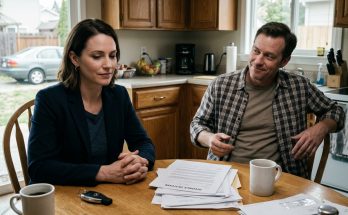
My mother finally looked at me and asked, “You would really take legal action against your own parents,” as if she had not just revealed who she truly was.
“You did not come here as my parents,” I said, feeling something inside me finally settle into clarity. “You came here as people who owe money.”
Mia stepped closer to me and held my hand, her small fingers cold but steady as she spoke again. “You did not come when my dad died,” she said, her voice calm but firm in a way that felt older than her years.
My father muttered that it was not fair, but Mia lifted her chin slightly and answered, “No, it wasn’t,” and in that moment I saw Adrian in her completely.
My parents tried to justify themselves, talking about obligations and events, but every excuse sounded weaker with each word. I told them clearly that I was done rearranging my life around Courtney’s constant crises, and that Adrian’s death had drawn a line I would not cross again.
They left without resolution, and that evening I spoke with Eleanor who confirmed that Adrian had updated his will months earlier. He had created a trust for Mia and me, with strict conditions preventing any financial help to my side of the family without careful oversight.
She read me his personal statement, and I broke down as I heard his words describing exactly what had just happened. He had understood the pattern long before I accepted it, and he had protected us even after his death.
In the following days, Courtney tried to manipulate public opinion through social media, portraying herself as a victim while my parents quietly spread false narratives among relatives. I refused to respond emotionally and instead forwarded everything to Eleanor, who quickly issued legal notices and documented every attempt at coercion.
Soon after, a financial review revealed that a large portion of the original loan had been diverted to cover my parents’ personal debts rather than Courtney’s business. This discovery strengthened the legal case significantly and removed any illusion of misunderstanding.
My parents returned again, this time desperate and shaken as they asked to resolve everything privately. I stepped outside to speak with them while Mia watched from the window, knowing I had to show her something different from what I had learned growing up.
“I want distance,” I told them firmly. “I want the harassment to stop, the lies corrected, and the debt repaid exactly as documented.”
My mother cried, but this time her tears came from fear rather than regret, and my father looked at me as though I had become someone he did not recognize. In truth, I finally had become someone who would not accept the same patterns anymore.
Within a month, Courtney was forced to sell part of her business, and my parents arranged loans to begin repaying what they owed. Legal agreements replaced empty promises, and boundaries replaced the expectations that had defined my entire life.
Mia began therapy and slowly found her way back to laughter, while I rebuilt a life shaped by loss but guided by clarity. Adrian’s company was sold to a trusted colleague, and the trust he created ensured stability for our future without interference.
Sometimes I still remember that phone call and feel the ache rise again, but now it is followed by something stronger. The day my daughter handed them that envelope, she did more than expose their intentions, she ended a pattern that had defined generations.
In the trembling of their hands, I saw the truth finally break through everything I had been taught to ignore. And for the first time in my life, I understood that protecting my child mattered more than preserving a version of family that had never truly protected me.