She sat on the kitchen chair and placed the bag on her lap. I turned off the stove because the oil was starting to smoke. The smell of onion hung between us, harsh, familiar, much like any given afternoon with Mr. Arthur yelling at me from the hallway that my soup looked like mop water. —”My name is Claire,” she said. “I’m the oldest daughter.” I didn’t know what to say.
For months, Mr. Arthur had talked about his children the way one talks about people living in another country, even if they only lived forty minutes away. “Claire was always the most serious one,” he would say. “Even as a little girl, she sounded like a lawyer, even when asking for a popsicle.” I had imagined her as distant, cold, the kind of person who answers calls in a rush and sends money so they don’t have to send affection.
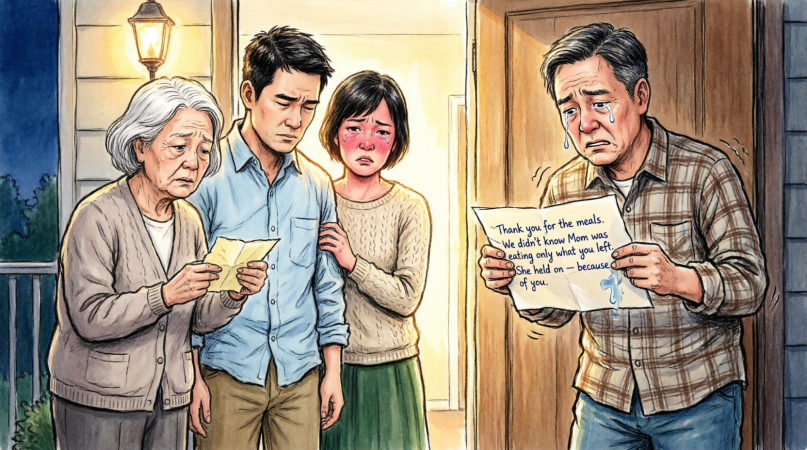
But the woman in front of me didn’t look cold.
She looked guilty.
And guilt, when it arrives late, ages you faster than the years.
—”My dad talked about you a lot,” she said.
I pressed my fingers against the table.
—”About me?”
She smiled without joy.
—”Not by your name. He never told us your name. He called you ‘the soup girl’.”
I felt a pang in my chest.
—”I’m not exactly a girl anymore.”
—”To him you were,” she replied. “To him, anyone who could still climb stairs without complaining was a kid.”
I wanted to laugh.
What came out sounded more like a sigh.
Claire opened the bag and took out my Tupperware containers one by one. They had been washed with an absurd delicacy. Some had lids that didn’t even close right anymore. One had a burnt corner because I once set it too close to the stove. Another had “lentils” written in marker. I recognized it and wanted to hug it, as if the plastic held something of his hands.
—”We found this in his kitchen,” she said. “They were all arranged on a shelf. Washed. Dried. Some had little pieces of paper inside.”
—”Paper?”
She swallowed hard.
She reached into the yellow envelope and pulled out several folded pieces of paper.
—”My dad started writing when he realized he was forgetting things. The doctor told us he should write down names, routines, medications. He turned it into something else.”
She handed me the first piece of paper.
Mr. Arthur’s handwriting trembled, but it was still elegant, the kind of old-school cursive learned from penmanship drills, not quick text messages.
I read:
“Monday. The neighbor brought soup. She said she had leftovers. She lies very poorly. The soup was good, but I’m not going to tell her because then she’ll get a big head. Reminder: she has a hidden laugh. Ask her for her name.”
I covered my mouth.
Not because I wanted to cry.
But because I was already crying.
Claire handed me another page.
“Wednesday. Tomato rice. It lacked a little garlic, but you can tell she made it with patience. When she knocked on the door, she didn’t run away. She stayed. That counts more than the garlic.”
Another one.
“Friday. Mild chili without any spice. What kind of punishment is it to live in America and not be able to eat spicy food? The neighbor said it was for my blood pressure. She scolded me exactly like Mary used to. It made me mad. It made me glad.”
The kitchen felt small.
As if the walls were closing in to listen, too.
—”We didn’t know,” Claire said.
Her voice broke at the edges.
—”We didn’t know how much he depended on you.”
I looked up.
—”He didn’t depend on me. I just left him food.”
Claire shook her head.
—”No. You don’t understand. He stopped eating almost entirely after he started getting confused. My brother would order him groceries through an app, I would come on Sundays… sometimes every other Sunday…” she closed her eyes. “We thought that was enough. That as long as he had beans, milk, bread, and medication, it was enough.”
I didn’t say anything.
Because I, too, had often thought that leaving a Tupperware and going back to my life was enough.
—”But the food was going bad,” she continued. “We would find rotting tomatoes, stale bread, unopened cans. He would say he had already eaten. He’d say he wasn’t hungry. He said food didn’t taste like anything to him anymore. And then you started knocking on his door.”
She looked toward the window, as if she could see her dad’s door from there.
—”In a notebook, he wrote that he got his appetite back because someone was waiting for his response.”
Something inside me folded.
I didn’t know a person could be sustained by soup.
I didn’t know a teasing comment could be a walking cane.
I didn’t know that sometimes you aren’t feeding the body, but the reason to get up from the chair.
Claire pulled a different piece of paper from the envelope. Thicker. Carefully folded. It had my name written on it, even though it wasn’t my name.
It said:
“For my Mystery Neighbor.”
—”This is the note,” Claire whispered. “He wrote it three days before he died. That day my brother came to see him, and he handed it to him. He told him: ‘When I’m no longer here, find her. But first, ask for her forgiveness.’”
I looked at her, confused.
—”Forgiveness? For what?”
Claire pressed her lips together.
—”Because we… we got mad at you.”
For a second, I didn’t understand.
—”At me?”
—”When we found the Tupperware, at first we thought horrible things. That maybe you were charging him. That maybe you had sneaked into his house. That maybe you wanted something from him. My brother was very upset. My dad had some savings that didn’t show up in the bank, and…” she put a hand to her forehead. “It was unfair. It was cruel to even think it. But when a family knows they’re guilty, they look for someone to blame so they don’t have to look in the mirror.”
I stood still.
The onion on the chopping board started crying for both of us.
—”You didn’t know me,” I said, because it was the only thing I could say.
—”No,” she replied. “And yet you knew him better than we did in his final months.”
The phrase fell onto the table like a broken plate.
I wanted to defend her from herself. Tell her no, that surely wasn’t true, that you can’t erase a whole lifetime for a few months of soup. But I remembered Mr. Arthur calling me Mary. I remembered the television turned on so the house wouldn’t sound dead. I remembered his laugh when I told him that if he kept criticizing my food, I was going to start charging him.
And then I understood that Claire’s pain didn’t need quick comfort.
It needed to stay there.
To breathe.
—”Can I read it?” I asked.
She nodded.
I took the paper.
My hands were shaking so much the letters danced.
“Mystery Neighbor:
If you are reading this, it means i’ve already done the rude thing of dying without saying a proper goodbye. I’m sorry. When you get old, you lose a lot of things: hair, strength, memory, friends, teeth, patience. But I hadn’t lost my shame yet, and I’m embarrassed to leave owing you so many Tupperwares.
I don’t know your name. I asked for it many times in my head, but when I had you in front of me, it slipped away. Then I got scared to ask because I thought: ‘What if she already told me? What if she realizes my world is erasing itself?’ So I left you as Mystery Neighbor, which sounds like a Cary Grant movie.
I want you to know something.
The first time you left soup at my door, I wasn’t going to eat that day.
Not for lack of food.
For lack of desire.
I had burned the soup because I put the pot on and sat down to wait for Mary to yell from the living room: ‘Arthur, it’s going to stick!’ But Mary didn’t yell. The house stayed quiet. And I just stared at the wall until the smoke started. When you knocked, I thought it was her. Look how foolish. Then I opened the door and it was you, looking scared, asking if I was okay.
I said yes.
I lied.
We old folks lie a lot about that.
We say ‘I’m fine’ because we don’t want to be a bother. Because we’ve already seen how people look at their watches when we talk. Because we feel our sadness is a bulky piece of furniture that no one knows where to put.
That soup tasted like a Sunday.
Not because of the chicken, which was a bit sad, excuse me, but because someone had thought of me long enough to serve me a plate.
After that, I started waiting for your footsteps.
Not the food.
Your footsteps.
I would hear the elevator, the neighbor from 3B dragging her sandals, the delivery boy bringing up pizzas, but your footsteps were different. You walked as if asking for permission, even in the hallway. Then you would knock, and I would act dignified, taking a little while so you wouldn’t notice I was already on the other side of the door with my cane in hand.
Sometimes I criticized your food because I didn’t know how to say thank you without crying.
Thank you.
For the lentils.
For the beans.
For the mild chili, even though i’ll never forgive you for that.
Thank you for letting me talk about Mary as if she still mattered.
Thank you for not making a weird face when I called you Mary.
Thank you for scolding me when I forgot to drink water.
Thank you for not treating me like I was dead ahead of time.
Now for the important part.
My children are not bad people.
Don’t let my loneliness make you think that.
My kids are tired people. Trapped people. People who think that loving is paying bills, bringing medicine, answering the phone when possible. I was like that with my mother, too. I sent her money and thought that meant I was keeping her company. Life is very mocking: one day it sits you in the very chair where you left someone waiting.
If they go to you, please don’t hurt them with what I didn’t know how to tell them. Tell them I forgave them before they asked for my forgiveness. Tell them I didn’t die angry. Tell them yes, it hurt, but love also hurts when it’s far away, not just when it’s missing.
In the pantry, behind the coffee canister, I left a tin box. It’s not a treasure, don’t get excited. There are some of Mary’s recipes. She used to say that food is the most humble way of saying ‘stay a little longer.’ I want you to have them. Not because you cook perfectly—I would never put that in writing—but because you understood something that took me eighty years to learn:
Sometimes a plate of food doesn’t save a life forever.
But it extends it just enough for that life to feel loved for one more day.
And one more day, when you are alone, is a miracle.
Don’t cry too much.
Well, cry a little, so it doesn’t look like I left without making an impact.
And if you ever make tomato rice again, add more garlic.
With affection and eternal hunger,
Arthur.“
I couldn’t finish it sitting down.
I stood up with the letter pressed against my chest and walked to the window. Outside, the Astoria afternoon looked the same as always. A man was selling street food on the corner. A dog barked from some balcony. A kid yelled that he didn’t want to do his homework. Life had the indecency to continue.
I wanted it to stop for just a little bit.
Even if just out of respect.
Claire was crying silently behind me.
It wasn’t a loud cry.
It was worse.
It was the kind of crying that takes years to form, built on unsaid sentences, unmade calls, postponed visits, “i’ll go next week,” “I can’t right now,” “i’ll call him tomorrow.”
I turned back to her.
—”Your dad loved you very much.”
She let out a broken laugh.
—”I know. That’s the worst part. That I know.”
She took a tissue from her purse and wiped her eyes.
—”My brother is downstairs. He couldn’t bring himself to come up. He thinks you hate us.”
—”I don’t know you well enough to hate you.”
—”That’s exactly what my dad would say.”
For the first time, we both smiled.
A small smile.
The kind that is born where it still hurts.
—”Do you want him to come up?” I asked.
Claire hesitated.
—”He needs to see you. But he’s also ashamed.”
—”Shame climbs stairs just like everybody else.”
She let out a brief, surprised laugh, as if she didn’t remember that you can laugh in the middle of grief without betraying anyone.
Five minutes later, Claire’s brother was sitting in my living room.
His name was Richard.
He had Mr. Arthur’s jawline and the gaze of someone who hadn’t slept in days. He wore a crisp, ironed shirt, expensive shoes, and red eyes. In his hands, he held a blue tin box painted with white flowers. I recognized it without ever having seen it. It was Mary’s box.
Richard didn’t look at me at first.
He looked at the table.
He looked at my hands.
He looked at anything but my face.
—”I’m sorry,” he blurted out.
It wasn’t a pretty apology.
It was a raw, clumsy apology, like a falling rock.
—”I’m sorry for thinking badly of you. I’m sorry for not coming sooner. I’m sorry for…” he swallowed hard. “I’m sorry for leaving him alone.”
Claire put a hand on his arm.
He gently brushed it off, not out of rejection, but because some guilt you want to carry without help.
—”I was the one who said my dad was exaggerating,” he continued. “That all old people get sentimental. That if we visited him too much, he would become dependent. Can you believe that stupidity? Dependent. As if needing company were a flaw.”
I didn’t know what to do with his pain.
I didn’t want to absolve him because I wasn’t a judge.
I didn’t want to punish him because I wasn’t the victim.
So I did the only thing I had learned to do when words weren’t enough.
I went into the kitchen.
—”Have you eaten?” I asked.
They both looked at me like I had spoken in another language.
—”No,” Claire said.
—”Then wait.”
—”We don’t want to be a bother,” Richard said.
I opened the refrigerator.
—”Your dad used to say that saying that was just an elegant way to stay hungry.”
Richard covered his face with his hand.
And he cried.
He cried the way men cry who were raised to hold it in until the body demands it all at once. Claire got up to hug him. He folded over her shoulder like a very large child.
I put rice on the stove to heat.
Beans.
Some shredded chicken.
It wasn’t a special meal. There was no fancy roast, no party soup, no dessert. It was what I had. Apartment food, for a random Saturday, for an improvised mourning.
I served three plates.
And when I put them on the table, I felt an absence so clear that I almost reached for another plate.
The fourth one.
Mr. Arthur’s.
I froze.
Richard noticed.
—”Set it,” he said.
—”What?”
—”The plate. Set it, too.”
Claire looked at him.
—”Richard…”
—”Please.”
I took out a bowl. I served rice, beans, and chicken. I placed it at the end of the table, where no one sat.
For a few seconds, no one spoke.
Then Richard opened the tin box.
Inside were handwritten recipes, old photographs, a handkerchief embroidered with the initials M.A., a yellowed ticket from a dance in Central Park, and a little bag with dried seeds.
—”What’s that?” I asked.
Claire took the bag and smiled sadly.
—”Rosemary. My mom saved seeds like they were gold.”
I touched the recipes with my fingertips.
Mary’s handwriting was round, cheerful, different from Arthur’s. On the first page, it said:
“Chicken noodle soup for sad days: start with patience and finish with lemon.”
Below, in Mr. Arthur’s handwriting, someone had added years later:
“And with a neighbor, if you’re lucky.”
My throat closed up again.
We ate unhurriedly.
At first, in silence.
Then Claire started telling how, when she was a little girl, her dad braided her hair so tight it felt like he was trying to stretch her ideas. Richard shared how Mr. Arthur taught them to ride bikes in Prospect Park, and when he fell, instead of helping him up, he said: “Look at that, you already learned how to land.”
I told them about the salt.
About the mild chili.
About the time I brought him jello and he told me that wasn’t dessert, it was just water with a superiority complex.
Richard laughed so hard he had to take his glasses off.
And suddenly, Mr. Arthur’s house, which for weeks had smelled like goodbye in my memory, started to smell like something else.
Like a return.
Not of him.
But of what he had left behind.
When they finished eating, Claire asked if she could see the hallway.
I didn’t understand, but I nodded.
The three of us walked out.
Mr. Arthur’s door was closed. It still had the building management’s tape stuck to the side, that cold mark of procedure, of inventory, of “no one lives here anymore.”
Claire stood in front of it.
—”When we were kids,” she said, “my dad always waited for us outside. Even if we came up late, even if he had already scolded us over the phone, even if we were grounded. He would sit in a chair by the door. He said no one should arrive at a house without someone welcoming them.”
Richard lowered his head.
—”And he arrived many times with no one there.”
The sentence lingered in the air.
I looked at my own door.
I remembered all the times I had arrived loaded down with bags, exhaustion, problems I told no one about. All the times I walked in fast, locked the door, and thought: “Finally alone.” As if being alone was rest, and not also a risk.
—”Sometimes I heard him,” I said.
They both looked at me.
—”Heard who?”
—”Your dad. At night. He spoke softly. I thought he was watching TV. But sometimes the TV was off. I think he was talking to your mom.”
Claire closed her eyes.
—”He never stopped talking to her.”
Richard pulled something out of his shirt pocket.
It was a key.
—”We want to give you this.”
I took a step back in fear.
—”No.”
—”Let me explain,” Claire said. “It’s not for you to look after the apartment or anything like that. We’re going to pack things up, sort out the paperwork, sell or rent, we don’t know yet. But my dad requested something.”
Richard held out the key.
—”He wanted you to go in once. Alone. He said there was something on the table for you, besides the box.”
—”I can’t.”
—”Yes, you can,” Claire said. “He wanted to say goodbye.”
I looked at the door.
My entire body resisted.
Because as long as I didn’t go in, an absurd part of me could imagine him inside, asleep in his armchair, waiting to criticize my food. But if I went in, I would confirm what I already knew: that houses are left orphaned, too.
I took the key.
It was cold.
Richard and Claire went downstairs to buy coffee, or so they said, to leave me alone. I waited until their footsteps faded on the stairs. Then I slipped the key into the lock.
The door opened with a groan.
Mr. Arthur’s apartment smelled like dust, old wood, and that faint cologne older men use, a mix of cheap aftershave and laundry soap. The living room was tidy. Too tidy. The turned-off television looked like a closed eye. Draped over the back of the armchair was his brown sweater.
I didn’t touch it.
Not yet.
I walked slowly.
In the kitchen, the burnt pot was still on the stove, washed but stained black at the bottom. I stepped closer and, without meaning to, I smiled.
—”You really can burn water,” I whispered.
On the table was a small envelope.
And on top of the envelope, a salt shaker.
I laughed.
I laughed while crying, like a crazy person, alone in a dead man’s kitchen.
I picked up the salt shaker.
It had a label taped to it:
“So you have no more excuses.”
I opened the envelope.
Inside was a photo.
Mr. Arthur and Mary in Central Park, young, dancing. He in a light suit, she in a floral dress. They looked at each other as if the world wasn’t enough for them. Behind them, barely visible, a balloon stand, trees, people paused in an afternoon that no longer existed.
On the back of the photo, Mr. Arthur had written:
“Take us to eat with you when you make something delicious.”
Below was another, shorter note.
“And if you can, open the window every now and then. This house forgets to breathe.”
I went to the living room and opened the window.
The street noise rushed in: horns, voices, a food vendor in the distance, the massive murmur of the city. The curtains barely moved, as if someone had let out a sigh.
Then I saw it.
In a corner of the dining room, against the wall, was a wooden chair with an embroidered cushion. Resting on it was a notebook.
I opened it.
It wasn’t a full diary. It was lists.
“Things I don’t want to forget.”
Mary laughed when she lied.
Claire cries at movies with dogs.
Richard hates cilantro, but eats it so we don’t argue.
The mystery neighbor cooks better when she’s sad.
Ask her not to eat alone.
The last line hit me.
Ask her not to eat alone.
I sat down in the chair.
The notebook remained open on my lap.
I thought I had been the one to see him.
I thought I was the one who noticed his loneliness, his forgetfulness, his hunger.
But Mr. Arthur had seen me, too.
He had seen my plates served in front of the television. My groceries bought for one. My laugh coming through the wall, followed by no other noise. He had seen that I left food at his door and then went back to eat standing in my kitchen, with no table set, no voice, no one to tell me if my life needed more salt.
I felt ashamed.
Not of him.
Of myself.
Because sometimes you help others so you don’t have to look at your own empty space. You give soup so you don’t have to admit you are also cold.
I stayed there for a long time.
I don’t know how long.
Until I heard a soft knock on the door.
—”Are you okay?” Claire asked from outside.
I wiped my face with my sleeves.
—”Yes.”
I lied.
Just like Mr. Arthur lied.
But this time, I opened the door.
Richard and Claire walked in with coffee, pastries, and the carefulness of someone who doesn’t want to step on a memory. I showed them the notebook. Claire read it first. Then Richard. When he got to the line about cilantro, he let out a choked laugh.
—”I knew it,” Claire said. “I kept telling him you hated cilantro.”
—”And I told him no, because my mom put it in everything.”
—”That’s exactly why he added more.”
Richard stared at the notebook.
—”‘Ask her not to eat alone,’” he read softly.
None of us said anything.
The phrase included all three of us.
That afternoon, we took some things from the kitchen. Not to empty it. To understand it. We found duplicate cans of tuna, sixteen chamomile tea bags, folded receipts, a bag full of rubber bands, prayer cards, expired medications, and a school photo of Claire with crooked teeth.
We also found, taped to the refrigerator, a sheet of paper with my supposed weekly menu.
“Monday: Soup or something that looks like it.
Tuesday: Not a food day, do not disturb.
Wednesday: Tomato rice.
Thursday: Wait without looking hungry.
Friday: Surprise.
Saturday: Maybe she won’t come. Don’t get sad.
Sunday: Kids. Act happy.”
Claire put a hand to her chest.
—”I came on Sundays,” she said.
—”He would dress up,” I said. “He’d put on a collared shirt.”
Richard looked at the fridge as if he wanted to apologize to the pharmacy magnet holding the paper.
—”He told us he was perfectly fine.”
—”He wanted you to have peace of mind.”
—”He gave us too much peace of mind,” Claire said.
I shook my head.
—”No. You let yourselves have it.”
It was the first time I said something harsh.
I regretted it as soon as it came out.
But Claire wasn’t offended. On the contrary, she nodded.
—”Yes.”
Richard took a deep breath.
—”Yes.”
And there I understood something: some words aren’t knives, even though they cut. Sometimes they are scalpels. They hurt because they open up the places where the silence has festered.
When it got dark, we left the apartment. Claire locked the door and stared at it.
—”I don’t know what we’re going to do with all this.”
—”You don’t do something with all this all at once,” I said. “You do it little by little. Like beans simmering.”
Richard smiled.
—”Did my dad say that too?”
—”No. I say that when I want to sound wise.”
They went down to the parking garage, and I went back to my kitchen with the tin box, the salt shaker, the photo, and the notebook.
The onion was still on the chopping board, now withered. I threw it away.
I didn’t cook that night.
For the first time in weeks, I didn’t make extra food.
I poured myself a glass of water, placed the photo of Arthur and Mary next to the salt shaker, and sat at the table.
The chair across from me was empty.
But it didn’t look like an enemy anymore.
The next day, Sunday, I woke up early.
I don’t know why.
Maybe because the body remembers routines even when the heart doesn’t want to. I got up, made coffee, and opened Mary’s recipe box. I chose the first one: chicken noodle soup for sad days.
I went to the market.
I bought chicken, carrots, zucchini, potatoes, chickpeas, cilantro even though Richard hated it, and a bunch of rosemary because Mary’s seeds deserved earth but also memory. The lady at the stall asked me if I was cooking for a family.
I almost said no.
But I heard myself answer:
—”Yes. Something like that.”
In the afternoon, I made the soup unhurriedly. I added enough garlic. Enough salt. Enough patience. As it boiled, the steam fogged up the windows, and the apartment smelled just like the hallway used to when Mr. Arthur was still around.
At three o’clock, someone knocked on my door.
It was Claire and Richard.
But they weren’t alone.
Behind them was a young woman holding a little boy’s hand. The woman had Claire’s eyes and the impatience of a twenty-something. The boy was holding a plastic dinosaur.
—”This is Maya, my daughter,” Claire said. “And this is Liam.”
The boy looked at me seriously.
—”My mom says you used to feed my great-grandpa.”
I didn’t know how to answer.
—”Your great-grandpa also fed my patience,” I said.
Liam wrinkled his nose.
—”Can you eat that?”
—”With enough lemon, yes.”
They came in.
Then came another of Richard’s sons, a tall young man who greeted me awkwardly. After him, the neighbor from 3B, who had smelled the soup and peeked in “just to see if everything was okay.” Then the super, using the excuse of bringing a receipt. In less than an hour, my apartment had more people in it than it had since I moved in.
And I, who had always thought my kitchen was too small, discovered that kitchens stretch when someone is hungry.
I served bowls.
A lot of them.
The last one I placed at the corner of the table.
Mr. Arthur’s.
No one mocked it.
No one said it was weird.
Liam was the only one who asked:
—”Whose is that one?”
Richard knelt next to him.
—”Your great-grandpa’s.”
—”But he died already.”
—”Yes.”
—”Then how is he going to eat?”
Claire froze.
I placed a folded tortilla next to the bowl.
—”With us,” I said. “When we talk about him.”
Liam thought about it.
Then he placed his dinosaur next to the bowl.
—”So he doesn’t eat alone.”
Claire burst into tears.
Maya hugged her.
Richard walked over to the window.
The neighbor from 3B blew her nose with a napkin.
I looked at the bowl, and for the first time since that rainy night, I didn’t feel the absence tearing something away from me.
I felt him sit down.
I felt him keeping us company.
I felt him critiquing the soup.
—”It needs salt,” I said out loud, imitating his voice.
Everyone went quiet.
Then Richard, with a trembling smile, picked up Mr. Arthur’s salt shaker and raised it like a toast.
—”Well, buy yourself a salt shaker.”
Laughter filled the apartment.
And it was a laugh so alive, so unexpected, that for a second I swore someone tapped softly on the other side of the wall, just like when Mr. Arthur wanted to get my attention without getting up.
I didn’t say anything.
There are miracles that get ruined if you try to explain them.
After that Sunday, something changed in the building.
Not all at once.
Not like in the movies where everyone becomes good after a death. Real life isn’t that obedient. The neighbor from 3B kept complaining about the noise. The super kept losing packages. Maya kept arriving late. Richard kept hating cilantro. Claire still cried sometimes when she saw a brown sweater.
But we started to see each other.
Truly.
The following week, the neighbor from 2A left pastries at the door of a student who always came home in the early hours of the morning. The super carried a bag of oranges up for the lady in 4C, who had a cold. Richard had the hallway light fixed, the one that had been flickering like a lost soul for months. Claire put a note in the elevator:
“Community meal on the first Sunday of every month. Bring what you can. If you can’t bring anything, bring yourself.”
She signed it with her name.
But below, someone added with a marker:
“And salt, just in case the mystery neighbor is cooking.”
I knew who it was.
Richard denied it.
Very poorly.
The first Sunday, seven people showed up.
The second, fifteen.
The third, we had to set up tables in the hallway. Someone brought chicken. Someone brought rice. Someone brought iced tea. The neighbor from 3B brought jello, and I had to bite my tongue to keep from saying it was just water with a superiority complex.
A month later, Claire arrived with a potted plant.
—”My mom’s seeds,” she said.
We planted the rosemary in an old planter by the building’s entrance. Liam made a sign with crayons:
“Mary’s Rosemary. Do not pick because Mr. Arthur will haunt you.”
No one picked it.
Not even the dogs.
Three months passed.
Mr. Arthur’s apartment remained closed, but it no longer felt abandoned. Claire and Richard decided not to sell it yet. They cleaned it, painted the walls, and left some furniture. One afternoon they asked me to come up.
When they opened the door, the living room looked different.
They had placed a large table in the center. Mismatched chairs around it. On one wall they hung photos of Arthur and Mary, framed recipes, and a handwritten page:
“Food is the most humble way of saying: stay a little longer.”
Below it, on a shelf, were my Tupperwares.
All of them.
Washed.
Organized.
Like little plastic witnesses.
—”We want to turn it into a neighborhood dining room,” Claire said. “Nothing formal. No foundations or speeches. Just… a place where someone can knock if they don’t want to eat alone.”
Richard cleared his throat.
—”We gave it a name.”
They pointed to the wall next to the kitchen.
There, painted in blue letters, it said:
“The Decent Soup House.”
I laughed so hard I almost had to sit down.
—”It was the absolute most my dad would have accepted to say,” Richard said.
—”Don’t let it go to your head,” Claire added, imitating his voice.
That day we inaugurated The Decent Soup House with a massive pot of chicken noodle soup. Neighbors came whom I didn’t even know existed. A widowed man from the first floor who always ate at diners. A nurse who slept during the day and lived on coffee. A delivery guy who sometimes sat on the stairs waiting for orders. Two little girls who asked if they could do their homework at the table because it was too noisy at their house.
No one asked who deserved to eat.
No one asked for explanations.
The only requirement was to sit down.
And stay a little while.
At first, I cooked almost everything.
Then others started bringing things. The lady from 4C made rice pudding. The super made egg sandwiches with a dignity no one expected. Maya learned to make chicken tortilla soup and showed it off as if she had won an international award. Richard kept picking the cilantro out of everything, but without hiding it anymore.
Claire came every Wednesday.
Sometimes she talked a lot.
Sometimes she just washed dishes.
One day, as we were drying glasses, she said to me:
—”I thought my dad’s death had left us without a home.”
I looked at her.
—”And it turns out it left us one full of people,” she finished.
I didn’t answer.
Because it was true.
Also because I was learning that not all silences mean abandonment.
Some mean gratitude.
One rainy afternoon, almost identical to that first night, a young woman arrived at the dining room. She had swollen eyes, a soaked jacket, and a grocery bag with only two things: white bread and a can of tuna.
She stayed by the entrance, afraid to come in.
—”Do you sell food here?” She asked.
—”We don’t sell,” I said. “We serve.”
—”I don’t have money.”
—”That’s good, because we wouldn’t know where to ring you up.”
She looked at me suspiciously.
—”So then what?”
I pointed to a chair.
—”Then you sit.”
She sat on the edge, ready to bolt.
I served her hot soup.
She held the bowl with both hands, as if it were a campfire.
She ate slowly at first. Then ravenously. Then crying.
No one looked at her weirdly.
That was an unwritten rule of The Decent Soup House: when someone cries over their soup, everyone pretends to be very busy with the tortillas.
When she finished, the woman helped me wash her bowl.
—”My name is Tessa,” she said. “I live in the building across the street. Today… today I didn’t want to go back home.”
I didn’t ask why.
Not yet.
I gave her a Tupperware with more soup.
—”For tomorrow.”
She took it and stared at the lid.
—”Do I have to return it?”
I thought of Mr. Arthur.
Of his washed Tupperwares.
Of his little notes.
Of the way life turns around with a clean spoon in hand.
—”When you can,” I said. “And if you can’t, return yourself.”
Tessa came back.
And then she came back again.
Over time she told us that she was running from a man who had convinced her she wasn’t even worth the plate she ate off of. Claire helped her find legal advice. Maya got her clothes for interviews. The neighbor from 3B, who was a gossip but not useless, found out about a safe room for rent. Richard lent her money without making it feel like charity.
One Sunday, Tessa arrived with a pot of chili.
—”It turned out kind of ugly,” she said.
I tasted a spoonful.
It lacked salt.
I felt a sweet shiver.
—”It’s decent,” I replied.
And everyone laughed, even though Tessa didn’t understand why.
That’s how Mr. Arthur continued playing pranks after he died.
A year after he passed away, Claire organized a special meal. She didn’t want to call it a death anniversary because she said it sounded like funeral paperwork. She called it “Gratitude Sunday.”
We placed the photo of Arthur and Mary on the main table. Liam, now taller and full of questions, brought paper flowers. The lady from 4C made rice pudding. Richard prepared, against all odds, a salsa with cilantro.
—”A miracle?” I asked him.
—”Therapy,” he answered.
Claire read a part of her dad’s letter out loud. Not all of it. Just the line about the plate of food and the miracle of one more day. Many cried. Others looked down. Tessa clutched her Tupperware to her chest.
I didn’t cry at first.
I felt strangely calm.
Until Liam approached with a folded piece of paper.
—”My mom says you keep letters,” he said.
—”Depends on who writes them.”
—”I wrote this one.”
I opened it.
It said, in big, crooked handwriting:
“Thank you for giving soup to my great-grandpa. My mom says because of you we got to know him better. I don’t remember him much, but when I eat here I feel like I do. Also thank you for not letting my dinosaur eat alone.”
Below was a drawing: a table, a lot of people, a green dinosaur, and a little old man with a cane saying: “Needs salt.”
Then I cried.
A lot.
Not just a little.
That night, when everyone left, I stayed alone in The Decent Soup House. I washed the last plates. Put away the bread. Turned off the lights one by one. Before locking up, I sat in Mr. Arthur’s chair, the one with the embroidered cushion.
On the table was his salt shaker.
We had used it so much the lid was getting loose.
I held it in my hands.
—”Well, sir,” I said to the empty air. “Look at the mess you made.”
The apartment creaked in the wind.
The window was open.
Outside, the city breathed.
Click Here to continuous Read Full Ending Story PART2: For months I left food at my neighbor’s door without knowing that that plate was the only thing keeping him going. The day he died, his family knocked on my door with a note that broke me in two.
For months I left food at my neighbor’s door without knowing that that plate was the only thing keeping him going. The day he died, his family knocked on my door with a note that broke me in two.
Part 1 of 2