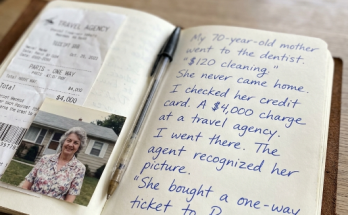
Part 1 — The One-Way Ticket
My 70-year-old mother went to the dentist.
“$120 cleaning,” she told me that morning.
She never came home.
At first, I wasn’t worried.
My mother, Evelyn, was independent to the point of stubbornness. She could spend three hours in a grocery store because she’d run into someone she knew.
But by seven that evening, she wasn’t answering her phone.
At nine, I called the dentist’s office.
Voicemail.
At ten, I drove to her house.
Her car was gone.
Her medication was still on the kitchen counter.
Her suitcase was missing.
That was when I checked the credit card account I helped her manage.
There was a charge from that morning.
Not $120.
$4,000.
A travel agency downtown.
I went there as soon as it opened the next morning.
The agent recognized my mother’s photograph immediately.
“Yes. She was here yesterday.”
“Was she alone?”
The woman hesitated.
“No.”
My stomach tightened.
“She purchased two tickets.”
“To where?”
“Paris.”
I almost laughed.
“My mother hates flying.”
The agent turned her computer toward herself.
“They’re one-way tickets.”
“One-way?”
“Yes.”
“Who was the second passenger?”
She gave me the name.
Dr. Nathan Reeves.
My mother’s dentist.
I drove straight to his clinic.
The doors were locked.
A FOR SALE sign hung in the window.
The police arrived twenty minutes later.
They broke the lock.
The clinic was completely empty.
No chairs.
No computers.
No dental equipment.
Nothing.
It looked as though someone had erased the entire business overnight.
But on the front desk was a note in my mother’s handwriting.
Don’t look for me.
Below it, the writing became shaky.
The flight leaves in six hours, and the man I’m traveling with is not Dr. Reeves.
I read that sentence twice.
“What does that mean?”
The officer took the note from me.
There was more on the back.
The real Nathan Reeves died fourteen years ago.
My knees nearly gave out.
The police immediately contacted the airport.
The tickets were real.
The flight was scheduled to leave that afternoon.
But the name Nathan Reeves belonged to a dentist who had died in another state in 2012.
The man operating my mother’s dental clinic had been using a dead man’s identity.
And apparently my mother knew.
“Why would she willingly buy him a ticket?” the detective asked.
“I don’t know.”
“Did your mother seem frightened recently?”
“No.”
“Secretive?”
I thought about it.
Three weeks earlier, she’d asked me how to scan old photographs.
A few days after that, she’d wanted to know whether deleted emails could be recovered.
I’d teased her about becoming a detective.
At the time, she’d laughed.
Now nothing about it felt funny.
The police searched the clinic.
Behind a loose panel in the reception desk, they found a flash drive.
On it were dozens of scanned documents.
Old newspaper articles.
Passport photographs.
Death certificates.
And photographs of men.
Different names.
Different cities.
But the same face.
The dentist.
Nathan Reeves.
Except in 2008, he’d apparently been Michael Turner.
In 2011, David Ross.
In 2016, Peter Lawson.
The detective looked at me.
“Your mother was investigating him.”
“But why?”
Then they found the photograph.
It had been scanned from an old Polaroid.
My mother looked about twenty-five.
Beside her stood a young man.
Even forty-five years younger, I recognized him.
The dentist.
On the back, my mother had written:
Paris, 1981. Daniel.
I stared at it.
“My mother has never been to Paris.”
At least, that’s what she’d always told me.
The detective enlarged the image.
Then he pointed to something.
My mother’s left hand rested on her stomach.
And on her finger was a ring I’d never seen.
“Who’s Daniel?” he asked.
“I have no idea.”
We searched my mother’s house.
Inside a box beneath her bed, we found letters tied with a ribbon.
All from 1981.
All signed:
Daniel.
The first few were love letters.
Then the tone changed.
Daniel was frightened.
Someone was looking for him.
He needed to leave France.
He promised he’d explain everything.
The final letter contained one sentence underlined twice.
If anything happens to me, don’t believe the name they give you.
I felt sick.
The police contacted the airline again.
My mother and the man using Nathan Reeves’s identity had already checked in.
They were inside the airport.
Officers were sent immediately.
I drove there with the detective.
We reached the international terminal with less than two hours before departure.
Then my phone rang.
Mom.
“Where are you?”
“Please go home.”
“Mom, the police are looking for you.”
“I know.”
“Who is that man?”
Silence.
Then:
“Someone I thought was dead.”
“Daniel?”
She stopped breathing for a second.
“You found the letters.”
“Yes.”
“Then you know enough.”
“No, I don’t.”
I heard an announcement behind her.
Boarding would begin soon.
“Mom, don’t get on that plane.”
“I have to.”
“Why?”
Her voice cracked.
“Because forty-five years ago, Daniel disappeared before he could tell me the truth.”
“And now?”
“Now he’s ready.”
I gripped the phone.
“Ready to tell you what?”
There was a long silence.
Then my mother said:
“Why your father wasn’t really your father.”
The call ended.
Twenty minutes later, police found my mother near the gate.
She was alone.
Daniel was gone.
His boarding pass had been scanned at security, but he had somehow disappeared inside the terminal.
My mother refused to explain.
Then the detective placed the old Polaroid in front of her.
“Evelyn, we know this man has used multiple identities.”
She stared at Daniel’s face.
“He had to.”
“Why?”
“Because someone spent forty-five years looking for him.”
“Who?”
My mother looked at me.
And for the first time, I saw genuine fear in her eyes.
“Her grandfather.”
I froze.
“My grandfather died before I was born.”
Mom shook her head.
“No.”
She reached into her handbag and removed a sealed envelope.
My name was written on it.
She handed it to me.
Inside was my birth certificate.
Or what looked like my birth certificate.
Except the father’s name had been covered by correction fluid decades earlier.
Underneath, faintly visible, was another name.
Daniel Mercer.
I looked at my mother.
“Daniel is my father?”
Before she could answer, her phone buzzed.
A message.
She read it.
All the color disappeared from her face.
“What?”
She handed me the phone.
The message contained a photograph taken only seconds earlier.
It showed my mother and me standing with the police.
Someone was watching us.
Underneath were six words:
Evelyn, you should have stayed quiet.
Then another message arrived.
This one was from Daniel.
Do not board the Paris flight. They found me.
And below it:
Take your daughter to Locker 214. Everything I’ve hidden for forty-five years is inside.
Part 2 — Locker 214
The police wanted to evacuate us from the terminal.
My mother refused to move until we opened the locker.
Locker 214 was downstairs near baggage storage.
The police opened it.
Inside was an ordinary black suitcase.
No clothes.
No money.
Just documents.
Hundreds of them.
Daniel Mercer hadn’t been hiding from one person.
He had been hiding from a criminal network he’d encountered while working for an international shipping company as a young man.
He had discovered falsified cargo records and payments routed through legitimate businesses.
When he tried to report what he’d found, someone inside his company warned him that the people involved knew his name.
So Daniel disappeared.
Different identities.
Different cities.
Different jobs.
The dental clinic had been his latest attempt at building a normal life.
“How did you find him?” I asked Mom.
She looked embarrassed.
“My tooth hurt.”
I stared at her.
“What?”
“I went to a new dentist six months ago.”
She had recognized him almost immediately.
Daniel hadn’t recognized her.
Not at first.
Then she’d said one sentence from one of his old letters.
He had dropped the instrument in his hand.
They met privately afterward.
Daniel told her everything.
He also told her he believed the people he’d spent decades avoiding were mostly gone.
He wanted to return to Paris, where he’d hidden the original evidence.
My mother agreed to go.
“Why didn’t you tell me?”
“Because I didn’t know whether I believed him.”
“So you investigated him.”
She nodded.
The flash drive.
The death certificates.
The false identities.
She had spent months checking his story.
Most of it matched.
Then came the part that mattered to me.
“Is he my father?”
Mom looked at the floor.
“Yes.”
I couldn’t speak.
The man who raised me, Robert, had known.
My mother had been pregnant when Daniel disappeared.
For months, she believed Daniel had abandoned her.
Later, she met Robert.
He married her.
He raised me as his daughter.
And when Daniel resurfaced briefly years later, Robert refused to let my mother tell me.
“He was afraid you’d leave him emotionally,” she said.
“But he was my dad.”
“I know.”
“Knowing Daniel existed wouldn’t have changed that.”
“I know that now.”
A police officer interrupted us.
They had found Daniel.
He hadn’t fled the airport.
He’d seen a man he recognized from his past and panicked.
Airport police found him hiding in a service corridor.
When they brought him into the room, I saw him differently.
Not as the dentist.
Not as the mysterious stranger.
As the man whose face I had apparently inherited pieces of.
He looked at me for a long time.
Then he said:
“You have Evelyn’s eyes.”
I didn’t know whether to laugh or cry.
“You owe me about forty-five years of explanations.”
He nodded.
“I know.”
The investigation that followed was far less cinematic than the beginning.
Some of Daniel’s information was decades old.
Some people involved were dead.
Other evidence could still be verified.
Authorities took possession of the documents.
Daniel spent hours answering questions.
And the threatening messages?
They weren’t from my grandfather.
That was the lie Daniel had believed for years.
Investigators eventually traced them to an elderly former associate connected to the original company.
He had learned Daniel was resurfacing and wanted to frighten him back into silence.
My grandfather had died years earlier.
Daniel had spent much of his life running from shadows that had gradually disappeared.
The Paris trip was canceled.
My mother’s $4,000 was eventually refunded.
And the mysterious dental clinic?
Daniel had already decided to retire.
He had sold the equipment weeks earlier and was preparing to sell the property.
His disappearance only made everything look far more sinister than it actually was.
Six months later, the three of us sat together at my mother’s kitchen table.
It was awkward.
Daniel was not suddenly “Dad.”
You can’t walk into someone’s life after decades and claim a title another man earned.
Robert was my father.
He attended school plays.
Taught me to drive.
Walked me down the aisle.
Sat beside me when my first marriage ended.
Daniel understood that.
“I don’t want to replace him,” he told me.
“Good.”
“I’d just like the chance to know you.”
I looked at my mother.
Seventy years old.
The woman who hated airplanes so much she once took a fourteen-hour train journey to avoid a ninety-minute flight.
“You were really going to fly to Paris with him?”
She smiled.
“I bought the ticket.”
“That’s not what I asked.”
She laughed.
“I was planning to take a sleeping pill.”
Daniel laughed too.
And suddenly they looked young.
Not physically.
But for a second, I could see the two people in that old Polaroid.
Two young people in Paris before fear, secrets, and forty-five years separated them.
A year later, Mom finally made the trip.
This time, I went with her.
Daniel came too.
When our plane took off, Mom squeezed my hand so hard my fingers hurt.
“I hate this,” she whispered.
“You’re the one who bought a one-way ticket last time.”
“That was temporary insanity.”
When we landed in Paris, Daniel took us to the place where the old photograph had been taken.
The building was still there.
We stood in almost exactly the same spot.
I took out the Polaroid.
Then I asked a stranger to take a new photograph.
Mom in the middle.
Daniel on one side.
Me on the other.
Three people connected by a truth that had taken forty-five years to reach daylight.
My mother never did get that $120 cleaning.
She still complains about it.
But whenever she does, I remind her:
“You went to the dentist with a toothache and came home with an international investigation, a trip to Paris, and my biological father.”
She always gives me the same answer.
“Worst dentist I’ve ever had.”
And Daniel, without fail, says:
“You never complained about my fillings.”
Some stories don’t give you back the years you lost.
They don’t erase the lies or make every decision understandable.
But sometimes they give you something else.
Time you thought was already gone.
And for my mother, Daniel, and me, that had to be enough.
THE END