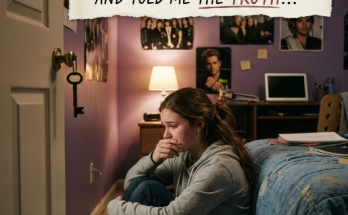
Chloe stared at the old photograph.
“I was seventeen.”
I sat beside her.
“You never told me.”
“I know.”
Maria quietly pulled up another chair.
Chloe’s voice became softer.
Her home life had been falling apart during her final year of high school.
Her parents were separating.
There were constant arguments.
Doors slamming.
Days when neither parent seemed to notice whether Chloe came home.
She started spending evenings anywhere except her house.
Libraries.
Bus stops.
Coffee shops.
Then one rainy night, she walked into this diner.
She had six dollars.
Maria was working the late shift.
“She ordered fries,” Maria said.
Chloe laughed through tears.
“Of course I did.”
“She stayed almost four hours.”
The next night, she came back.
Then the next.
Maria never pressured her.
Never demanded explanations.
She simply let Chloe sit in the corner booth.
Sometimes she brought extra fries.
Sometimes hot chocolate.
Sometimes she said nothing.
“One night,” Chloe continued, “I told Maria I didn’t want to go home.”
My chest tightened.
Maria had helped her contact an aunt Chloe trusted.
She stayed with that aunt until things at home stabilized.
Nothing dramatic.
No secret crime.
No giant family conspiracy.
Just a teenager who desperately needed one adult to notice that she wasn’t okay.
Maria had noticed.
Chloe wiped her eyes.
“When Leo was eight, you told me how hard restaurants were becoming for him.”
I remembered.
At the time, I had been exhausted.
Worried.
Constantly wondering whether I was doing enough.
Chloe continued.
“And I thought about this booth.”
She looked toward the corner.
“I thought maybe a place that had been safe for me could become safe for him too.”
That was why she kept coming back.
At first, Leo would sit in the corner and eat fries.
He didn’t speak much.
Maria learned not to approach too quickly.
The cooks stopped ringing the service bell when he was there.
Someone replaced a flickering light above the booth.
Little adjustments.
Nothing dramatic.
But they mattered.
Then one afternoon, Leo noticed another child covering his ears.
And everything changed.
“He asked me why the boy looked scared,” Chloe said.
“I told him maybe the noise hurt.”
Leo nodded.
“I knew where it was quieter.”
So he showed the boy.
That became the first time he helped someone.
Then another family.
Then another.
Over the years, the diner adapted with him.
And Leo adapted the diner for other people.
I looked at Chloe.
“You kept all of this from me because…”
She smiled.
“Because I didn’t want you turning it into therapy.”
I blinked.
Then laughed.
“That sounds terrible.”
“I know.”
She laughed too.
“But I knew you.”
She was right.
If she had told me when Leo was eight that the diner was helping him interact more, I would have measured everything.
How many words did he say?
How long did he sit?
Did he make eye contact?
Was he improving?
Was he progressing?
I would have turned a safe place into another place where Leo was being observed.
Chloe squeezed my hand.
“I wanted him to have somewhere that wasn’t about fixing him.”
That sentence hit me hard.
Leo looked at us from across the table.
“I didn’t need fixing.”
I swallowed.
“No.”
I smiled at him.
“You didn’t.”
For years, I had known that intellectually.
But sometimes parenting from fear makes you forget what acceptance actually looks like.
Chloe gave Leo a place where nobody cared whether he appeared more typical.
They cared whether he felt comfortable.
And once he did—
he began helping others.
Mr. Frank cleared his throat.
“So.”
Everyone turned toward him.
“What are we doing with my storefront?”
Leo stood.
He walked to the locked connecting door.
Then held up the brass key.
“I want tables.”
Maria laughed.
“Of course.”
“Not too many.”
“Okay.”
“Soft lights.”
“Good.”
“No hand dryer.”
The entire diner laughed again.
Leo continued seriously.
“Headphones.”
“A shelf with things people can use.”
“Pictures that explain what happens.”
“Water.”
“Charging outlets.”
Then he stopped.
“And fries.”
Maria smiled.
“Definitely fries.”
Three months later, the room opened.
They called it Leo’s Corner.
I tried to convince him to choose a different name.
He refused.
“People already know me.”
Fair enough.
It wasn’t a therapy center.
It wasn’t a clinic.
It wasn’t only for autistic people.
It was simply a quiet space connected to the diner.
Anyone could use it.
A child overwhelmed by noise.
An elderly customer who needed a break.
Someone having a difficult day.
A parent who needed five quiet minutes.
Nobody had to explain.
Nobody had to earn it.
The rule was written on a small sign near the door:
If you need quiet, come in.
Underneath, in smaller letters:
You can go back when you’re ready.
Leo wrote that himself.
The hospital job started after graduation.
Three days a week at first.
He helped review waiting rooms.
Signs.
Check-in processes.
Noise.
Lighting.
He was good at it.
Really good.
Not because autism magically gave him some special power.
Because he had spent years paying attention to what made spaces easier or harder for him and for the people he met.
That experience had value.
For the first time, other people were paying him for it.
Chloe came to the diner every month even after Leo started driving himself.
At first, I teased her.
“You know he doesn’t need a chaperone anymore.”
She smiled.
“I’m not here for him.”
She sat in the old corner booth with Maria.
Sometimes they talked.
Sometimes they didn’t.
Eventually, Maria retired.
On her final shift, Leo gave her a binder.
Not the original one.
A new one.
Inside were photographs from the opening of Leo’s Corner.
Letters from families.
Notes from hospital staff.
And on the first page was the old photograph of seventeen-year-old Chloe.
Underneath it, Leo had written:
Maria helped Chloe. Chloe brought me. Now lots of people come here.
Maria cried for nearly ten minutes.
Leo timed it.
“Eight minutes and forty-three seconds.”
She threw a napkin at him.
A few years later, Mr. Frank sold the building.
Before he did, he offered the diner first refusal on the storefront.
The owners bought it.
Leo’s Corner became permanent.
The Fries Fund became a small registered community program managed by the diner.
Leo insisted that his name not be attached to that part.
“Why?”
I asked.
He looked confused.
“Because fries don’t need my name.”
Fair point.
The biggest change, though, happened in me.
For years, I thought being Leo’s mother meant constantly preparing him for a world that might not understand him.
Teaching him.
Protecting him.
Helping him adapt.
I still did those things when he needed them.
But that eighteenth birthday showed me something I had missed.
Leo had also been changing the spaces around him.
Quietly.
Without speeches.
Without needing anyone to call him inspirational.
He simply noticed what made people uncomfortable.
And whenever he could, he made it a little easier.
Years later, I found the first guide he ever made.
One sheet of paper.
Crayon marks.
Messy handwriting.
At the top:
DINER THINGS TO KNOW.
Underneath:
Door bell is loud.
Corner booth is best.
Maria waits if you need time.
Fries are always the same.
At the bottom, Leo had added one final line.
People are nice here.
I framed it.
It hangs in Leo’s Corner now.
That little diner had been Chloe’s safe place before my son was even born.
Then she brought Leo there.
And for ten years, I thought she was simply giving him somewhere familiar to eat french fries.
I was wrong.
She gave him something much bigger.
A place where he could exist without being measured.
A place where people learned how to meet him halfway.
And once Leo felt safe enough to stop worrying about whether he belonged—
he started noticing everyone else who needed to belong too.
That was what Maria wanted me to understand on his eighteenth birthday.
My son hadn’t spent ten years learning how to fit into that diner.
He had spent ten years teaching the diner how to make room.
The End