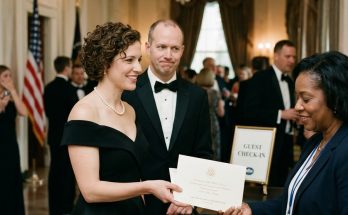
Two years after the sale, Cornerstone invited our family to the opening of the first completed phase of the development.
Not the full resort.
A clubhouse, part of the course, roads, and early facilities.
Former owners were invited.
I almost declined.
Then Melissa asked:
“Do you want to see it?”
I realized I did.
Not because I wanted a plaque.
Because for ten years I had pictured the property as a failed field and a tax bill.
I wanted one look at what it had become.
Caroline came.
Richard too.
We drove out together.
The place was almost unrecognizable.
Where I had once parked an old pickup beside waist-high grass, there was paved access, drainage, and construction equipment.
A Cornerstone executive shook my hand.
“You must be proud.”
I smiled.
“I’m mostly glad someone found a use for it.”
He laughed.
A local photographer asked for a picture of the former owner with his family.
We stood together.
Caroline beside me.
Richard on one side.
Melissa on the other.
If someone saw only that photograph, they would probably imagine a united family celebrating a brilliant investment.
The real story was much messier.
But a photograph does not have to carry every truth.
After the ceremony, we walked along the edge of the property.
Melissa asked where the old underground tank had been.
I pointed roughly.
Richard groaned.
“I still hate that tank.”
We laughed.
Caroline looked at me.
“Do you regret that I didn’t share in the land?”
I thought.
“I regret that our marriage got to a place where the old agreement felt normal. I don’t regret respecting its logic once the land became valuable.”
She nodded.
“I don’t either.”
That surprised me.
“Why?”
“Because if I had automatically received half the upside after demanding protection from half the downside, I think I would have learned the wrong lesson.”
I took her hand.
No need to turn it into a speech.
Richard and Melissa were ahead of us.
I resisted the instinct to listen.
Their relationship belonged to them.
At lunch, the Cornerstone representative described how the highway interchange had transformed the entire region.
Several formerly marginal parcels were now worth far more.
That reminded me again how much luck had mattered.
If the interchange had been built elsewhere, I would not be telling a story about fifteen million dollars.
I might still be paying taxes.
That mattered because families love to rewrite outcomes as proof of character.
If the land stayed worthless, I was reckless.
Because it became valuable, I was suddenly visionary.
Neither was fully true.
The original purchase had involved risk.
The environmental problem had been bad luck.
Holding the property had required stubbornness and patience.
The interchange was luck.
The result did not prove I had always been right.
Just as Caroline’s fear did not make her disloyal.
And Richard’s refusal did not make him a monster forever.
On the drive home, Richard asked:
“If Cornerstone had offered fifteen million five years earlier, do you think Mom would have signed the agreement?”
Caroline answered immediately.
“No.”
We all laughed.
Then she said:
“And that’s why I can’t pretend today’s price existed when I made the decision back then.”
Exactly.
Decisions should be judged using the information people had at the time.
Not only the outcome.
I bought a risky property.
She protected herself.
Richard advised her.
All reasonable in part.
What became unreasonable was how we treated one another when the circumstances changed.
The hospital.
The pressure.
The assumptions.
Those were choices we could own.
At the end of the visit, Cornerstone gave us small gift bags.
A hat.
A golf ball.
Richard held up the ball.
“Finally. My share of the land.”
Melissa laughed.
Caroline covered her face.
I pointed at him.
“Too far.”
He raised both hands.
“Fair.”
We all laughed anyway.
The joke did not erase the pain.
It showed the pain no longer controlled every sentence.
On the way home, we stopped at a roadside café.
Caroline looked at Richard.
“I owe you an apology too.”
He frowned.
“For what?”
“I made your success into a family trophy. I told everyone about your deals.
I treated you like the proof that our family was doing well.”
Richard looked embarrassed.
“I liked it.”
“I know. And when your father needed help, I protected your celebration because I had put so much emotional weight on your success.”
Then she looked at Melissa.
“And I treated you like the reliable daughter who would solve whatever everyone else avoided.”
Melissa nodded.
“Yes.”
No softening.
Caroline cried.
“I’m sorry to both of you.”
Richard said:
“I used the successful-son role to avoid things.”
Melissa said:
“And I used the responsible-daughter role later to feel better than Richard.”
We all sat with that.
The land had exposed more than ownership.
It had exposed family roles.
Successful child.
Responsible child.
Failed father.
Practical mother.
Those roles had once helped us simplify a hard decade.
Then they trapped us.
Money changed.
People can too.
That day, driving away from the property, I finally felt the land become ordinary real estate instead of a member of our family.
That was a relief.
At the Cornerstone opening, a local reporter recognized my name from the old property filings.
“Are you the owner who made millions because of the interchange?”
“Former owner.”
“Would you tell us the story?”
I declined.
Not because I was ashamed.
Because public stories flatten people.
The headline would become:
Dad denied $3,200, gives $15 million land to loyal daughter.
Catchy.
Wrong in important ways.
Richard did not receive nothing forever.
Melissa did not buy a fortune with $2,000.
Caroline was not simply greedy.
The property did not produce $15 million net.
And none of us needed strangers voting on who was right.
I gave the reporter one safe comment about the development being good for the area.
That was enough.
Our family had spent too long performing money for audiences.
Church friends.
Relatives.
Business contacts.
I wanted the repair to remain mostly ours.
Before we left Cornerstone that day, Melissa pulled me aside.
“If you ever tell this story publicly, promise me something.”
“What?”
“Do not tell people I turned two thousand dollars into millions.”
“I wouldn’t.”
“People love that kind of story.”
She was right.
It would sound like a moral lottery ticket.
Help your parent and maybe they are secretly rich.
Terrible lesson.
“What should I say?”
She thought.
“Say I helped because I thought you had nothing to give back. And later you made a separate property decision because you trusted me.
Those things are connected emotionally, not as a transaction.”
That was exactly right.
Richard later asked for his own correction.
“Do not say I personally had twelve million dollars and refused you thirty-two hundred.”
“Fair.”
“You can still say I could afford to help.”
“You could.”
“I know.”
Accuracy protected everyone.
Not from consequences.
From becoming simpler than they really were.
If the story was ever told, I wanted the main point preserved without making the people unreal.
The reporter later published a short piece about the development.
My name appeared once.
No family story.
I was relieved.
Richard sent the link with one message:
Boring. Perfect.
Exactly.
For years, our family had been attracted to dramatic financial narratives.
Big deal.
Failed land.
Huge offer.
Sacrificing daughter.
Selfish son.
The more boring the public version became, the more room we had to be complicated privately.
I began to value that.
Not every meaningful lesson needs an audience.
Some of the healthiest changes in our family happened because no one outside us was watching and no one needed to win.
Click here to continue reading: PART 12: Finalizing my estate plan forced me to tell both children plainly that unequal dollars would never mean unequal love or a permanent judgment on their character
My son refused $3,200 for my urgent procedure, my daughter sacrificed nearly everything, and then the land my family called worthless drew a $15 million offer
Part 11 of 13