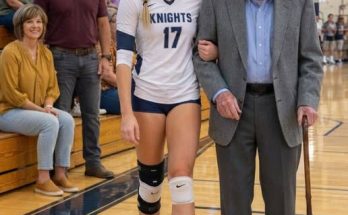
Emily was nineteen when she moved out for her apprenticeship.
Not far.
Forty minutes.
A small shared apartment.
Her trust paid a reasonable portion under the training terms.
She covered the rest with wages.
The first night after she moved, Richard’s house became enormous.
It had always been enormous.
But children fill space.
Without her, I heard every clock.
Every creak.
Richard’s bedroom had long since become an office.
The library remained.
The garden remained.
I asked myself:
Why am I still here?
Immediate answer:
Because Richard left it for me.
Then:
Because I can stay for life.
Then the most honest answer:
Because leaving still feels like losing a home.
There it was.
The trust had given me a legal right to leave.
My history kept me emotionally inside.
I talked to Dr. Ortiz.
“If you move, does that mean the house was never truly yours?”
“No.”
“Does selling mean rejecting Richard?”
“No.”
“Then what does it mean?”
I did not know.
Maybe security had finally done its job.
Maybe I no longer needed to keep every wall to prove no one could move me.
I called Arthur.
He was semi-retired by then.
He explained the mechanism.
The trust could sell the property.
A defined amount could be used to purchase or fund a replacement residence appropriate to my lifetime housing right.
The remainder stayed invested for trust obligations and eventual charitable distribution.
I could not take all the difference in cash.
Fine.
I toured houses.
Then apartments.
A small three-bedroom house near the city caught me.
Tiny garden.
Bright kitchen.
No elevator needed.
No eight unused rooms.
I visited three times.
Emily said:
“Buy it.”
“It isn’t exactly me buying it.”
“You know what I mean.”
I did.
I still hesitated.
Then I found one of Richard’s old notes in a maintenance binder.
Nothing sentimental.
A list.
Repair shutter.
Call plumber.
Ask Anna whether she might want something smaller after Emily leaves.
I sat on the floor.
He had thought about it.
Again.
This time I did not feel angry.
Only tenderness.
He knew the house might become weight.
He had not written:
Never leave.
He built an option.
I chose to sell.
The trust hired professionals.
Valuation.
Broker.
Inspection.
No rushed transaction.
Several months later, the property sold to a couple with three children.
I met them once.
They loved the garden.
The woman asked:
“Are you sure you want to leave?”
An innocent question.
I smiled.
“Yes.”
And I was.
On the last day I walked through every room.
The bedroom where Emily had burned with fever.
The library where Richard proposed.
The hallway where his wheelchair had hit the wall more than once.
The table where Arthur placed the envelope.
I cried.
But it was not panic.
It was ordinary grief.
I left the key on the counter for the agent.
Then walked out.
No foster parent was sending me away.
No landlord was taking anything.
I was leaving.
Choice.
The word finally had physical weight.
My new house was smaller.
The first night, boxes were everywhere.
I was afraid.
Not rationally.
My body remembered childhood moves.
New ceiling.
New sounds.
Who decides how long I stay?
I got up at two in the morning.
Found the trust documents.
Read the housing provisions.
Then stopped.
I did not need to read them every night.
The document existed.
I was an adult.
I could be there.
Within weeks the house began to look like me.
Not Richard.
Not Michael.
Me.
I chose the curtains.
Bought a couch far less elegant than the old one.
Hung photographs of Emily.
One of Michael.
One of Richard.
Not side by side as rivals.
Different chapters.
On a shelf in my office, I placed one black chess knight from Richard’s set.
That was all.
The estate had been our home.
The smaller house became home too.
That may have been the most important thing Richard’s security gave me.
Not a building.
The chance to learn that a home can change without belonging disappearing.
Moving closer to the city changed my life in another way.
I began working part-time at an independent bookstore.
Not because I needed money.
Because I wanted to.
Emily was shocked.
“Why would you work?”
“Because I like working.”
“But you don’t have to.”
Exactly.
For the first time, employment was not tied directly to survival.
I handled orders and worked the front desk three days a week.
The pay was modest.
I used some for ordinary expenses and put some into an account in my own name.
Not necessary.
Symbolic.
I enjoyed earning money myself.
Not because Richard’s trust income was shameful.
Because my identity had spent years swinging between scarcity and being financially protected by someone else.
Chosen work gave me another texture.
At the bookstore, people did not know my story at first.
I carried boxes.
Talked to customers.
Made mistakes on the register software.
A twenty-two-year-old coworker patiently taught me the system.
I loved being a beginner.
No one called me Mrs. Vale.
No one asked about the foundation.
After three years, I left the bookstore.
No crisis.
I wanted more time for Second Door and myself.
Those years gave me something inheritance could not.
Proof that I could choose a role simply because I liked it.
Not because I had to survive.
That freedom was new.
And gentle.
The move also forced me to deal with something less sentimental and more practical: what to do with Richard’s belongings.
I had already donated clothes years earlier.
The furniture was harder.
Some pieces belonged to the house and moved with the sale.
Some were mine to keep.
A few had emotional weight.
His desk.
The leather chair in the library.
A cabinet where he kept chess sets.
For weeks I treated every object like a test.
If I sold the desk, did that mean I was erasing him?
If I kept it, was I letting a dead man furnish every future room?
Dr. Ortiz laughed gently when I described the dilemma.
“Sometimes a desk is a desk.”
“I know.”
“Do you?”
Apparently not.
I asked Emily to choose anything she genuinely wanted.
She chose one chess board.
Not the most valuable.
The scratched wooden one Richard used with her.
Good choice.
I kept his fountain pen and one photograph.
The rest was appraised, donated or sold according to ownership and trust rules.
I expected regret.
Mostly I felt relief.
Memory became lighter when it did not require storage space for every object.
That lesson helped later with my own possessions.
Keeping everything because someone died can turn grief into inventory.
I wanted memories.
Not a warehouse.
The new house had room for what I actually used.
That was another kind of freedom Richard’s planning had accidentally made possible.
He gave me enough security that I did not need to preserve expensive objects as emergency value.
I could let a chair be sold because I was not secretly wondering whether I would need to sell it for rent someday.
That realization made me cry too.
Security changes the emotional meaning of objects in ways I had never understood when I was poor.
Click here to continue reading: PART 11: When Second Door made its first serious mistake, I learned that a generous mission does not protect an organization from the very abuses of power it was created to fight
Richard’s lawyer said the will left me nothing, but the envelope in front of me contained a confession that forced me to see our marriage in an entirely different way
Part 10 of 16