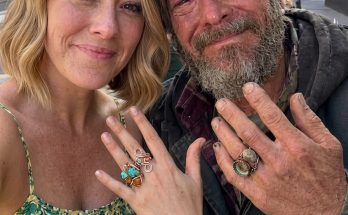
Noah and I married on a Saturday in October.
There were thirty-two people.
I knew because Eli counted them twice.
We held the ceremony in the courtyard behind a small restaurant near the river. Holly wore dark green. Mason complained about his tie until Dana threatened to frame a photograph of him frowning. Eli carried the rings and nearly dropped one between the deck boards.
Grant attended.
That had not been my original plan.
Months earlier, Noah asked whether I wanted him there.
“I don’t know,” I said.
“Would it make the kids easier?”
“Probably.”
“Would it make you uncomfortable?”
“Probably.”
He considered that.
“Which problem matters more?”
I laughed.
“Why are you so reasonable?”
“I’m not. Ask my daughter.”
In the end, I invited Grant and Rachel because the children had important roles in the ceremony and I did not want them splitting their joy into acceptable and unacceptable halves.
Grant stood at the back with Rachel and little Nora.
He did not approach me before the ceremony.
Afterward, he shook Noah’s hand.
“Take care of her,” he said.
I heard it.
Before I could object to the ancient language of men transferring responsibility for women, Noah said, “She takes care of herself pretty well.”
Grant laughed.
“Fair.”
Then he looked at me.
“Congratulations.”
“Thank you.”
That was all.
My father cried during the ceremony.
Later he claimed it was allergies.
No one believed him.
Mom danced with Mason.
Dana gave a toast that lasted exactly three minutes because I had threatened to cut the microphone if she told embarrassing childhood stories.
Eric came too.
Our relationship was still distant, but he hugged me and said, “You look happy.”
“I am.”
He nodded.
“I’m glad.”
It was not repair.
It was kindness.
I accepted it for what it was.
Marriage to Noah did not feel like my first marriage.
Partly because we were older.
Partly because the children were older.
Mostly because neither of us confused dependence with devotion.
We kept separate retirement accounts.
We opened one joint household account for shared expenses.
The house we bought together was titled as our attorney recommended, with clear estate provisions because both of us had children from previous relationships.
Holly once rolled her eyes while I explained beneficiary designations.
“Mom, you made marriage into a spreadsheet.”
“Yes.”
“Is that romantic?”
“Very.”
Noah called from the garage, “Extremely.”
The first real crisis of our marriage came from Mason, not us.
At seventeen, he was caught with alcohol at a party after driving there with friends.
He had not been driving when police arrived, but the situation terrified me.
Grant and I disagreed immediately.
Grant wanted Mason’s license taken for six months.
I thought that was too long because Mason needed to drive to work and school activities.
Noah stayed out of it unless I asked.
Rachel did the same.
Grant and I met at a coffee shop, just as we had years earlier when everything was breaking.
“This feels familiar,” he said.
“Less adultery.”
He choked on his coffee.
“Please never say that sentence again.”
We negotiated consequences.
Mason lost social driving privileges for three months, had to contribute to the legal and administrative costs related to the incident, attend an alcohol education program, and maintain transportation only for school, work, and family obligations.
He thought we were cruel.
That was acceptable.
The important thing was that Grant and I presented one plan.
Mason could not shop for a softer parent.
Afterward, Grant said, “We’re weirdly good at this now.”
“Parenting?”
“Being divorced.”
I smiled.
“It took practice.”
The children’s graduations began arriving one by one.
Holly finished high school first.
At the ceremony, she had four parents in the audience if anyone counted generously: me, Noah, Grant, and Rachel.
My parents were there too.
When Holly’s name was called, all of us stood.
She saw us from the stage and laughed.
Later, she said, “You looked ridiculous.”
“We were proud.”
“You were blocking people.”
“That too.”
She chose a state university three hours away.
The night before move-in, she sat on my bed the way she had when she was little.
“What if I hate it?”
“Then you give it enough time to know whether you hate the place or just hate being new.”
“What if I want to come home?”
“You can.”
She was quiet.
“Even if I make a dumb choice?”
The question took me back to my parents’ porch so quickly I almost lost my breath.
I looked at her.
“Yes.”
“What if I date someone you hate?”
“You can still come home.”
“What if I fail classes?”
“You can still come home.”
“What if I get pregnant?”
My heart stopped for half a second.
“You can still come home.”
She smiled.
“I’m not pregnant.”
“Thank God.”
“I just wanted to know.”
I touched her hair.
“You never have to earn the right to ask me for a safe place.”
That was the promise I had needed at thirty-four.
I could at least give it to her at eighteen.
Move-in day was chaotic.
Grant carried boxes.
Noah assembled a shelf.
Rachel made the bed because apparently none of us could manage fitted sheets correctly.
I stood in the doorway while Holly arranged photographs.
One was from my wedding to Noah.
One was from Grant and Rachel’s house with Nora.
One showed my parents at a picnic.
Her family did not fit one simple shape.
It did not need to.
Before we left, Holly hugged me longer than usual.
“You did okay, Mom.”
“With what?”
“Everything after.”
I laughed softly.
“High praise.”
“I mean it.”
I believed her.
Click here to continue reading: PART 12: When Dad Became Ill, I Had to Decide What Family Duty Meant Without Losing Myself Again
The Night My Marriage Broke and My Parents Closed Their Door on Us
Part 11 of 16