Emily met Marcus at a charity 5K she did not want to attend.
That detail made me trust the relationship immediately.
Anyone can meet a man at a romantic dinner.
Meeting one while sweaty, annoyed, and wearing a paper race number reveals more useful information.
Marcus was an occupational therapist.
He worked at a different rehabilitation center.
He was thirty-two, patient, and terrible at making pancakes.
Emily brought him to Sunday dinner three months after they started dating.
He arrived with flowers for me.
“Those are suspiciously appropriate,” I said.
“My mother trained me.”
“Good woman.”
Emily rolled her eyes.
Marcus knew the story of the house.
Not every detail.
Enough.
The first time he used the bathroom, he returned and said, “That grab bar installation is excellent.”
Emily pointed at herself.
“I did that.”
“I’m reconsidering the relationship.”
I liked him.
Greg did not meet Marcus until several months later.
That was Emily’s choice.
She and her father were having lunch every few weeks by then.
Not rebuilding childhood.
Building something adult.
Greg respected the pace more than I expected.
When Emily finally invited him and Dana to dinner at her apartment, I was not there.
That was also good.
Their relationship did not need me as witness or referee.
The following day, Emily called.
“It was weird.”
“Good weird?”
“Mixed weird.”
“Those are the best families can offer.”
Marcus proposed the next spring.
Emily called me before anyone else.
“He asked.”
“And?”
“I said yes.”
I screamed loudly enough that my medical alert watch asked if I needed assistance.
Emily laughed for five minutes.
Wedding planning introduced a question none of us expected.
Where would Emily get married?
She wanted something small.
Marcus wanted outdoors.
Venues were expensive.
One Sunday, she stood in the backyard looking at Walter’s maple tree.
“What?” I asked.
“Would you hate it if we got married here?”
I looked at the yard.
Walter had planted that tree when Greg was ten.
Emily used to hang from its lowest branch when she was little.
Now she was asking to begin a marriage beneath it.
“No.”
Her eyes filled.
“Really?”
“Yes.”
Then I added, “But you own the place. You technically do not need my permission.”
She laughed through tears.
“I absolutely need your permission while you live here.”
That answer told me I had chosen well six months before Greg ever saw the deed.
The wedding was in September.
Forty-two guests.
White chairs on the lawn.
String lights between the maple and the garage.
Rosa came early and helped arrange flowers.
Dana baked two pies.
Greg wore a dark suit that fit him badly because he had lost weight after changing jobs.
He offered to walk Emily down the aisle.
She said no.
Not cruelly.
“I want Grandma to walk with me.”
Greg’s face fell.
Then he nodded.
“I understand.”
Later that evening, I found him alone near the side gate.
“You okay?”
“Yeah.”
“You look like someone stole your dog.”
He smiled without humor.
“I deserved that.”
“Maybe.”
He looked toward the yard where Emily was laughing with Marcus.
“I missed too much.”
“Yes.”
“I can’t fix it.”
“No.”
“That’s a terrible pep talk, Mom.”
“I am eighty-three. I am retired from pep.”
He laughed.
Then his eyes filled.
“I’m glad she has you.”
“So am I.”
I touched his arm.
“And I am glad she has some version of you again.”
He nodded.
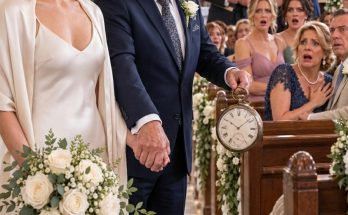
When the ceremony began, Emily linked her arm through mine.
“Walk slow,” she whispered.
“I have a cane. I was planning to sprint.”
She smiled.
We walked under the maple tree together.
Halfway down the aisle, I looked at Greg.
He was standing beside Dana.
He was crying.
This time, nobody moved him to a back row.
Nobody told him he did not count.
Emily had given him a seat.
Not the place he once assumed he deserved.
A place she chose.
There was dignity in that too.
After the wedding, Marcus and Emily discussed moving.
Their apartment was small.
They wanted children someday.
Emily could have moved into my house.
She owned it.
She never suggested it.
Instead, they bought a modest three-bedroom home fifteen minutes away.
“You could save money living here,” I said once.
She looked at me.
“Grandma.”
“Yes?”
“Do you remember why I own your house?”
I laughed.
“Point taken.”
The following spring, Emily told me she was pregnant.
I was eighty-four.
I sat down very slowly.
“Are you all right?” she asked.
“No.”
Her face changed.
Then I smiled.
“I am going to be a great-grandmother.”
She cried.
I cried.
The medical alert watch remained silent.
Good device.
When Greg learned, he called me that night.
“I’m going to be a grandfather.”
“You already are emotionally exhausting.”
“Mom.”
“I’m happy for you.”
He was quiet.
“Do you think she’ll let me be involved?”
“That is a question for her.”
“I know.”
He paused.
“I’m scared to ask.”
“Ask gently.”
He did.
Emily said yes, with limits.
No unannounced visits.
No opinions disguised as commands.
No criticizing Marcus’s parenting.
Greg accepted every rule.
I laughed when Emily told me.
“What?”
“You sound like me.”
“That is alarming.”
The baby, Nora, was born in November.
I held her when she was two days old.
She slept against my chest while Emily rested on the couch.
Marcus made tea.
Greg arrived later and stood in the doorway until Emily invited him in.
He washed his hands without being told.
Then he looked at his granddaughter.
His face changed.
Not dramatically.
Softened.
“Can I hold her?”
Emily looked at Marcus.
Then at Greg.
“Yes.”
He sat down.
Emily placed Nora in his arms.
Greg cried silently.
I watched from across the room.
There are moments when a family does not become whole.
Whole is too simple.
Something new forms instead.
Made from what survived.
Made from what changed.
Made from what will never be repaired.
Still worth holding.
Before the wedding, Emily worried about whether selling the house to her had changed how Marcus saw her.
“What do you mean?” I asked.
“He knows I own a house because my grandmother sold it to me under unusual circumstances. Sometimes I worry it sounds like I benefited from family chaos.”
“Did you?”
She frowned.
“I don't know.”
“You took on a mortgage, taxes, repairs, and a lifetime tenant with opinions.”
She laughed.
“Very strong opinions.”
“Then let Marcus decide whether that sounds like easy money.”
Later, Marcus told me privately that he admired what Emily had done.
“Not because of the property,” he said. “Because she protected you without trying to own your decisions.”
I liked him even more after that.
The house had once exposed the worst instincts in our family.
Now it was revealing better ones too.
Not because buildings have moral power.
Because property forces people to show what they believe they are entitled to.
Click here to continue reading: PART 12: When Dana needed surgery, our roles reversed again without turning care into a debt anyone could collect
The morning my son tried to remove me from a house that was no longer his to claim
Part 11 of 16