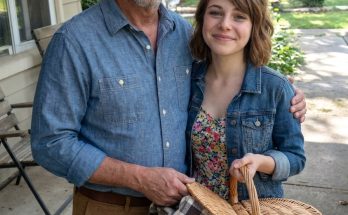
I invited the grandchildren to the cottage the following Saturday.
Owen came in first.
He was fifteen.
Tall.
All elbows.
The younger child from the birthday table was now old enough to understand tension even when adults thought they hid it.
His sister, Mia, was twelve.
She ran straight to the porch swing.
“Grandma, you have a swing.”
“Yes.”
“Can I sleep here?”
“Sometimes.”
Owen looked around.
“So this is why you didn’t want Sunrise Pines.”
“One reason.”
He hesitated.
“Dad says you own our house.”
There was no point pretending.
“Yes.”
“Why?”
“I bought it when the previous owner sold.”
“Are you kicking us out?”
I chose words carefully.
“The rental agreement is ending after proper notice. Your parents are choosing where the family lives next.”
He frowned.
“That sounds like lawyer talk.”
“It partly is.”
“Are you mad at Dad?”
“Yes.”
“Are you mad at us?”
“No.”
Mia looked worried.
“Do we still get to come here?”
“Of course.”
That was the question beneath all the others.
I made grilled cheese.
We ate at the oak table.
Then Owen asked about the scratch ticket.
“Did you really win millions?”
I looked at him.
“Your parents told you?”
“Dad said you had a big financial change.”
That was responsible.
“Yes. I won a large prize.”
“How much?”
I laughed.
“This family has one question.”
He smiled.
“Can I have a car?”
“No.”
“Worth trying.”
I liked that he could joke.
Then I told them something important.
“Your parents and I are having adult disagreements. You do not need to choose a side.”
Mia nodded.
Owen looked unconvinced.
“Dad says you’re hurt.”
“I am.”
“He feels bad.”
“I know.”
“Then why not just let us stay?”
A fair question from a fifteen-year-old.
“Because feeling bad does not automatically change every decision.”
He thought about that.
“If I apologize for not doing homework, I still get a zero?”
“Possibly.”
“That’s brutal.”
I laughed.
“Your father’s housing is more complicated than homework.”
We left it there.
When Daniel picked them up, he came inside.
He looked relieved to see everyone laughing.
Mia showed him the guest room.
Owen showed him the porch.
At the door, Daniel said quietly, “Thanks for not telling them everything.”
“They don’t need everything.”
He nodded.
“I’m trying not to make you the bad guy.”
“Good.”
“I’m also trying not to make myself the bad guy.”
“That may be harder.”
He almost smiled.
“Yeah.”
Then he said, “We’re looking at rentals.”
“Good.”
“We may not buy.”
“That’s okay.”
“Still deciding.”
For the first time, the house issue sounded like a practical decision instead of a moral verdict.
That was progress.
The grandchildren’s visit became a turning point for me too.
Until then, I had secretly hoped they would be angry at their parents.
I am not proud of that.
Not openly.
I would never have said, “Your parents treated me badly.”
But part of me wanted Owen to see the injustice.
Wanted Mia to choose me emotionally.
That impulse frightened me.
Children are powerful evidence in family disputes because everyone wants their love.
Using that love is a form of pressure.
I called Martin afterward.
“Is it strange that I’m telling my lawyer this?”
“Yes.”
“Helpful.”
“Also yes.”
He recommended a family therapist who worked with multigenerational conflicts.
I resisted.
“I’m not in crisis.”
“Therapy is not emergency plumbing.”
I laughed.
Eventually, I went.
The therapist, Dr. Ellis, asked what outcome I wanted.
“I want my son to understand.”
“Understand what?”
“That I was hurt.”
“And if he understands but still disagrees with the tenancy decision?”
I paused.
“Then I want to tolerate that.”
That answer surprised me.
Maybe that was the real work.
Not forcing shared interpretation.
Building a relationship strong enough for different interpretations.
Dr. Ellis helped me separate validation from agreement.
Daniel could believe terminating the tenancy was harsh.
I could believe it was necessary.
Both could still love each other.
That idea made the family conflict less like a trial.
No verdict required.
Owen eventually asked whether the scratch ticket meant he was rich.
“No.”
“But you are.”
“I have money.”
“That is not the same?”
“Not exactly.”
He rolled his eyes.
Teenagers hate philosophical distinctions.
I explained more plainly.
“My money does not belong to you now.”
“Okay.”
“It may support some things.”
“College.”
“Yes.”
“Car?”
“Maybe a reasonable one much later, depending on the plan.”
“Sports car?”
“No.”
He smiled.
“Had to ask.”
Mia asked a different question.
“If you’re rich, why is your couch normal?”
I laughed.
“What should it be?”
“Like gold?”
“Absolutely not.”
She thought wealthy people lived inside music videos.
I showed them the investment statement summary.
Not balances.
Categories.
Stocks.
Bonds.
Cash.
Trusts.
“Most wealth looks boring,” I said.
That lesson interested Owen more than any amount.
He asked about compound returns.
I sent him to Denise.
Let professionals teach the grandchildren before Grandma accidentally turns dinner into a seminar.
The grandchildren eventually asked whether their parents had been mean to me.
I refused the category.
“They handled something badly.”
Owen rolled his eyes.
“That sounds like adult diplomacy.”
“Probably.”
“Were you mad?”
“Yes.”
“Then why not say they were wrong?”
“They were wrong to plan without me.”
“That’s what I mean.”
“No. You want me to turn one action into a permanent description of them.”
He thought about that.
At fifteen, he wanted moral clarity.
I understood.
Stories often reward that.
Good parent.
Bad child.
Cruel daughter-in-law.
Wronged grandmother.
Real families are harder.
People can behave selfishly and still love you.
People can apologize and still disagree.
People can hurt each other without being monsters.
I wanted the grandchildren to learn nuance without learning to tolerate mistreatment.
That is a narrow path.
We walked it imperfectly.
Owen’s concern about choosing sides returned when he argued with Daniel about college.
He called me.
“Dad never listens.”
I knew the trap.
I could become the good adult against the unreasonable parent.
So I said, “Tell me what he said.”
Owen explained.
Daniel wanted him to apply to more schools.
Reasonable.
Owen wanted fewer.
Also reasonable.
I refused to intervene.
“Grandma.”
“I love you. Talk to your father.”
He groaned.
That was progress.
My role was grandmother.
Not alternative parent.
Mia once asked if the lottery was “family money.”
“No.”
She looked surprised.
“Not even partly?”
“It may benefit family. It is still mine.”
That distinction was not selfish.
Ownership makes generosity possible.
If money automatically belongs to everyone near you, consent disappears.
I wanted them to understand that before inheritance ever became relevant.
The grandchildren began using the cottage as neutral territory when their parents annoyed them.
I had to be careful.
I listened.
I did not undermine rules.
If Daniel grounded Owen, I did not turn my house into an escape.
Grandparent love is easy to misuse because it feels kinder than discipline.
I wanted safety without sabotage.
Owen eventually apologized for laughing at the bus-ticket joke on my birthday.
He had been following his parents.
Still, he remembered.
“I was a jerk.”
“You were a child.”
“I still laughed.”
“Yes.”
I hugged him.
Accountability can be age-appropriate without becoming shame.
The grandchildren adapted faster than the adults. They wanted to know where the snacks were, whether Wi-Fi worked, and which room was theirs when visiting. Children often return life to practical scale.
The grandchildren learned that adults can disagree and still remain family. I considered that one of the better outcomes.
The grandchildren benefited most when the adults stopped using them as evidence.
They did not need to prove who was right.
They needed stable parents, a grandmother who remained available, and permission to love everyone.
That sounded simple.
It required discipline.
Every time I wanted to say, 'See what your father did,' I remembered they were not jurors.
They were children.
Keeping them out of the adult scorekeeping may have been the healthiest decision we made.
Owen and Mia grew up knowing the adult conflict had happened without being asked to carry its details. I was proud of that boundary.
The grandchildren remembered the cottage for snacks and the porch, not the tenancy dispute. I was grateful.
Click here to continue reading: PART 7: Selling the rental house became possible only after I stopped using it to measure love
The landlord’s letter arrived and Daniel finally recognized Harold’s old company name
Part 6 of 16