Maya recovered quickly.
She went back to work after two weeks.
She complained about being tired, hated the lifting restriction, and tried to negotiate with Dr. Alvarez about returning to the gym.
The doctor won.
Daniel enjoyed that more than he should have.
“Medical professionals remain undefeated.”
Maya pointed at him.
“You are never allowed to brag on behalf of doctors.”
“Fair.”
Six weeks later, the follow-up ultrasound looked good.
The ovary had healthy blood flow.
The incisions had healed.
No additional treatment was needed.
Maya called us from the parking lot.
“All clear.”
I closed my eyes.
“Good.”
Daniel said, “Did you ask about recurrence?”
“Yes.”
“Did you ask—”
“Consultant.”
He stopped.
“Right.”
Maya laughed.
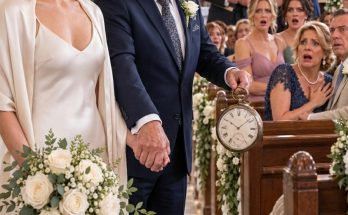
Two months later, she married Noah.
There was no dramatic reconciliation speech at the wedding.
No public mention of hospitals.
No father-daughter performance designed to prove that everything had been forgiven.
Daniel walked her halfway down the aisle because that was what Maya wanted.
Then they stopped.
I joined them.
For the final few steps, Maya walked between both of us.
Her choice.
At the reception, Daniel danced with her.
So did I.
Noah’s mother danced with her too.
Families are allowed to be wider than tradition.
Near the end of the night, Maya found me alone on the hotel terrace.
“You okay?”
“I’m happy.”
“You’re crying.”
“Those things can coexist.”
She leaned against the railing.
“I was thinking about when I was fifteen.”
“So was I.”
“Of course you were.”
She smiled.
Then she said, “I used to think the worst thing Dad did was miss the cyst.”
I looked at her.
“What do you think now?”
“The worst thing was teaching me not to trust what I felt.”
I waited.
“And the best thing he did afterward?”
She looked through the glass doors.
Daniel was helping Noah’s father gather abandoned champagne glasses.
“He stopped asking me to trust him and started acting trustworthy.”
I felt my throat tighten.
“That sounds right.”
She nudged me.
“You did too.”
“What did I do?”
“You stopped asking me to make you feel like a good mom.”
That landed harder than I expected.
“I did that?”
“At first.”
I thought about those early days.
How often I had searched her face for proof I had rescued her in time.
How much I wanted her to tell me I had not failed.
She had been fifteen.
She had just had surgery.
She should never have had to reassure me.
“I’m sorry.”
“I know.”
She smiled.
“You learned.”
That was the strange fairness of children growing up.
Eventually, if you are lucky, they get old enough to tell you where you got it wrong.
A year later, Maya and Noah bought a small house.
Nothing fancy.
Two bedrooms.
A yard barely large enough for a grill.
Daniel helped replace a broken fence.
He asked permission first.
Maya documented the moment with a photograph.
Historic event: Dad asks before fixing something.
He replied:
I have been slandered.
Life became ordinary again.
That was the ending I wanted.
Not a family permanently organized around one medical mistake.
Not a daughter forever introduced by what happened to her at fifteen.
Maya worked.
Noah worked.
Daniel complained about his blood-pressure medication.
I changed jobs and eventually reduced my hours.
We met for birthdays when schedules allowed.
Sometimes we argued.
Sometimes someone said the wrong thing.
The difference was what happened next.
People spoke.
Other people listened.
Secrets did not become a form of protection.
Pain did not become an accusation.
Money did not decide whether symptoms were real.
Several years after Maya’s first surgery, Dr. Patel’s original question came back to me unexpectedly.
I was cleaning the hall cabinet.
The hospital folder was still there.
I opened it.
The first note.
The follow-up recommendation.
The surgical report.
The social worker’s documentation.
The temporary parenting plan.
The later ultrasounds.
Years of paper.
At the very front, I had written the question in my own handwriting because I was afraid I would somehow soften it with time.
How long has her father known about this?
Five weeks.
That was the factual answer.
Five weeks between the first visit and the scan that found the cyst.
Five weeks in which Daniel could have scheduled imaging.
Five weeks in which he could have told me.
Five weeks in which Maya kept hurting and learned to doubt herself.
Time did not make those weeks smaller.
But they no longer contained the whole story.
I carried the folder downstairs.
Daniel was making coffee.
He saw it.
His face changed.
“Cleaning?”
“Yes.”
He waited.
I sat at the table.
“Do you want to keep this?”
He looked at the folder.
“That’s Maya’s medical history.”
“Some of it.”
“And our legal paperwork.”
“Yes.”
He sat across from me.
“What do you want?”
I smiled slightly.
That question had taken us years to learn.
“I want to scan the important records, give Maya the originals that belong to her, and shred whatever we no longer need.”
Daniel nodded.
“Okay.”
No defensiveness.
No need to preserve the papers as punishment.
No demand to destroy them as proof of forgiveness.
We called Maya.
She wanted the surgical and imaging records.
She did not care about the mediation drafts.
“Keep the final parenting agreement if you’re sentimental.”
“I am not sentimental about legal documents.”
“You have a folder labeled ‘Maya Medical 1.’”
“That is organization.”
“That is sentiment with tabs.”
Daniel laughed.
A week later, Maya came over.
We spread the papers across the dining table.
She read the first urgent-care note.
For a long time, no one spoke.
Then she looked at Daniel.
“You really knew.”
He nodded.
“Yes.”
“Five weeks.”
“Yes.”
He did not say but.
He did not explain the deductible again.
He did not talk about fear.
All of that had been said.
“I’m sorry,” he said.
Maya folded the paper.
“I know.”
She placed it in her keep pile.
Not because she wanted to punish him.
Because it was part of her medical history.
That distinction mattered.
Then she picked up the surgical pathology report.
“Benign mature teratoma.”
She shook her head.
“Still sounds like a dinosaur.”
Daniel said, “A very expensive dinosaur.”
He froze immediately.
Maya stared at him.
Then she laughed.
Hard.
I laughed too.
Daniel covered his face.
“I cannot believe I said that.”
Maya wiped her eyes.
“It’s okay.”
“Are you sure?”
“Yes.”
Then she added, “Because now we know medical care costs money and people still get to have it.”
Daniel looked at her.
“Exactly.”
We finished sorting the folder.
Most of the duplicate paperwork went into the shredder.
The important records went home with Maya.
The final parenting agreement stayed with me.
Not because it was still in force.
It had ended when Maya became an adult.
I kept it because it marked the period when our family stopped relying on good intentions and learned to build safer habits.
Later that evening, after Maya and Noah left, Daniel and I sat on the porch.
He asked, “Do you ever wish you had divorced me?”
The question surprised me.
“Sometimes I wonder what that life would have looked like.”
“That’s not an answer.”
“It’s the honest one.”
He nodded.
I took his hand.
“Staying was not proof you deserved forgiveness. Leaving would not have been proof I hated you. I stayed because over time, I wanted to.”
He looked down at our hands.
“I’m glad.”
“So am I.”
Inside, my phone buzzed.
A message from Maya.
A photo.
The old pathology report on her kitchen table beside a bright yellow folder.
The label read:
MEDICAL STUFF — TELL PEOPLE WHEN IT HURTS.
Under the photo she wrote:
Upgraded filing system.
I showed Daniel.
He laughed.
Then his eyes filled.
Neither of us said anything for a while.
There was nothing left to explain.
Our daughter had learned the lesson we should have taught her from the beginning.
Her pain did not need permission.
Her body did not need to protect anyone’s pride.
And the people who loved her were responsible for listening before fear, money, shame, or inconvenience taught them not to.
That was the answer we could live with.
Not that the five lost weeks no longer mattered.
They did.
They always would.
But they became five weeks inside a much longer life.
A life in which Maya spoke.
A life in which we listened.
THE END
The End
Read more original stories on Feel Every Story.
The Hospital Chart Showed Me the Appointment My Husband Had Chosen to Hide
Part 16 of 16