The next fall fair arrived faster than I expected.
Dustin knew the date months ahead.
I waited for anxiety.
He surprised me.
“Can we do costumes again?”
I stared.
“Seriously?”
“Not pumpkins.”
“Coward.”
He laughed.
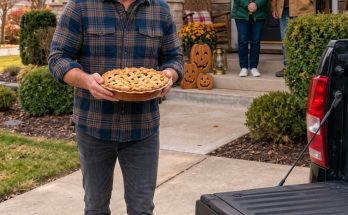
We made terrible scarecrow costumes.
Plaid shirts.
Straw falling everywhere.
No one looked good.
Perfect.
Nigel came alone at first.
Rebecca joined later with Dustin’s permission.
The school had changed procedures after the previous year.
Stage equipment supervised.
Student presentations approved in advance.
Not because of Dustin alone.
The incident had exposed a gap.
Schools adapt too.
When we arrived, Mrs. Grant smiled.
“No surprise presentations today?”
Dustin groaned.
“Never.”
She laughed.
Good.
No shame.
No whispering.
A teacher asked him to help announce raffle winners later.
He immediately said no.
Then changed his mind.
“I can read names?”
“Only names.”
He looked at me.
Not for permission.
Checking himself.
I said nothing.
His choice.
At two o’clock, Dustin stepped onto the same stage.
My chest tightened.
Nigel noticed.
He moved closer but did not touch me.
Interesting.
Dustin took the microphone.
“Winning ticket 4021.”
That was it.
No reveal.
No speech.
No flash drive.
He read fifteen names.
Made one joke about a pumpkin-shaped prize.
Then stepped down.
The crowd barely reacted.
Exactly what he needed.
The stage became a stage again.
Afterward, Dustin said:
“That was weird.”
“Bad weird?”
“No. Just regular weird.”
I loved that phrase.
Regular weird.
That was healing more than any dramatic victory.
Annabelle did not attend.
Her absence was not discussed.
Rebecca complimented our scarecrow costumes without insulting anyone.
Low bar.
Still appreciated.
Nigel bought Dustin a caramel apple.
I bought one too.
Dustin held both.
“Divorce benefit.”
We laughed.
Humor from him.
Not forced.
The fair ended without incident.
On the drive home, he said:
“I think last year feels smaller now.”
Good.
Not gone.
Smaller.
Memory does not need deletion to lose power.
It needs new experiences around it.
The school courtyard had held humiliation.
Now raffle tickets.
Music.
Bad costumes.
Friends.
That was enough.
At home, Dustin hung the scarecrow hat beside the old pumpkin costume.
I watched.
“Keeping both?”
“Obviously.”
Then:
“Can we make something less embarrassing next year?”
“No promises.”
He smiled.
The fair became ours again.
Not Annabelle’s.
Not the video’s.
Not the crowd’s.
Ours.
At the second fall fair, one parent recognized me from the previous year and gave a sympathetic look.
I hated it.
Then she said only:
“Cute costumes.”
Perfect.
No story.
No pity.
I thanked her.
That moment helped me remember most people move on faster than we imagine.
Public embarrassment feels permanent from inside.
Outside, people return to their own lives.
Dustin learned that too.
The stage had seemed like the entire school saw his family forever.
A year later, new students barely knew.
Teachers had other problems.
Parents had other concerns.
The social world kept moving.
That knowledge reduced his shame.
He was not permanently frozen in everyone else’s memory.
None of us are as central to strangers as embarrassment makes us feel.
A comforting truth.
Dustin did one more thing at the second fair that mattered.
He bought a cupcake from the same booth where Annabelle had made the pumpkin comment.
He did not realize the connection at first.
I did.
Then he looked around and remembered.
For a second, his face changed.
I waited.
He took a bite.
“Still good.”
That was it.
No exposure therapy plan.
No therapist assigning the location.
Life brought him back.
He stayed.
The place became ordinary again.
Later, he and Tyler ran a ring-toss booth.
They argued over rules.
Laughed.
Tried to win prizes themselves and got caught by a teacher.
Regular ten-year-old behavior had returned to the same setting that once made him feel like a witness in an adult war.
That contrast mattered more than any speech.
At the end of the fair, Mrs. Grant asked if he wanted to help carry equipment off the stage.
He did.
No hesitation.
The stage was furniture again.
Not a symbol.
That is the kind of recovery people rarely write about because nothing dramatic happens.
The nervous system learns:
This place is not always dangerous.
This microphone is not always a weapon.
This crowd is not always judging me.
Ordinary repetition does the work.
On the drive home, Dustin asked whether we should save the scarecrow costumes.
“Yes.”
“Why?”
“So I can embarrass you at seventeen.”
He groaned.
Good.
Future embarrassment.
Normal embarrassment.
The healthy kind.
The second fair ended with Dustin helping take down banners.
Last year he had left early, shaking.
This year he stayed until cleanup.
That mattered.
He carried folding chairs.
Complained.
A teacher gave him leftover popcorn.
No one treated him like the child from the video.
He was simply one of the kids helping.
Ordinary participation replaced dramatic memory one task at a time.
The next fall fair also gave me a chance to watch Nigel from across the courtyard.
He laughed with Rebecca.
Dustin ran between us.
No tension.
For one second, I realized I no longer cared whether Nigel wanted me to see that he was happy.
That old competition had dissolved.
His happiness was his.
Mine was mine.
Dustin no longer stood between them as proof of anything.
At the next fair after the scarecrow year, Dustin skipped costumes entirely. He wore jeans and a hoodie. I liked that too. Reclaiming an event does not require repeating the ritual forever.
The fall fair eventually returned to being one date among many on the school calendar. That ordinariness was a relief. We did not need to avoid the season or turn every October into an anniversary.
The fall fair stopped being a date I dreaded. One year I almost forgot it until Dustin mentioned cupcakes. That felt like freedom.
Click here to continue reading: PART 14: Nigel and I learned to co-parent without using Dustin as a messenger, witness, or judge
Dustin’s video stopped the fair cold and forced Nigel to hear what his son had been carrying
Part 13 of 16