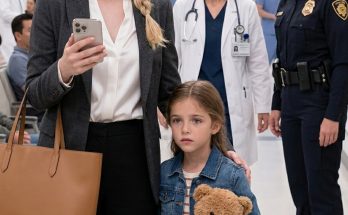
Violet arrived at Denver International Airport on a cold Friday evening.
Anne and Michael Brooks walked beside her.
I recognized them from photographs she had shared.
Anne wore a green scarf.
Michael carried a suitcase with one broken wheel.
I had brought flowers.
Then I worried flowers would be too much.
Then I worried not bringing them would look careless.
Marisol took the bouquet from my shaking hand and set it in the car.
“You can simply say hello,” she told me.
She was right.
At the arrivals door, Violet saw me and lifted one hand.
I waved back.
She did not run into my arms.
I was glad she didn't feel obliged.
Anne hugged me lightly.
Michael shook my hand.
“It's good to meet you,” he said.
We drove to the hotel where they had chosen to stay.
I had offered them my guest rooms.
Anne politely declined.
“It's easier for everyone to have a little private space,” she explained.
I agreed at once.
The following morning, we went to a neighborhood cafe.
Violet ordered pancakes.
Michael teased her about always ordering the same breakfast.
I listened to the small family rhythm between them.
It was a beautiful thing.
There was a time when I thought seeing another woman call my daughter by a childhood nickname would destroy me.
Instead, I felt immense gratitude.
We spent the afternoon walking through an art museum.
Violet stopped in front of a textile exhibit.
She asked how I chose fabrics for the clothing line.
I described the years when I made every decision using samples spread across my apartment floor.
Anne asked which fabric sold first.
“A cotton wrap skirt with uneven stitching.”
Michael smiled.
“Those are the beginnings people forget when they see a storefront.”
I told them I had not forgotten.
That evening, Violet asked to speak with me alone for twenty minutes in the hotel lounge.
Anne and Michael went upstairs.
We sat by a window looking out at the streetlights.
“Do you regret giving me up?” she asked.
I held my cup with both hands.
“I regret that I couldn't safely care for you.”
“That's not quite the same thing.”
“No,” I said.
“It's not.”
She looked at me steadily.
“Do you wish I'd grown up with you?”
“I wish we had both been safe enough to have choices.”
“I love my parents.”
“I can see why.”
She rubbed the rim of her glass.
“I've had a good life.”
“I'm glad.”
“I don't want you to feel like your whole life was a tragedy.”
“It wasn't.”
I thought of Marisol, our first order packed in a kitchen, employees whose children now attended college.
“And I don't want you to feel like you owe me a happy ending.”
Violet looked relieved.
We sat together until the waiter began turning chairs over at the far end of the room.
In January, my mother called again.
She said she had found a box in the hall closet.
“It has your old things,” she told me.
I did not want a box of old things.
Then she said it contained letters.
I flew to Alabama for one night.
This time, I met her in a public library meeting room.
An employee was working behind the circulation desk.
I felt safer knowing someone else was nearby.
Elaine placed a faded shoebox between us.
Inside were five envelopes addressed in my own handwriting.
Each carried the Denver return address I had once printed carefully on the corner.
Some had been opened.
I stared at her.
“You said you didn't open them.”
“I opened two.”
“You read them?”
She nodded.
“In one, you said you were working in a shop.”
“In another, you said you had finished your GED.”
“And you never wrote back.”
She looked down.
“Your father said we shouldn't encourage you.”
“You could have disagreed.”
“I know.”
I lifted a card with a blue snowflake on the front.
I remembered mailing it from a post office near my apartment.
I had saved for the stamp.
I had wanted to tell my mother the mountains looked almost purple in winter.
There was no request for money inside.
Only a hope that she was well.
“You had proof I was alive,” I said.
“Yes.”
“And every year you chose silence.”
She wiped her eyes.
“I was afraid of losing my marriage.”
“You lost your daughter instead.”
She flinched.
I did not soften the sentence.
Then I asked whether there were other things in the box.
A school picture.
My debate-club certificate.
An old receipt from a pair of shoes.
Finally, a letter from my high school guidance counselor.
It was dated after I disappeared.
The counselor had written asking whether I was safe and whether the family would provide contact information to help coordinate school records.
My mother had never answered.
I turned the letter over.
There was no reply.
“That teacher looked for me,” I said.
Elaine nodded.
“She did.”
I thought of the months I'd spent believing absolutely nobody had searched.
The knowledge didn't erase those months.
But it changed the way I saw them.
One adult had tried.
One adult had recognized that a girl could not simply vanish without somebody asking a question.
I photographed the letter with my mother's permission.
I left the originals with her except for the cards I'd written.
She asked if I would come to the house.
“No.”
“Your father is getting older.”
“So am I.”
On the drive back to the airport, I pulled into a parking lot and cried.
Then I phoned my old high school.
The counselor had retired years before.
The receptionist promised to pass along my message if she could locate a forwarding address.
For once, it was a connection I wanted to rebuild.
After the winter visit, Violet started sending me pictures of things she noticed.
A dog sleeping in a shop doorway.
A poster with a spelling error.
A sunset with clouds that looked like wet paint.
I sent my own pictures back.
Sometimes the messages led to conversations.
Sometimes they didn't.
One afternoon she asked to see the yellow socks I had mentioned.
I opened the coffee tin for the first time in months.
The socks were faded and stretched.
They looked impossibly small.
I photographed them against a white towel.
Violet replied after an hour.
“Anne kept my first little shoes. I could send you a photo.”
I said yes.
The shoes were white with tiny blue flowers along the edges.
For a moment, I imagined them side by side with the socks.
Two different homes.
Two women trying to keep evidence of a child's beginning.
I asked Anne whether I could thank her without making her uncomfortable.
She laughed gently.
“Just thank me. It's allowed.”
So I did.
I told her I was grateful that she had preserved Violet's history rather than pretending adoption erased everything before it.
Anne said she had never thought of it as erasure.
“We wanted her to know that being loved by us didn't require forgetting you.”
The words settled inside me.
For years I had feared I was a threat to the family she loved.
Now I was learning that honest boundaries could make room for all of us.
At dinner the next night, Marisol asked what I hoped would happen next.
“I hope she calls me when she wants to,” I said.
“And if she doesn't?”
“Then I hope she's happy.”
Marisol considered that and nodded.
It sounded simple.
I knew it would sometimes hurt.
But it was the kind of love I could live with.
Before I went to bed, I drafted a letter to Anne and Michael.
I wrote about the first six weeks.
I included medical details and the story behind Violet's name.
I said they didn't have to show her the letter immediately.
Then I stopped.
Violet was an adult.
She could decide what to read.
I sent the letter to her instead and told her she could share it with her parents if she wished.
She thanked me.
Two weeks later, she said they'd read it together.
She didn't tell me everything they discussed.
I didn't ask.
I was learning that trust sometimes looked like leaving parts of a conversation alone.
During the family's visit to Denver, Michael asked whether he could see our warehouse.
He had managed shipping for a small company before retirement.
I told him he'd probably notice everything we needed to improve.
He laughed.
“Only if you ask me to.”
We toured the loading area on a quiet afternoon.
Lena introduced him to our logistics supervisor.
They talked about labels, packing schedules, and avoiding damage during winter shipments.
Violet wandered toward the design room with Anne.
For a moment, Michael and I were alone beside a row of shelves.
He said, “I know this must be complicated.”
I nodded.
“I'm grateful you came.”
“Violet wanted us here.”
“I'm glad she did.”
He looked at the pallets stacked near the loading door.
“She was nervous before meeting you,” he said.
“So was I.”
“She's grown into someone who asks her own questions.”
“I've noticed.”
He smiled.
“I hope you don't feel you have to impress us.”
I looked around at the warehouse.
I had spent the week making sure the shelves looked perfect.
He had seen straight through me.
“Maybe a little,” I admitted.
“Don't. We already know you worked hard to build this.”
I swallowed.
“We wanted to know the person.”
After the visit, we went to a modest restaurant where the tables were covered in paper.
Violet ordered too many appetizers.
Anne teased Michael about always stealing the last fried potato.
I found myself laughing with them.
We talked about traffic, movies, and why the restaurant's chairs squeaked.
The evening was remarkably ordinary.
When I drove home, I felt something gentle settling in me.
I hadn't been examined and approved as a mother.
I had simply eaten dinner with three people who knew how to belong to one another.
They had let me join them for an evening without insisting on a new definition of family.
I was grateful for their generosity.
I also knew I wanted to offer the same freedom to Violet.
Click here to continue reading: PART 9: The Woman Who Tried to Find Me Twenty Years Ago Finally Heard What Happened
The Girl at My Parents’ Door Asked Me Which Family I Had Come Looking For
Part 8 of 16