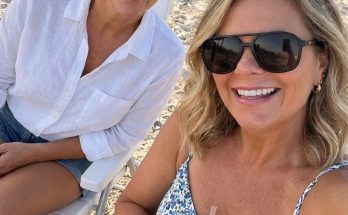
The following summer, I booked a room near the same beach.
I went alone.
Ruth asked whether I was certain.
“Yes.”
“Do you want me on standby?”
I smiled.
“You are always on standby.”
“Someone has to be.”
The drive took four hours.
I stopped for coffee halfway.
This time I didn't spend the journey wondering what Daniel would have thought.
I listened to the radio.
I bought a peach from a roadside stall.
I took a wrong turn and found a scenic road along a river.
By the time I reached the coast, I was tired and hungry.
I checked into a modest room facing a car park.
It wasn't beautiful.
It was clean.
I opened the window and could hear gulls in the distance.
The next morning, I walked to the beach.
The striped umbrellas were gone.
A different company had installed blue ones.
The sand looked exactly as it always had.
Children dug holes near the water.
Two women argued cheerfully about sunscreen.
A man struggled to open a folding chair.
I rented an umbrella and sat beneath it.
For a few minutes, my chest tightened.
I could hear Emily saying she wanted one last photograph.
I could see her hands shaking.
I could remember the moment my whole history began to feel unreliable.
Then I opened my sketchbook.
I drew the man with the folding chair.
He finally got it open.
His wife applauded.
I laughed to myself.
Later, I walked along the boardwalk.
The café where Emily and I had eaten pastries was still there.
I ordered tea and a slice of lemon cake.
I sat outside.
There was an empty chair opposite me.
For the first time, I didn't feel an urgent need to fill it.
I took a photograph of the sea.
Then I took one of the sketchbook beside my plate.
I sent the second to Ruth.
Her response came almost immediately.
Please tell me you've eaten more than cake.
I wrote back that I'd had eggs earlier.
She replied with a thumbs-up.
In the afternoon, I walked to the public garden behind the hotel.
There were roses planted in long beds.
An elderly volunteer knelt beside a patch of lavender.
I asked whether I could sit on the bench to sketch.
“Of course,” she said. “Just don't draw the weeds. I'm behind on those.”
I drew them anyway.
They made the garden look lived in.
Back in my room, I checked my email.
There was an update from Nora about the settlement payments.
The scheduled installment had arrived.
The corrected product listings were being updated by retailers.
Some older online images would take time to disappear.
There was nothing I needed to do that evening.
I closed the laptop.
For dinner, I bought fish and chips wrapped in paper.
I ate them overlooking the water.
I thought about friendship.
For most of my life, I had believed a good friend was someone who knew every part of your history.
Now I thought perhaps a good friend was someone who allowed you to be the author of it.
Emily had failed me in that way.
She had also loved me in others.
Both facts remained.
I didn't need to erase either one.
When the sun went down, I walked back to the hotel.
At the entrance, a young woman asked whether I could take a photograph of her and her mother.
I said yes.
They stood with their arms around each other.
I took three pictures.
The mother inspected them and laughed.
“You made us look happy.”
“You looked happy,” I said.
I handed back the phone.
In my room, I looked at the single photograph I'd taken of myself that morning.
My hair was windswept.
I was squinting into the sun.
There was sand on my sleeve.
It wasn't a perfect photograph.
I kept it.
On the beach, I opened a notebook and wrote a list of what had changed since my last visit.
The first items were practical.
A different bank account for my artwork.
A current portfolio.
A written agreement for new commissions.
A community of artists who knew me as Claire rather than Daniel's wife or Emily's friend.
Then I wrote things that were harder to measure.
I could sleep through most nights.
I could look at an old photograph without always searching for evidence.
I could talk about Daniel without defending him.
I could speak about Emily without explaining why I had not forgiven her.
I closed the notebook.
A woman nearby was struggling to put sunscreen on her own back.
She asked whether I could help.
I did.
She thanked me and offered to watch my bag while I went into the water.
I declined politely.
Then I laughed at myself.
Trust did not have to mean either handing everything to someone or refusing every small act of kindness.
I could help a stranger with sunscreen without giving her my wallet.
I could accept directions without making someone responsible for my whole journey.
I could develop a friendship gradually.
That evening, I attended an outdoor concert near the harbor.
The musicians played folk songs.
Several couples danced on the pavement.
One older man invited me to join a group doing a simple line dance.
I told him I didn't know the steps.
“Neither do half of us,” he said.
I tried.
I stepped in the wrong direction twice.
A woman beside me laughed and showed me what to do.
By the end of the song, I was laughing too.
When it finished, I went back to my seat.
I wasn't looking for a new romantic relationship.
I wasn't trying to become someone dazzlingly different.
I had simply spent an evening among people who knew nothing about my history.
It felt surprisingly good.
Before leaving the town, I bought a small postcard.
It showed the lighthouse at dusk.
For a moment, I considered sending it to Emily.
Then I tucked it into my sketchbook.
I wasn't ready.
The choice didn't require an explanation.
At home, I pinned the postcard beside my sea drawing.
It reminded me that the beach belonged to the world, not only to the last difficult conversation we'd had there.
During the drive home, I stopped at a small farm shop.
There were jars of honey and baskets of summer fruit.
An old radio played behind the counter.
I bought peaches for Ruth.
The woman at the till asked whether I'd enjoyed the coast.
“I did,” I said.
“Going back?”
“Probably.”
The answer surprised me.
I had once thought the place would always belong to the worst conversation of my life.
Now I wanted to return to draw the lighthouse again.
At home, I unpacked my sketchbook before my clothes.
I taped the sea drawing beside my desk.
The next morning, Mara stopped by to see it.
She pointed to the line where the ocean met the sky.
“That's difficult to get right.”
“I had a lot of time to look.”
“That usually helps.”
We made coffee and discussed another workshop.
I told her I'd been thinking about a series of drawings based on quiet places.
She suggested a small exhibition.
I said I wasn't ready to promise one.
She accepted the answer.
Then we spoke about gardens and the rising cost of paper.
When she left, I returned to the sea drawing.
I added the shape of a distant boat.
I didn't draw anyone standing on the shore.
The scene already felt complete.
Click here to continue reading: PART 16: I Finally Answered Emily’s Last Letter and Chose What Thirty-Seven Years of Friendship Would Mean Now
The Last Photograph Emily Asked Me to Take Beside the Water Before She Told Me About Daniel
Part 15 of 16