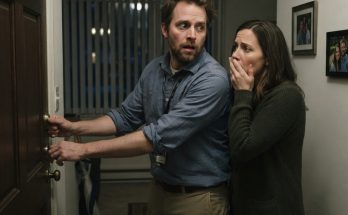
The paper trembled between my mother's fingers.
Mr. Cole had opened his briefcase, but he didn't take anything out.
He waited for her to look up.
The first line was written in Dad's careful block letters.
EVELYN, IF YOU ARE READING THIS, I WAS WRONG TO WAIT.
Mom ran her thumb over his name at the bottom.
Then she said, "Jenny, get my glasses."
I hurried inside.
Dad's glasses were still on her dresser.
Hers were beside the kitchen calendar, where she had left them after checking a dentist appointment she kept forgetting to cancel.
I brought both pairs by mistake.
She took her own and let out a surprised little laugh.
"Your father would say I can't keep track of anything."
Her laughter disappeared when she looked at the paper again.
Ed, the secondhand-shop owner, remained standing on the porch.
He was holding his cap in both hands.
"Please come inside," Mom said.
"Only if you're comfortable with that," Mr. Cole replied.
He introduced himself as Andrew Cole, a lawyer who worked on estate matters in the next county.
Ed explained that he had found Andrew through a customer who knew his practice.
"I didn't want to come here with something like this and make promises I couldn't keep," Ed said.
"What promises?" I asked.
"That's what we need to understand," Andrew answered.
Mom led us to the kitchen table.
There were still four mismatched mugs on the drying rack.
Dad had always insisted that his coffee tasted different in the chipped green one.
Nobody had used it since October.
Mom sat in his usual chair without realizing it.
She spread the paper flat beneath the sugar bowl.
The writing was tiny.
Dad had written on both sides.
The front began with an apology.
He said that in the summer of 1981, when the steel mill had been threatening layoffs, he had made an arrangement with a friend named Thomas Bell.
Thomas had helped him put money into a small machine-repair business outside town.
Dad had never told Mom.
He wrote that the money was partly theirs, saved from overtime shifts, and that he had been ashamed of taking a risk without speaking to her.
The paper referred to a signed agreement and a metal document box.
It gave a locker number at the old train station.
Then came the sentence that made my mother cover her mouth.
IF THE BUSINESS EVER AMOUNTS TO ANYTHING, YOUR SHARE IS YOURS, EVELYN. I SHOULD HAVE TOLD YOU BEFORE I SIGNED.
"What share?" I asked.
"I don't know," she whispered.
She turned the paper over.
The second side held a date and a short message.
Dad had written that if he couldn't explain the arrangement himself, the watch should remind her where to look.
He had not written a company value.
He had not named an account balance.
And he had not explained why he never told her during the next forty-four years.
Andrew leaned forward.
"Mrs. Brennan, this isn't proof that the business still exists. It's a lead. We would need records."
Mom nodded as if she understood.
I wasn't sure she did.
I wasn't sure I did either.
"Why bring a lawyer?" I asked Ed.
"Because the paper says signed agreement," he said. "And because I didn't want to hand it to the wrong person."
"You could have called," I said.
"I tried," he answered.
He pulled a folded receipt from his pocket.
There was Scott's signature, a date in October, and forty dollars written in blue ink.
"He wouldn't give me your mother's number," Ed said. "When I told him I'd found something, he asked what the watch was worth. Then he hung up."
I felt heat rise in my neck.
Mom looked down at the receipt.
"He sold Harold's watch," she said.
Her voice was very quiet.
"Yes, ma'am."
"I know."
She pushed the receipt away.
"I know he did."
There was no anger in her face just then.
That worried me more than shouting would have.
Andrew offered to let us make a copy of the note before anyone handled it further.
He said a conservator could advise on keeping the fragile paper safe.
He also said that if we wanted his help looking for the agreement, he would need to discuss his fees and his role before beginning work.
Mom asked him to write his number on a clean sheet.
"I need to think," she said.
He agreed immediately.
Ed put the watch on the table.
A faint ticking came from inside its case.
"I had the movement checked," he said. "Didn't want to leave it damaged."
"How much do I owe you?" Mom asked.
"Nothing for the repairs."
"There must be something."
"I bought it. I can return it. That's enough."
Mom closed the velvet box.
"Then you'll take some pound cake," she said.
It was the first ordinary sentence she had spoken all morning.
While she wrapped two slices in foil, I walked Andrew and Ed to the porch.
I wanted to ask a hundred questions.
I settled on one.
"Have you ever heard of Thomas Bell?"
Andrew shook his head.
"Not personally. We should start with records, not assumptions."
Ed hesitated at the bottom step.
"There was something else," he said.
I watched him turn his cap in his hands.
"When Scott called back, he told me to throw the paper away."
"He knew about it?"
"He knew I found a paper. He didn't ask what it said."
I gripped the porch railing.
"Did you keep a record of that call?"
"I wrote the date on the receipt. That's all."
Andrew spoke gently.
"Don't confront your brother based only on that. Let your mother decide what she wants to do first."
He was right.
I didn't appreciate hearing it.
After they left, I found Mom in the bedroom.
She had opened the watch box and placed the watch beside the reading glasses.
The empty space was filled again.
Yet her eyes stayed on the folded note.
"Dad was afraid of losing the money," I said.
"Maybe," she answered.
"You didn't know anything about a machine shop?"
She folded one of his sweaters and put it back in the drawer.
"I knew he helped Thomas with repairs sometimes. I thought he was doing favors."
"Did Dad ever mention the station locker?"
"No."
She closed the drawer.
"But I remember that summer."
I waited.
"He came home one night with a split lip. He said he'd slipped carrying a gearbox. He didn't speak at supper."
"You think it was connected?"
"I think I have no idea what was connected. That's the problem."
She sat on the bed.
"Your father wasn't a perfect man, Jenny. He was careful about bills. He was stubborn. He could hold a worry inside until it made everyone else miserable."
"He loved you."
"Of course he loved me. That doesn't mean he told me everything."
She pressed her hands against her knees.
"I spent forty-four years wondering why he flinched whenever someone mentioned Thomas. Now I have another thing to wonder about."
I asked whether Thomas was alive.
Mom said she'd heard he moved away in the nineties.
His wife had died years before that.
They'd once received a Christmas card with no return address.
Dad had put it in his desk.
He never displayed it.
I went into the den.
As we began sorting Dad's desk, Mom found a birthday card tucked behind the drawer.
The envelope had never been sealed.
It was addressed to me.
The date belonged to a birthday seven years earlier.
Inside, Dad had written that I reminded him of Mom because I never accepted the first answer someone gave me.
He had drawn a crooked star beside the sentence.
"Why didn't he send it?" I asked.
Mom looked at the card.
"He probably forgot where he put it."
We both smiled.
Dad could rebuild a lawnmower engine and still lose the grocery list between the front door and his car.
I slipped the card into my handbag.
It didn't explain his secret.
It reminded me that his ordinary life hadn't disappeared when the note came out of the watch.
Mom then opened the small tin of keys.
There were keys to a shed we no longer owned, a padlock Dad had thrown away, and the trunk of a car he'd driven before I was born.
Each key carried a little paper tag.
One said DON'T FORGET, in his handwriting.
"He wrote that on everything," Mom said.
"Did it work?"
"Not once."
The kitchen clock struck two.
Mom said we should eat something.
I found a container of chicken soup in the refrigerator.
She had made it the day before.
We sat at the small table and ate while the house settled around us.
"Do you want to call Scott?" I asked.
She stared at the empty chair opposite her.
"Not today."
"He'll hear about the watch eventually."
"Then he'll hear."
She held her spoon over the bowl.
"I spent so much of your brother's life making sure he didn't feel ashamed. I kept explaining away every accident, every unpaid bill, every apology that came too late."
"You loved him."
"I did. I do."
She put down the spoon.
"But love isn't the same as telling somebody they have nothing to answer for."
That afternoon, we made a list of questions for Andrew.
Not accusations.
Questions.
Who had owned the repair business?
Had the agreement been amended?
Was the company still operating?
Where were the original papers?
How could a paper hidden in a watch be preserved without destroying it?
Mom wrote the last question herself.
She wanted to keep it safe even if it turned out to be nothing more than a record of Dad's mistake.
When I left, she walked me to the door.
"Jenny, promise me one thing."
"What?"
"If we find something ugly, don't decide for me whether I can bear it."
I promised.
Driving home, I understood that Dad's greatest mistake might not have been risking the money.
It might have been assuming Mom needed protection from knowing.
His desk was still full of sharpened pencils, instruction manuals, and newspaper clippings about local baseball.
Mom had asked me not to empty it until she was ready.
I had respected that.
Now she stood behind me and nodded.
"Look in the bottom drawer."
The drawer resisted.
I lifted its front, just as Dad used to, and it slid open.
Inside lay two envelopes of warranties, a tin of old keys, and a photograph.
Dad was younger in the picture.
He stood beside a broad-shouldered man outside a low brick building.
There was a hand-painted sign above the door.
BELL PRECISION REPAIR.
On the back, in Dad's handwriting, were four words.
SUMMER 1981. FIRST DAY.
Mom touched the photograph.
"That's Thomas."
Then her gaze moved to the right edge of the picture.
Someone else stood there, partly cut off.
Only one hand and the sleeve of a work jacket remained visible.
She leaned close.
"Your father kept this photograph all these years?"
I turned it over again.
Beneath the date was a second line, written so faintly I almost missed it.
ASK ABOUT THE BLUE LEDGER.
Mom took a slow breath.
I laid the photograph next to the note.
We finally had something to search for.
But first, we had to find out what Dad had meant by a ledger he had never once mentioned to his family.
Click here to continue reading: PART 2: A Forgotten Photograph and an Old Business Filing Gave Us Our First Real Lead
The Folded Paper in My Father’s Watch Raised Questions My Mother Had Never Asked
Part 1 of 12