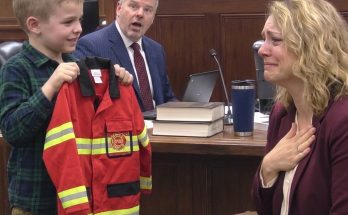
The photograph from the stadium arrived in a padded envelope on Tuesday.
It had been printed by the team's community relations office.
Marcus had written a note along the white border.
Coach Ethan, thanks for the advice. Keep cheering for us, and remember to rest your voice when the defense gets frustrating.
Ethan read it twice.
Then he asked me to tape the picture above his desk.
"Not too high," he said. "I want to see everybody."
Everyone included Ben.
The brothers were standing close together, still awkward, but present.
I had been tempted to crop the photograph so Ethan and Marcus filled the frame.
Now I was glad I hadn't.
A week later, Tessa from the wish organization called.
Marcus had asked whether Ethan might enjoy a brief video message from the team during their off-season charity event.
She emphasized that we could decline and that there was no expectation of publicity.
I thanked her and asked Ethan.
He thought about it.
"Can I send him a question instead?"
"What question?"
"Why did he ignore the open receiver on the second play?"
I laughed.
Tessa arranged a short private video call.
The next afternoon Marcus appeared on our tablet from a plain office with team posters behind him.
He wasn't wearing a uniform.
Without stadium lights, he looked like an ordinary man who needed a haircut.
Ethan sat up straighter.
"I have notes," he announced.
Marcus nodded solemnly.
"I was afraid you would."
For fifteen minutes they discussed football.
Marcus answered carefully, admitting when a defensive read had fooled him and explaining how split-second decisions sometimes failed.
Ethan was delighted.
Then Marcus asked what Ethan had been doing since the game.
Our son told him about the paper bridge at school and the red notebook.
"I have a trick play," he said. "But Dad says it's too risky."
"Risky plays make good drawings," Marcus replied. "You don't have to run every idea to enjoy thinking about it."
Ethan seemed impressed by the distinction.
Before the call ended, Marcus thanked him for coming to the game.
He did not make a speech about bravery.
He did not ask Ethan to promise to get better.
He simply said he hoped they could talk football again someday if Ethan felt up to it.
Afterward Ethan asked for a nap.
I helped him into bed.
He fell asleep smiling.
The call left me thinking about the difference between being celebrated and being seen.
At the stadium, a crowd had cheered for a boy they barely knew.
Today a football player had listened to a boy who cared about game strategy.
Ethan had not needed to tell anyone about his treatments.
He had been allowed to be himself.
That evening Chris suggested we call Tessa to thank her.
I did.
She told me that the organization took privacy seriously and that she was sorry the first introduction had become more public than we expected.
I appreciated the apology.
We asked that future contact remain private unless Ethan and we specifically agreed otherwise.
She documented the preference.
Later, Ben came over to replace the loose latch on the backyard gate.
He saw the photograph taped above Ethan's desk.
"You kept the whole thing," he said.
"Of course," Ethan answered. "You're in it."
Ben looked down at the floor.
I could see his throat move.
He thanked Ethan and went back outside before his eyes filled.
Chris followed him with a screwdriver.
They spent an hour fixing the latch.
When they finished, Ben stayed for dinner.
We ordered pizza because I was tired of planning meals around everyone's schedules.
Ethan ate three bites, then decided he wanted applesauce.
Nobody insisted he finish the pizza.
He seemed relieved.
After dinner Ben asked whether he could show us something.
He had brought Lily's old video camera.
The memory card contained short clips from family gatherings.
One showed Lily teaching four-year-old Ethan to kick a football in the backyard.
He ran in the wrong direction.
She chased him, laughing.
Another showed Chris pretending to be a referee while Ben argued about an imaginary penalty.
We watched the clips on the television.
Ethan pointed at his younger self.
"My hair was weird."
"Your hair was excellent," Chris said.
"My haircut was weird," Ben corrected.
Everyone laughed.
Then a clip appeared of Lily sitting at our kitchen table, carefully drawing a route on a napkin.
She looked into the camera.
"Someday Ethan will be the coach," she said. "But he has to learn not to eat all the chips first."
Our son laughed at first.
Then he watched the clip again.
"She knew," he whispered.
I didn't know what he meant.
"She knew I'd like football."
"She did," Ben answered.
We watched the clip a third time.
The room grew quiet.
Ben did not hide his tears.
Chris put a hand on his shoulder.
It was the first time I had seen him do that since Lily's funeral.
Ben let the hand stay.
The week after the video call, I received a message from a parent in Ethan's support group.
She had seen the stadium photograph on the wish organization's private family portal and wanted to know how we had managed the outing.
Her son was also ten and had been asking to attend a concert.
She was frightened about noise, crowds, and the possibility that his condition might change while they were away from home.
I told her I wasn't a medical professional and couldn't advise her about her son's needs.
But I could share how our own planning had worked.
We had asked Ethan's doctors whether the trip was reasonable for him.
We had arranged accessible transportation, quiet space, and a clear plan for leaving early.
We had packed medicines and contact numbers according to the care team's instructions.
Most importantly, we had told Ethan that he could change his mind.
She thanked me.
Then she admitted that she was afraid of disappointment.
"If he gets tired after ten minutes," she wrote, "I'll feel like I failed him."
I stared at the message.
I knew that fear intimately.
I wrote back that a child's day could still matter even if it did not match the original plan.
Ethan had enjoyed the stadium.
He had also needed rest during the game.
Neither fact canceled the other.
Later that day I mentioned the exchange to Chris.
He said he had been thinking about our first trip to the beach after Ethan learned to walk.
We had packed everything for a full afternoon.
Ethan spent fifteen minutes building a sandcastle, then demanded to go home because the sand felt strange against his feet.
"I was furious about the parking fee," Chris admitted.
I laughed.
"You complained all the way home."
"And he talked about the sandcastle for weeks."
Chris shook his head.
"He got the part he wanted. I was the one who decided it hadn't been enough."
That memory stayed with us.
The following Sunday we planned to watch a game in the living room.
Ethan was tired and wanted to stay in bed.
Chris offered to carry the television upstairs.
I pointed out that we already had a tablet and a stable internet connection.
Ben offered to bring the snacks upstairs.
Ethan rejected the entire plan.
"I don't want a game today."
Chris paused.
"What would you like?"
"The dinosaur documentary."
Ben put down the chips.
"A shocking change in management."
We watched a documentary about fossils instead.
Ethan corrected the narrator twice.
Then he fell asleep before the end.
Nobody finished the episode without him.
A few days later Sam came over with a small plastic dinosaur he had found at a museum gift shop.
It was a triceratops painted an impossible shade of purple.
Ethan inspected it critically.
"It's not scientifically accurate."
"I know," Sam said. "That's why I bought it."
Ethan placed the dinosaur beside the signed football.
He decided the triceratops was the team's defensive coordinator.
Sam suggested naming it Professor Horns.
Ethan rejected that name and proposed Coach Purple.
The argument lasted almost twenty minutes.
I sat nearby with Rachel, listening to the boys fill the room with opinions.
Their voices were not always cheerful.
They disagreed, became annoyed, and changed the rules of their game.
I felt grateful for that ordinary friction.
Ethan deserved friendships that were real enough for disagreement.
After Sam left, Ethan asked me to photograph the purple dinosaur with the football.
He wanted to send the picture to Marcus.
We wrote a short caption together.
New defensive coordinator. Very aggressive. No experience.
Tessa replied a few days later with a laughing emoji from the community relations office.
Ethan was delighted.
He asked me to print the message and tuck it into his notebook.
The little exchange did not require a stadium, an announcer, or a crowd.
It became another story Ethan could tell on a quiet afternoon.
And I began to trust that our smaller days could be meaningful without resembling the biggest one.
The next day Ethan asked whether the purple dinosaur could sit on the bedside table. I moved the lamp to give it room. He told me the dinosaur had to face the window so it could watch for opposing teams. Chris gave it a paper visor. Ben drew a tiny playbook. Every adult in the house understood that we were following a ridiculous game, and none of us wanted to stop. Ethan approved the visor and laughed very loudly.
The following week, Ethan's energy began to decline.
He spent more hours sleeping and needed help walking even short distances.
We contacted the care team and adjusted our daily routine.
Chris moved the recliner closer to the downstairs window so Ethan could watch Patch in the yard without taking the stairs.
Ben helped install a shaded area on the porch.
I rearranged my work schedule and accepted assistance from friends for errands.
Rachel brought groceries on Monday.
Mrs. Lewis sent voice messages from classmates on Wednesday.
We played them one at a time so Ethan could decide when he wanted to listen.
Sam's message was mostly a complaint about a math assignment.
Ethan laughed at it.
One evening he asked to send Sam a reply.
"Tell him he should show his work," he dictated.
Then he added, "And tell him his dinosaur fact is wrong."
I recorded the message and sent it.
A few minutes later Sam responded with an indignant voice memo.
The two boys continued their argument across the phone until Ethan became tired.
That was enough.
He rested against me while I closed the app.
"Do you think Marcus remembers my name?" he asked.
"I think he does."
"Good."
He looked toward the photograph.
"But I think I like talking to Sam better."
I kissed the top of his head.
"That makes sense."
Marcus was his hero.
Sam was his friend.
One had given him a spectacular afternoon.
The other knew which jokes could make him laugh on an ordinary Tuesday.
There was room for both in Ethan's life.
That night Chris sat beside our son's bed and read football statistics until Ethan asked him to stop.
"Too boring," Ethan murmured.
Chris closed the book.
"You told me the boring parts helped you sleep."
"They do. I'm already sleepy."
Chris smiled.
"Then my work is done."
Ethan reached for his hand.
"Good job, Coach."
Click here to continue reading: PART 8: One Clear Night Became a Family Gathering Without Speeches or Cameras
The Man Descending the Stadium Steps Carried a Memory Chris Could Barely Face
Part 7 of 12