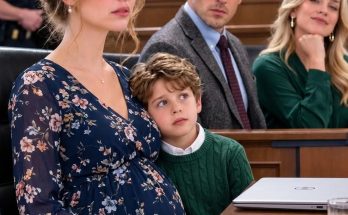
A little more than a year after the courtroom drawing, I received a letter that finally gave the trust matter a clearer ending.
The review had taken time. Investigators had gathered messages, business records, the disputed digital files, and statements from the adults involved. Julian had obtained counsel for that matter separately from his divorce lawyer. Melissa had also received legal advice about her role.
The authorities concluded that there was sufficient evidence to proceed on a narrow allegation connected to the attempted false authorization. The resulting case did not involve money taken from the trust. The trustee's safeguards had prevented disclosure and disbursement.
I learned the distinction was important.
An attempted deception could be serious without producing the enormous financial loss that people might imagine from a dramatic headline.
Julian did not suddenly go to prison because Leo had drawn a picture.
There were filings, discussions with counsel, and a court proceeding in which the evidence and the applicable rules mattered. After receiving legal advice, Julian accepted responsibility for making a false representation in the authorization process. The court imposed a sentence that included supervision, financial penalties, and compliance obligations, rather than an exaggerated punishment that magically repaired our family.
The details were recorded in the order.
I kept a copy with the other legal documents.
Melissa's role was handled separately. Her cooperation and the evidence about what she knew were evaluated in their proper context. I was not entitled to invent a verdict about her simply because she had hurt me. I did not need to keep her in my life to acknowledge that distinction.
I was relieved that the facts had been examined.
I did not feel victorious.
There had been no missing fortune restored to my account, because no fortune had left the trust. There had been no moment when every year of disappointment vanished. There was a verified account of the attempted paperwork, a measure of legal accountability, and rules that would remain in place for future trust requests.
Harriet, the trustee's compliance officer, confirmed that the trust was secure and that its enhanced verification procedures would continue for an appropriate period. Peter helped me update my personal contact information and maintain copies of essential documents.
I thanked them both.
After the call, I put the phone down and looked around the new kitchen.
Maya was at the table banging a plastic spoon. Leo was working on a school poster about the solar system. A pan of chicken and vegetables was cooling on the stove.
Nothing in that room looked like the climax of a legal drama.
It looked like my life.
Later that week, Julian requested a meeting about the children's schedules. We arranged it through the parenting coordinator and kept the discussion limited to practical matters. He had followed the existing schedule more reliably over the previous months and wanted to consider longer visits as Maya grew older.
The professionals reviewing the plan took the children's ages, routines, and well-being into account. Leo's school commitments mattered. Maya's sleep and feeding patterns mattered. Any changes would be gradual and subject to the appropriate review or agreement.
I did not treat Julian's legal accountability as a reason to erase his parental role automatically.
I also did not confuse his promises with proof that every problem had been solved.
During one meeting, he said, “I've been trying to do better.”
“I've noticed some things,” I replied. “You arrive when you say you will. You keep the appointment information. Those things help.”
He looked relieved.
Then I added, “The children need you to keep doing them, not just this month.”
“I understand.”
His expression told me he wanted more from the conversation. Perhaps forgiveness. Perhaps a declaration that we could be friends.
I wasn't ready to offer either.
But I could speak to him without anger controlling every word.
That was enough for now.
In late spring, the school held a family picnic. Leo asked whether his father could attend. Julian confirmed that he was free, so we sat on separate blankets near the playground while Leo raced between them carrying a paper airplane.
Maya toddled along the grass holding my hand.
At one point Julian picked her up to keep her from stepping into a puddle. She laughed and reached for his nose.
I took a photograph for the shared family album.
There was no need to cut him out of the frame.
The picnic ended with children chasing bubbles and parents collecting empty juice boxes. Julian helped carry a folding chair to my car, said goodbye to the children, and left.
No argument.
No speech about what we used to be.
Just a reasonable afternoon.
My own life had changed too. I increased my work hours gradually after Maya started part-time childcare. I made arrangements for sick days and school pickups rather than assuming I could manage every interruption alone.
Naomi remained a close friend. Ethan came over on Sundays when his schedule allowed. I had begun attending a small book group at the library, where nobody cared what my former husband did for a living or whether my trust held valuable investments.
We talked about stories and exchanged recipes.
Sometimes I came home laughing.
One evening Naomi asked whether I wanted to start dating again.
“Not yet,” I said.
She smiled.
“That's allowed.”
I thought about how often people expected a satisfying ending to include a new romance, a dramatic confrontation, or a lavish display of success.
I had no interest in proving I was desirable by finding someone immediately.
I was learning to enjoy my own company.
On the anniversary of the court hearing, I opened the folder containing Leo's original drawing.
The paper had been copied and handled according to the needs of the legal process, but I kept a personal reproduction with the documents Caroline had given me. I looked at the large brown rectangle, the names DAD and MELISSA, and the little shapes labeled MOM.
I remembered how frightened Leo had looked with Oliver tucked against his chest.
I remembered Julian standing, demanding that the courtroom be cleared.
Most of all, I remembered the moment I almost surrendered every financial interest simply because I wanted the marriage to end.
The drawing had not proved the whole case by itself.
It had brought attention to an adult problem that needed to be investigated independently.
That distinction mattered.
I placed it back in the folder, beside the trustee's correspondence and the final court documents, and closed the cover.
I did not show the drawing to Leo.
I wanted him to remember the birdhouse, the dinosaur books, and his little sister's first steps, not grow up believing he had saved his mother by exposing his father.
He had been a child who saw something confusing.
The adults had been responsible for what happened next.
That summer, we planted sunflowers in the backyard beside the green birdhouse. The first shoots rose unevenly. Some grew tall, while others stayed close to the soil. Leo measured them every Saturday and recorded the numbers in a notebook.
Maya followed him through the garden with a little watering can, spilling most of the water onto her shoes.
“She's doing it wrong,” Leo complained.
“She's learning,” I said.
He watched her pour another stream onto the path.
Then he showed her how to tilt the can toward the roots.
They both ended up wet.
I sat on the back step and let them laugh.
Later, after baths and bedtime stories, I returned to the kitchen table with a cup of tea. There were no papers waiting for an urgent signature. The house payment was accounted for. The trust remained under professional administration. The parenting schedule was on the refrigerator, with the next exchanges marked clearly.
We still had ordinary problems. A leaky faucet. A school project due Monday. A toddler who believed sleep was negotiable. Sometimes Julian and I disagreed over a schedule change, and sometimes I worried about money more than I wanted to admit.
But I no longer mistook conflict for a reason to stop asking questions.
I no longer measured peace by how much I was willing to give away.
I turned off the kitchen light and walked down the hallway.
Leo's bedroom door stood slightly open. He had fallen asleep with his dinosaur book across his blanket.
Maya was curled in her crib, one little hand resting beneath her cheek.
I stood between their doors for a moment.
The life ahead wasn't the one I'd planned when I married Julian.
It was smaller in some ways, quieter in others, and far more honest about what it required.
I could live with that.
I went to bed knowing I hadn't won because Julian had lost.
I had found a way to protect what was mine, care for my children, and move forward without asking either of them to carry the weight of the adults' mistakes.
The next morning, Leo asked whether we could invite his father to the school science fair.
I checked the calendar. The date did not interfere with any existing arrangement, so I sent Julian the information. He confirmed that he would attend.
At the fair, Leo stood beside a poster showing how seeds grew under different amounts of light. His handwriting was uneven, and one photograph had been glued upside down.
He was enormously proud of it.
Julian asked him questions about the experiment. I took photographs. Maya tried to pull a paper leaf from the display, and we both moved her hands away before she damaged it.
For a few minutes, the attention belonged entirely to the children.
Afterward, Julian thanked me for including him.
“Leo invited you,” I replied. “I'm glad you came.”
He hesitated, then said, “I know I haven't earned the kind of trust we used to have.”
“No,” I said. “And we don't need that kind of relationship anymore. We need a dependable way to raise our children.”
He looked toward Leo, who was running ahead with his project tucked beneath one arm.
“I can keep working on that,” he said.
“Yes,” I answered. “You can.”
We parted in the parking lot without bitterness or false promises.
At home, Leo put the science-fair ribbon on his bedroom shelf beside Oliver. Maya climbed onto the rug and reached for the dinosaur book. I heated dinner and opened the back door to let in the warm evening air.
The sunflowers were turning toward the light.
And for once, I was not waiting for anyone to tell me what my life was worth.
THE END
The End
Read more original stories on Feel Every Story.
The Drawing My Son Made at Court Exposed Questions My Husband Could Not Answer
Part 12 of 12