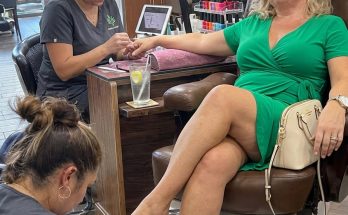
A demanding customer spent hours enjoying every service at my hair salon.
But when I handed her the bill, she announced, “I’m not paying a single dollar.”
Instead of arguing, I quietly took one simple step.
An hour later, she stormed back through my door, screaming, “You can’t do this to me!”
My name is Claire Bennett.
I was thirty-nine when Vanessa walked into the salon I had spent three years building.
The place was called Juniper Hair Studio.
It occupied the narrow storefront between a tailor and a coffee shop on Maple Street.
There were four styling chairs, two shampoo sinks, a cramped staff room, and a reception desk I had sanded and painted myself.
Nothing about the place was glamorous when I signed the lease.
The floor was scuffed.
One ceiling tile had a water stain.
The front window still carried the faded outline of the previous tenant's lettering.
But it was mine.
Every evening, I checked the towels, the product shelves, and the next day's appointments.
Every Friday, I checked payroll before I thought about paying myself.
My assistant, Emily, called that habit my Friday face.
“You always look as though you're doing taxes during a thunderstorm,” she told me.
“Sometimes that is exactly what it feels like.”
We laughed.
Then I checked the numbers again.
The salon wasn't a charity, even though I often felt guilty saying that aloud.
Rent had increased twice.
Professional color cost more than it had when I opened.
My stylists deserved their wages even when a client didn't like a result.
We handled unhappy customers carefully.
We asked questions.
We offered corrections where appropriate.
We didn't pretend that every disagreement was an attack.
That was why Vanessa's appointment bothered me so much afterward.
There had been no disagreement at all until it was time to pay.
She booked our complete beauty package online.
Color, haircut, deep conditioning, professional blowout, and styling.
The posted price was $285.
Our booking confirmation showed the services separately and explained that extra color work would require approval.
Vanessa accepted the confirmation with a tap on her phone.
She arrived on Wednesday just before ten.
Her large sunglasses stayed on until she reached my chair.
Then she produced a photograph of a woman with glossy chestnut hair and loose waves.
“I want exactly this.”
I tilted the phone to catch the light.
“It's a lovely color. Your hair is darker at the roots, so we should discuss what we can safely achieve today.”
She waved that concern away.
“I've got all afternoon.”
“That helps. It will still take several hours.”
“Fine.”
I brought out shade swatches.
I explained the warm tone in the photograph.
Before Vanessa arrived, I had already worked through a difficult morning.
A delivery driver left two boxes at the wrong entrance, and I had to carry them around the building in the rain.
A supplier had substituted a conditioner we didn't order.
It was the kind of morning that taught me to keep paper, pencils, and patience close to the register.
I didn't open Juniper because I thought owning a salon would be easy.
I opened it after thirteen years working for other people and wondering whether I could create a place where clients were heard and stylists were respected.
When Lily was small, I saved money in an envelope labeled FRONT DOOR.
It wasn't a sophisticated business plan.
It was my reminder of what I wanted.
I saved between grocery trips and utility bills.
Some months, the envelope stayed empty.
When the storefront on Maple Street became available, I nearly talked myself out of calling the landlord.
The rent sounded enormous.
The deposit was worse.
But the windows faced the afternoon sun, and the layout could hold four stations without feeling cramped.
I showed the listing to my mother.
“Can you afford it?” she asked.
“I've made a budget.”
“That's not what I asked.”
“I think I can, if I don't count on being busy immediately.”
She read the projected expenses while I waited.
Then she asked about insurance, utilities, and the costs of equipment repair.
I'd included two of those three.
We spent the evening correcting the numbers.
The experience was humbling.
It was also the reason I knew the difference between $285 in revenue and $285 in money I could spend on myself.
By the time the salon opened, I'd learned to calculate color usage, commission, taxes, rent, and the money needed for replacing a broken dryer.
Every service on our menu had a price based on more than hope.
Our complete package took the most time because the color and conditioning stages couldn't simply be rushed.
When a client booked that package, we blocked out several hours.
We couldn't give the chair to another person during that period.
I didn't expect customers to care about my spreadsheet.
I did expect them to understand a quoted price before accepting the service.
That distinction guided my consultations.
With Vanessa, I wasn't trying to lecture her about business costs.
I wanted to know what she hoped the finished hair would look like.
I studied the photograph in her phone.
I asked about past coloring.
She told me she had used a dark box dye eight months earlier.
That mattered because lifting old pigment could produce uneven warmth.
I explained that I would work conservatively and check the color before promising an exact match.
Vanessa asked whether there would be an extra charge if the result needed toning.
“Not for the toning included in the service we've discussed,” I said. “If you wanted a separate correction beyond that, we'd agree on the price first.”
She nodded and asked me to proceed.
I remember this exchange because I wrote it in the consultation record after we finished discussing her hair.
Not because I expected trouble.
Because we'd learned that clear notes were useful when someone returned six weeks later and couldn't remember which shade we'd chosen.
That day, Vanessa even complimented our salon decor.
She liked the pale green walls and the plant beside the mirror.
She asked where I'd bought the brass hooks for the coats.
We chatted about places to eat nearby.
For stretches of the appointment, she was pleasant company.
That made the refusal at checkout more unsettling.
Nothing in the chair had warned me that she intended to walk out.
I had imagined difficulties with color, timing, or the health of her hair.
I had not imagined that a smiling customer would decide payment was optional after she saw the finished work.
I showed her where the layers would fall.
She asked whether the waves would look as soft in ordinary daylight.
I said they could, though styling products and lighting always made a difference.
Vanessa nodded at each explanation.
“Let's do it.”
Emily offered water.
Vanessa requested sparkling water instead.
We didn't stock it.
So Emily offered tea.
Vanessa sighed, then accepted peppermint.
At eleven, the first color was processing.
I checked her hairline and asked whether she was comfortable.
She scrolled on her phone.
“Perfectly.”
At noon, she complained that the magazine beside her had an outdated fashion section.
Emily brought a newer one.
At one, Vanessa wanted to know whether we could move her phone charger closer.
I found an extension cord.
These were small annoyances.
None of them mattered much.
Most people spending half a day in a salon need something.
What mattered was the work.
I rinsed the color, applied the conditioning treatment, and showed Vanessa the tone under two different lights.
“Do you like it?”
“Oh, I love it.”
I cut the length slowly because she wanted to preserve her hair past her shoulders.
“Here?” I asked, holding my fingers against the ends.
“Yes. Exactly.”
After the blowout, I shaped the waves with a round brush and curling iron.
Vanessa turned left and right in the mirror.
She smiled so broadly that Emily smiled back.
“Oh my goodness. My hair looks amazing!”
She took photographs in the mirror.
Then she stood by the front window for better daylight.
I held a hand mirror so she could see the back.
“That's beautiful,” she said.
I felt the tired satisfaction that comes when a difficult appointment still ends well.
I swept the hair from beneath my chair.
Emily walked Vanessa to checkout.
I followed with the service record.
“Your total today is $285,” I said.
Her smile disappeared.
“I'm not paying you.”
I waited, expecting a joke.
She adjusted the strap of her handbag.
“I said I'm not paying.”
“Is there something about the work you're unhappy with?”
“No.”
“Then help me understand.”
“I've decided it's too much.”
“The price was listed when you booked.”
“That's your problem, not mine.”
Emily looked from Vanessa to me.
The salon had gone quieter.
I kept my voice level.
“We discussed the services before starting, and I checked each stage with you.”
Vanessa shrugged.
“And? I've changed my mind.”
She walked toward the door.
“Vanessa, I'd like to resolve this before you leave.”
She turned with her hand on the handle.
“What are you going to do? Arrest me for having nice hair?”
Then she laughed and stepped outside.
I watched her car pull away.
Emily's cheeks had gone red.
“Are we really just letting her go?”
“No. But we're not having a shouting match in front of everyone either.”
At the front computer, I reopened Vanessa's appointment.
I verified the service list, total, and email address she had entered herself.
Then I marked the invoice unpaid and sent it through our ordinary billing system.
The message included the itemized $285 charge and a secure payment link.
I added one factual note for our own records.
Customer left after declining payment; services completed and approved during appointment.
No insults.
No threats.
No public accusations.
Just the record of what happened.
I saved the invoice and returned to my chair.
An hour later, the front door swung so hard that the little bell rattled against the glass.
Vanessa marched inside.
“You can't do this to me!”
Everyone looked up.
I set my comb down.
“Vanessa. What's happened?”
She held her phone inches from my face.
“You sent me a bill!”
Emily glanced at the screen behind the desk.
She pressed her lips together.
One of my stylists made a startled sound that turned into a laugh.
A second followed.
Several customers smiled before they could stop themselves.
Vanessa stared around the room.
“Do you all think this is funny?”
I didn't.
Not really.
Because the message on her phone wasn't just about an unpaid haircut.
It was the first clue that Vanessa had told somebody else a very different story about what happened in my salon.
Click here to continue reading: PART 2: An Ordinary Unpaid Invoice Made Vanessa Rush Back With an Extraordinary Accusation
The Customer Who Loved Every Minute of Her Appointment Until the Bill Appeared
Part 1 of 12