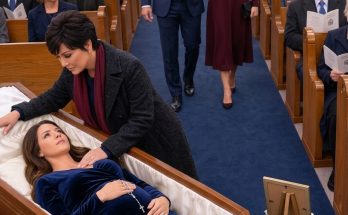
The cemetery service took place on a cool morning when the grass was still damp.
We held it several months after Dad's death, once the arrangements and custody of the remaining ashes had been properly coordinated.
Ray brought the container to the funeral director himself.
There was paperwork, a receipt and a quiet conversation about how the transfer would be documented.
He didn't argue.
I couldn't decide whether to thank him for doing what should have been done from the beginning.
I chose to say, "I'm glad he's coming home."
Ray nodded.
The cemetery crew had prepared the space beside Mom.
A small table held Dad's photograph, a folded blue cloth and a vase of flowers.
I brought the old pocket watch, still stopped at the same minute, and laid it beside the photograph during the service. It would return to the estate inventory afterward.
Lydia arrived early with her husband.
Martin came in the jacket he wore to every important gathering.
Two of Dad's old coworkers stood together near the oak.
Nobody had to ask where to go.
The place was familiar to all of us.
Mom's headstone was weathered but clean. Dad had paid to have the lettering repaired a few years earlier.
The first time Ray brought the cremated remains to the funeral director, I couldn't bear to look at the container.
I sat in an office while the director checked the identifying information and explained the next steps. He spoke respectfully and did not treat our family's dispute as a spectacle.
Ray signed the necessary paperwork. We reviewed how the remains would be transferred and how the cemetery would receive them. The process was careful and quiet.
I wished the original arrangements had been handled with the same patience. I also understood that wishing wouldn't change what happened.
I met with the cemetery manager to choose a service time. She walked me to the plot and explained where visitors could stand without crowding the neighboring graves.
We discussed a simple arrangement, weather contingencies and the work needed to update the marker. I brought Dad's old photograph in a frame Mark had repaired.
His face was sunburned from a fishing trip, and he was smiling at something outside the picture.
It was how I wanted people to remember him, not in a hospital bed or on a form labeled deceased.
Selecting a hymn took me an entire afternoon. Dad had liked old country songs, but Mom's favorite hymn was one he hummed while making breakfast.
I played the melody quietly on my phone and remembered him tapping a spoon against the counter.
I asked the church organist if she could play it on a small portable keyboard at the service. She said she could. Later I found the song listed in Mom's funeral program.
I sat on the floor of the guest room holding that yellowed paper. It felt as though the two of them had left a small path for me to follow.
I contacted the guests without discussing the estate dispute. Martin offered to bring chairs for older relatives. Lydia promised to bring bottled water.
Ray asked whether he could place the first flower beside Dad's name. I told him yes. I did not make him earn that right through another conversation about the bank.
We could disagree about money and still share the duty of honoring our father. The distinction took effort, but I wanted to preserve it.
The night before the service, I slept poorly. I dreamed about arriving at Dad's house on the day he died and finding him in his kitchen making coffee.
In the dream he asked why I was upset, and I couldn't explain. I woke at four and went downstairs. Mark found me sitting with the program drafts spread around the table.
He put a blanket over my shoulders and made toast. We didn't say much. After breakfast, I chose the shortest program and threw the others away.
Dad wouldn't have wanted us fussing over fonts until the sun came up.
At the cemetery, I watched Ray greet Martin. They shook hands and then embraced awkwardly.
Ray had avoided some of Dad's friends during the dispute because he feared they'd been told he was a thief. I couldn't solve that fear for him.
But I could refuse to turn the service into evidence of who was on which side. When relatives approached, I thanked them for coming.
If anyone started asking about court papers, I pointed them toward the refreshments after the service and said this was a day for remembering Dad. Most understood immediately.
During my remarks, I nearly forgot the story about the mailbox. I looked down at the index card, saw the word TILT and started laughing through tears.
I explained how Mom complained that the leaning post made the house look neglected. Dad insisted it was sturdy and promised to straighten it the following spring. He never did.
The small group laughed too. For a moment I heard the family as it had sounded at holiday dinners before every conversation became strained.
I held onto that sound while the final prayers were spoken.
After the service, Lydia touched my arm and said I had given Dad a good goodbye. I told her I wished he'd received it earlier.
She answered that the timing wasn't what made it sincere. I wasn't sure I believed her completely, but I appreciated the kindness.
When everyone had left, I stayed beside the grave with Mark. We stood quietly under the oak until a gust of wind shook the last leaves from a branch.
I placed my hand on Mom's stone and then on Dad's new lettering. Both names were where he had wanted them.
At Martin's workshop, one of Dad's coworkers described how he used to bring an extra sandwich for a young apprentice whose lunchbox was often empty. Nobody outside the shop had known.
Another remembered Dad staying late to fix a machine after everyone else went home. Ray sat beside me and listened.
I could see him discovering parts of Dad's life that had nothing to do with taking care of him or asking him for money. I felt the same surprise.
Our father had been more than the role he played in either child's life.
When the gathering ended, I walked Ray to his truck. He asked whether I was going back home in the morning. I said I would after meeting Ellen about one remaining document.
He nodded and offered to bring me coffee before I left. I accepted. We did not call it a reconciliation. We simply chose to spend fifteen minutes together the next day.
It was a manageable promise, and he kept it.
I remembered him complaining about the cost while carefully polishing the stone with his sleeve.
The minister read a short passage.
Then I stood to speak.
I had written four pages and crossed out half of them the previous night.
In the end, I brought one index card.
"My father believed a thing worth keeping was a thing worth maintaining," I began.
I told everyone about the leaning mailbox he never straightened because Mom teased him about it.
I told them about his first toolbox and the way he wrapped each wrench in a rag.
I told them how he saved the last corner of pie for whoever came to visit.
I did not speak about bank accounts.
I did not speak about Ray's mistakes.
I said Dad loved his children and sometimes struggled to tell us difficult truths.
Then I said goodbye.
The sound of my own voice surprised me.
For months, I'd spoken about Dad as if he were a file that needed to be corrected.
At the grave, he was my father again.
After the service, Ray stood beside me while the other guests moved toward their cars.
"I shouldn't have done it so fast," he said.
I looked at him.
"The cremation?"
I also asked the funeral director about the small cardboard container Ray had handed me after the cremation.
I wanted to ensure the remains we both held were accounted for and handled with dignity.
He explained how the portions could be brought together or interred according to the family's arrangements, and he documented what was received.
I brought my container in its original packaging rather than transferring anything myself. I signed the necessary receipt and sat for several minutes after the meeting.
There had been a week when I could hardly open the guest room door. Now the contents were being prepared for the place Dad had chosen decades earlier.
The practical step did not erase my grief. It gave it somewhere to go.
He nodded.
"I thought if I got the arrangements finished, I wouldn't have to watch him be gone."
"I needed to see him."
"I know."
"And he wanted to be here."
Lydia brought a small album to the memorial gathering and invited relatives to write their favorite memories on index cards. Some were funny. Some were only a sentence long.
I took the cards home afterward and read them slowly. They gave me stories of Dad I might never otherwise have heard.
Lydia brought a small album to the memorial gathering and invited relatives to write their favorite memories on index cards. Some were funny. Some were only a sentence long.
I took the cards home afterward and read them slowly. They gave me stories of Dad I might never otherwise have heard.
Ray stared at Mom's name.
"I told myself cremation didn't matter because we could still put him here. But I didn't ask you. I made the choice because I could."
I waited.
"I'm sorry, Jan. Not for how upset you were. For taking that choice away."
That apology was different from the ones he'd offered in the months before.
He named the decision.
He didn't blame my distance.
He didn't tell me to move on.
"Thank you for saying it," I answered.
I wasn't ready to tell him everything was fine.
It wasn't.
He seemed to understand.
Later, at a small gathering in Martin's workshop, we ate sandwiches and looked through photographs.
Ray found one of Dad teaching him to replace a bicycle chain.
He handed it to me.
"You can have this."
"Let's make a copy first," I said. "Then we both can."
He smiled faintly.
For the first time since the funeral, sharing something didn't have to mean surrendering it.
Click here to continue reading: PART 11: Selling Dad’s House Took Careful Work and Changed What We Each Believed We Deserved
The Sealed Envelope in My Father’s Jacket Exposed the Lie My Brother Had Told Me
Part 10 of 12