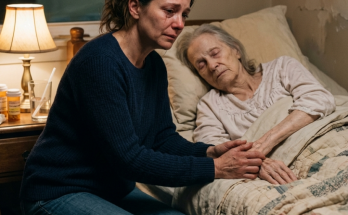
Mara believed family loyalty was unbreakable—until one night proved her wrong in the most devastating way. The betrayal wasn’t loud or dramatic; it was quiet, personal, and final. When she discovered her husband and her sister together, something inside her shut down completely.
She didn’t argue or demand explanations. She disappeared. New address, new number, new life.
For the next fifteen years, Mara rebuilt herself piece by piece, surrounding her heart with routines and distance. From the outside, she healed. On the inside, the memory stayed—silent, unresolved, and heavy.
Time moved on, but the past never fully loosened its grip.
Then a phone call shattered the calm she had constructed. A distant relative informed her that her sister had died during childbirth and that a funeral was being planned. Mara’s response was immediate and cold: she would not attend.
To her, that chapter had ended long ago. Yet that night, sleep refused to come. The anger she thought had faded stirred again, mixed with something unfamiliar—unease.
She told herself she felt nothing, but the silence said otherwise.
The following day, curiosity pulled her toward the truth she had avoided for years. Searching online, Mara stumbled across a message thanking “Aunt Mara” for quietly helping with medical expenses long ago. Confused, she dug deeper and uncovered an old, unopened email—a final letter from her sister.
In it, her sister admitted the betrayal, called it a painful mistake, and confessed she had never found the courage to ask for forgiveness. Then came the revelation that froze Mara in place: the child her sister died giving birth to was not her husband’s. The affair had ended long before Mara vanished, but the truth had never reached her.
The weight of fifteen years collapsed in a single moment.
Anger gave way to grief, and grief to regret—for words never spoken, for forgiveness delayed too long. Mara wrote a reply no one would ever read, letting years of emotion spill onto the page. That evening, she attended the funeral quietly, standing at the back, unseen and unannounced.
There was no confrontation, no closure wrapped in neat answers—just release. As she walked away, tears finally came, not for the betrayal that once defined her life, but for the peace she had finally allowed herself to feel.
The story doesn’t end here — it continues on the next page.
Tap READ MORE to discover the rest 

I was thirty-two when everything I believed about my childhood quietly unraveled. After my grandmother’s funeral, I returned to the small house where she had raised me, still moving through the motions of grief.
Three days later, a letter arrived in her familiar handwriting. I stood in the kitchen where she once made pancakes for dinner and counted coins at the table, afraid that opening it would change something I wasn’t ready to face. When I finally read her words, memories rushed back—late-night stories, careful routines, and a life built on love rather than excess.
I thought I knew our story. I was wrong.
Her letter explained how carefully she had planned for my future without ever letting me know. Hidden away were documents I’d never seen: savings accounts, a college fund, the deed to her house, even a note about a “practical car” she hoped I’d someday need.
I had grown up believing we struggled, that every frugal choice was born of necessity. In truth, it had all been deliberate—her quiet way of ensuring I would never worry about tomorrow while learning the value of today. Then the letter shifted in tone, and with it, my understanding of the past.
My parents, she wrote, had not died as I’d been told.
They were alive, but absent by choice after serious mistakes led them away from my life. She had decided it was kinder to let me believe they were gone forever than to burden a child with betrayal and shame she couldn’t yet understand. The story she gave me was a shield, meant to protect my sleep, my innocence, and my sense of safety.
As the truth settled in, grief took on a new shape—not just for what I’d lost, but for what I’d never known.
Years later, holding a small award in a quiet dressing room, I placed her letter beside me and finally understood the weight of her choice. My life wasn’t extraordinary, but it was steady, honest, and fully mine—made possible by the protection she offered in silence. I don’t search for my parents.
I don’t feel abandoned. I feel deeply, fiercely loved. My grandmother may have hidden the truth, but she gave me something greater in return: a childhood built on care, stability, and a devotion strong enough to carry even the hardest secrets.
The night before my husband Jason’s birthday party, I worried out loud about the icy porch and asked him to clear it.
He waved it off. The next morning, rushing out the door, I slipped, fell hard, and broke my arm. What followed was a blur of pain, an ER visit, and a heavy cast with strict instructions to rest.
When I finally made it home, I expected concern. Instead, Jason scanned the house and asked a single question that stopped me cold: how was his birthday party going to happen now that I “couldn’t manage things”?
That moment pulled a curtain back on years of quiet imbalance. Every holiday, every gathering, every dinner had been my responsibility, while the compliments flowed his way.
Even injured, exhausted, and in pain, the focus wasn’t my well-being—it was the event. I didn’t argue. I said I’d handle it.
That evening, while he went out with friends, I made different arrangements: a cleaning service, professional catering, and payment for it all. Then I made one more call—to confirm I was ready to move forward with a decision I’d been weighing for a long time.
On the day of the party, the house looked flawless and the food was impeccable. Jason welcomed guests as if it were all his doing, brushing off questions about my cast.
Then the doorbell rang. A legal representative arrived with official documents. The service managers followed, calmly confirming that I had arranged and paid for everything because I was medically unable to do physical work.
The room went quiet. Jason looked stunned. I stayed composed.
This wasn’t about public embarrassment—it was about truth finally taking up space.
That night, I left with a packed bag and a friend waiting outside. My arm still hurt, and my heart was heavy, but underneath it was relief. I wasn’t leaving in anger; I was choosing a life where my effort and health mattered.
Healing would take time, physically and emotionally, but I knew the decision was right. That birthday didn’t just mark another year—it closed one chapter and opened another, where I would no longer carry everything alone.
For decades, Bob Weir has stood at the center of a musical universe unlike any other. As a founding member of the Grateful Dead, he helped shape a live performance culture built on improvisation, shared experience, and emotional freedom.
What started in California’s countercultural scene evolved into a movement that transformed concerts into communal journeys. Fans didn’t just attend shows—they became part of them, following the music wherever it led.
Even as the years passed and the music industry changed, Weir’s dedication to performing and exploring sound never faded. Through reunion tours, anniversary concerts, and new projects, he continued to reinterpret classic material while pushing it forward.
His later collaborations and touring bands preserved the spirit of the Grateful Dead while inviting new generations to discover the music. For longtime followers and first-time listeners alike, his performances remain unpredictable, alive, and deeply immersive.
The foundation of that legacy dates back to the early 1960s, when a chance meeting sparked one of the most influential partnerships in American rock history. The band that emerged rejected rigid formulas, favoring long improvisations and ever-changing setlists.
Weir’s rhythm guitar became a crucial anchor within that freedom, adding structure and texture to expansive performances. His songwriting contributed timeless tracks that continue to resonate, while the fan community that grew alongside the band became a culture of its own—one defined by curiosity, creativity, and connection.
Beyond the stage, Weir is respected for his thoughtful reflections on art, nature, and the evolving role of music in human life. He has long emphasized that music is not static, but a living force meant to grow and adapt.
Rather than symbolizing nostalgia, his ongoing work represents continuity—proof that meaningful art can endure by changing with the world. As fans look ahead, the message remains clear: the music doesn’t end, it moves forward, carried by those who continue to listen, gather, and share the journey.
From the moment she stepped onto the stage, Nikki Glaser made it clear the night would be anything but predictable. Hosting the Golden Globe Awards, Glaser opened the ceremony with sharp confidence and a rhythm that instantly pulled the room in.
Her monologue felt current, fearless, and effortlessly controlled—earning immediate laughs from the audience inside the venue and lighting up social media within minutes. Viewers quickly agreed: this was an opening that commanded attention and set a high bar for the rest of the night.
Glaser’s humor walked a careful line between bold and approachable. She touched on pop culture, media buzz, and Hollywood habits with precision, never sounding forced or mean-spirited.
The jokes landed quickly, her timing crisp, and her delivery self-aware. Many fans praised her ability to say what others might avoid while keeping the tone playful rather than confrontational. As reactions poured in online, her monologue was widely described as one of the strongest Golden Globes openings in recent memory.
As the ceremony progressed, Glaser showed range beyond comedy alone.
Toward the end of the night, she shifted into a quieter, more reflective moment, offering a respectful tribute to a recently departed filmmaker. The brief acknowledgment, paired with a subtle visual nod to his work, stood out for its warmth and restraint. The contrast between humor and sincerity resonated with viewers, reinforcing her ability to guide the room through multiple emotional tones without losing authenticity.
The Golden Globes appearance marked another milestone in Glaser’s steadily expanding career.
Alongside stand-up success, she is preparing new projects, including an upcoming streaming special and film collaborations, while also taking on more behind-the-scenes creative roles. From early comedy stages to hosting one of Hollywood’s most visible nights, her trajectory reflects confidence, versatility, and momentum. If the opening moments of the Golden Globes were any indication, Nikki Glaser’s influence in entertainment is only continuing to grow.