I was sixteen when I decided I was done with school.
By then, I had already learned how temporary everything was. Homes. Promises. Adults. I had been moved through so many foster placements that I stopped unpacking my bags. I kept my shoes by the door. You don’t plan for a future when you’re trained to leave at any moment.
School felt pointless. College was a fantasy meant for kids with parents who helped with homework and saved money in accounts with their names on them. I was just trying to survive until eighteen.
That’s when she noticed me.

Mrs. Langston taught biology. She was calm in a way that made the room feel quieter just by her standing there. She didn’t raise her voice. She didn’t embarrass students. She watched—really watched.
One afternoon, she stopped me as I was heading for the door.
“Have you ever thought about medicine?” she asked.
I laughed. Not kindly. Not cruelly. Just tired.
“People like me don’t become doctors,” I said.
She didn’t argue. She just said, “Sit with me tomorrow after class.”
That was the first day someone refused to let me give up.
She helped me piece together transcripts scattered across districts. She stayed late filling out scholarship forms with me. She taught me how to write an essay when my life felt too messy to explain. When I didn’t have a quiet place to study, she opened her classroom. When I missed deadlines, she helped me fix them instead of shaming me.
On the days I wanted to disappear, she reminded me—softly, stubbornly—that I mattered.
I graduated. Then college. Then medical school.
Twelve years passed in a blur of exhaustion and disbelief. The night before my graduation ceremony, I stared at my white coat hanging in the closet and thought of her.
So I called.
“I owe everything to you,” I said, my voice breaking. “Please come to my graduation.”
She paused, then said yes.
At the ceremony, I scanned the crowd until I saw her—sitting quietly, hands folded in her lap. She didn’t clap loudly. She didn’t wave. She just watched me with a small, unreadable smile.
Afterward, while classmates posed for photos and families cheered, she waited patiently on the edge of the room.
“I’m so proud of you,” she said.
Then she reached into her bag and pulled something out.
“I kept this for you.”
She handed me a perfectly folded white coat.
I froze.
It wasn’t mine.

Through tears, she told me the truth.
Her daughter had been in her final year of medical school—fifteen years ago—when a car accident took her life. The white coat had been hers. Mrs. Langston had never been able to give it away.
“The first day I saw you,” she whispered, “you had the same twinkle in your eyes. Bright. Curious. But lost.”
She swallowed hard.
“Helping you wasn’t charity. It was continuity. I didn’t replace my daughter. I just refused to let the love I gave her disappear.”
I broke.
I hugged her, and we cried there in the middle of the room, surrounded by noise that suddenly didn’t matter. In that moment, I understood something I’d never been taught in foster care—that family isn’t always assigned. Sometimes it’s chosen. Sometimes it’s built out of quiet persistence and unconditional belief.
From that day on, I made her a promise without saying it out loud.
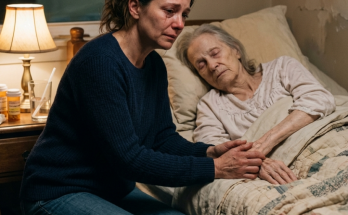
I visit her every Sunday. We drink tea. I listen to her stories. I call her on hard days. When I doubt myself, she reminds me who I am. When she feels lonely, I remind her she isn’t.
She’s not just my teacher anymore.
She’s my family.
And the kindness she gave me—the kind that saved my life—I give back to her every single day.