When my father died, I thought the worst part would be the grief. I was wrong.
The real shock came afterward, when the will was read.
After twenty-five years of marriage, my stepmother, Sandra, was left with nothing. No savings. No property. Not even the house she had lived in for half her life. My father had quietly put everything in my sister’s name years earlier. I watched Sandra sit there, hands folded in her lap, her face perfectly still as the lawyer spoke. She didn’t cry. She didn’t argue. She just nodded once, as if she had expected it all along.

My sister didn’t bother hiding her cruelty. The moment we stepped outside, she scoffed and said, “Well, that settles it. Let her rot in the streets. Not my problem.”
Sandra had nowhere to go.
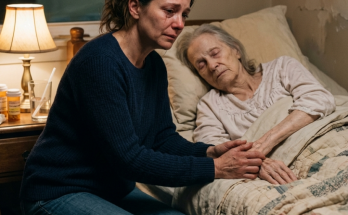
I took her in. Not because we were close. Not because I felt some sudden rush of affection. I did it because leaving a woman in her sixties homeless felt inhuman. Basic decency. That was all.
She moved into my guest room with two suitcases and an apology she repeated far too often. “I won’t be any trouble,” she kept saying. “I’ll be gone as soon as I figure something out.” I told her to stop worrying, but she never really did.
For months, we lived quietly under the same roof. She cooked simple meals and cleaned up after herself immediately, as if afraid of taking up space. Sometimes I’d catch her looking at old photos on the bookshelf—pictures of my childhood, my mother still alive, my smile wide and careless. She never said much. Sandra was never one to push her way into conversations. She had always been like that.

Then one evening, I came home late from work, exhausted and distracted, and something felt wrong the moment I stepped inside.
The house was too quiet.
Her shoes were gone from the hallway. The guest room door stood open, the bed neatly made, the closet empty. No suitcase. No folded clothes. No note on the kitchen counter. It was as if she had erased herself.
My first reaction was anger. Then confusion. Then a hollow ache I hadn’t expected. I called her phone—disconnected. I checked the bus station the next day, the shelters, even distant relatives I barely knew. No one had seen her.
That night, while searching for an old document in my desk drawer, my fingers brushed against something unfamiliar.
An envelope.
It was thick and heavy, with my name written carefully across the front in Sandra’s neat, familiar handwriting. My hands started shaking before I even opened it.
Inside were photographs. Dozens of them.
My childhood—captured moment by moment.

The first picture stopped my breath completely. I was eight years old, standing awkwardly beside Sandra, still stiff with grief after my mother’s death. Another showed my first school play. Then birthdays. Science fairs. Graduation day. My university ceremony, my face glowing with pride.
I stared at them in disbelief.
Every single photo had been taken by her.
Not my father.
Sandra.
She had been there for everything. Every scraped knee, every nervous smile, every milestone I barely remembered—but she did. She had never tried to replace my mother. She had never asked to be called “Mom.” She had simply stayed. Quietly. Steadily. Loving me in the background, where no one would accuse her of overstepping.
At the bottom of the envelope was a small velvet pouch. Inside lay a heavy heirloom ring, studded with gemstones, unmistakably valuable. It caught the light as if it carried years of stories within it.

Beneath it was a short note.
“This is all I have, and I want you to have it now. May it bring you luck in your darkest days. Love, Sandra.”
I broke down then. Fully. The kind of crying that leaves you breathless.
I never saw her again.
I searched for months. Years. I asked everyone. Filed missing person reports. Followed rumors that led nowhere. It was as if she had vanished into thin air, leaving behind only proof that she had loved deeply and without conditions.
But her kindness didn’t disappear.
It lives in those photographs. In that ring I still wear on hard days. In the quiet understanding that the person who loved me most after my mother died never needed recognition, gratitude, or even a place to stay.
I still dream of finding her someday.
Just to hug her.
Just to tell her she mattered.