I was twenty-two when my life split cleanly in two—into before and after.
Before, I was a college student with a boyfriend who promised we were building something together. After, I was standing on a sidewalk with one suitcase and a positive pregnancy test folded in my pocket, listening to him say I had “ruined everything.” He didn’t shout. That somehow made it worse. He just opened the door, set my bag outside, and closed it like I was a mistake he could erase.

I went to my parents next. I thought blood meant safety. I was wrong. My mother cried, my father stared at the floor, and they told me I’d made my choices. They said coming home would only “encourage irresponsibility.” I remember nodding like I understood, then walking back out into the cold with nowhere left to go.
The building janitor found me sitting on the stairs that night.
His name was Mr. Alvarez. He was in his late fifties, with tired eyes and hands rough from decades of work. I’d seen him every day, pushing his cart down the halls, nodding politely. We’d never really talked. When he asked what was wrong, something in his voice—quiet, steady—made me tell the truth.
He didn’t ask questions. He just said, “Come on,” and unlocked the door to his small basement room beneath the building. It had one bed, a table, a hot plate, and a single lamp that hummed when you turned it on. It wasn’t much. But it was shelter.
I stayed there for weeks. He gave me the bed and slept on the floor. He made soup and left it on the table without comment. Some nights, when the fear got too loud, he’d sit nearby and talk about nothing—weather, old movies, the pigeons that gathered outside the loading dock. He never judged me. He never told me what I should have done.

At thirty-two weeks, everything fell apart.
The pain came suddenly, violently. By the time the ambulance arrived, it was already too late. I remember waking afterward, empty and shattered, the weight of loss pressing on my chest until I couldn’t breathe. Back in that small room, I broke completely. I screamed until my throat burned.
Mr. Alvarez held me while I cried, his arms awkward but steady, like he was afraid of doing it wrong but refusing to let go. When my sobs finally slowed, he said softly, “This isn’t the end of your story. It’s the turning point.”
I didn’t believe him then. I barely believed in tomorrow.
After I recovered, I moved into a shared apartment and tried to piece myself together. Life didn’t suddenly get easier, but it moved forward. I finished my classes slowly, worked part-time, learned how to wake up without dread. Mr. Alvarez and I stayed in touch, though not closely. A check-in here and there. A nod when our paths crossed.
Two years later, he asked to see me.
I thought it was just a friendly visit. We sat at a café near campus, the kind with chipped mugs and mismatched chairs. He looked older, more tired. After a while, he reached into his jacket and pulled out a worn envelope.
“I never stopped believing in you,” he said. “And I’ve been holding onto something.”

Inside was a small savings account booklet. My name was on it.
He explained, almost apologetically, that every month since I left, he’d put aside a little from his paycheck. Not much. Whatever he could spare. “I knew one day you’d need a fresh start,” he said. “I wanted you to have choices.”
I couldn’t speak. This man—who earned so little, who lived in one room—had been saving for me. For someone he’d known only briefly.
When I finally found my voice, it came out as tears. I told him I needed that money more than he knew. Smiling sadly, he said, “You reminded me what it feels like to have someone to care for. That’s worth more than money.”
Then he told me about his daughter. How he’d lost her years ago, when she was about my age. “I couldn’t save her,” he said quietly. “But I thought… maybe I could still do something right.”
That money carried me through my final year of college. It helped me find a job. It gave me back my footing.
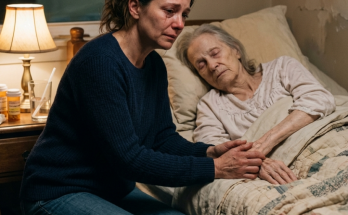
Years later, when his health failed and he could no longer work, I brought him to live with me. For the first time in decades, he had a real room—with a window facing the garden. He had no family left.
But he had me.
When he died, I buried him beside his daughter.
So he would never be alone again.