My mother-in-law fell gravely ill in early winter, the kind of sickness that steals strength quietly before anyone wants to admit what it means. At first, it was just fatigue. Then missed calls. Then a neighbor knocking on our door because she hadn’t been seen in days.
When the family group chat lit up, the responses were cold. My sister-in-law said she was too busy with work. One brother said hospitals made him uncomfortable. Another didn’t reply at all.

My husband scoffed when I suggested we help.
“Bad mothers die alone,” he said, like it was a proven law of nature.
The words landed heavy, but no one challenged them. Not even me.
Still, I went.
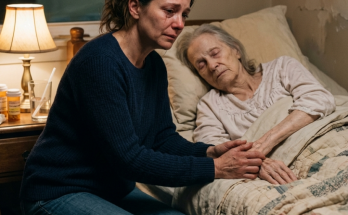
Her house smelled of old books and disinfectant. She lay small in her bed, thinner than I remembered, eyes dull with pain but bright with surprise when she saw me.
“You came,” she whispered.
From that day on, I showed up every morning. I cooked, cleaned, bathed her, drove her to appointments, and sat beside her through nights when sleep wouldn’t come. I paid for medications when insurance stalled. I learned the rhythm of her breathing, the way she squeezed my hand when the pain spiked.
Her children never came.
Sometimes she apologized to me for being a burden. Sometimes she cried quietly when she thought I wasn’t listening. Once, she said, “I tried so hard to be enough.”
She died on a gray afternoon, holding my hand, her last breath warm against my skin. No dramatic speeches. Just a soft exhale and a stillness that felt final and unbearably lonely.

The funeral was brief. Polite. Hollow.
A week later, the will was read.
Everything—house, savings, insurance—went to her daughter. The same daughter who never called. Never visited. Never asked how her mother was doing.
My husband and I were left with one thing: a stack of old, torn magazines tied together with string.
I didn’t argue. I didn’t cry. I told myself I hadn’t done any of it for money.
Months passed.
Then my phone rang.
It was my sister-in-law, her voice shaking.
“There’s a problem,” she said. “The will hasn’t gone through.”
That’s when she explained. My mother-in-law had added a clause years earlier—one no one had noticed.
If abandoned in illness, all assets would go to the caregiver.
My sister-in-law claimed she was that caregiver.

When the lawyer requested proof, panic set in. That’s when she called me again, her tone desperate now.
“I just need you to say I helped,” she pleaded. “Just confirm it. We’re family.”
I said no.
At the hearing, I brought everything. Receipts for medications. Hospital invoices in my name. Appointment logs. And then the footage—footage from the small security cameras my mother-in-law had installed after a break-in years earlier.
Weeks of recordings showed the truth clearly.
Only one person ever walked through that door.
Me.
The ruling was swift. The inheritance was transferred to me.
I didn’t feel victorious. Just tired.
Days later, while cleaning my closet, I finally untied the string around the magazines she’d left me. I flipped through one absently—until I noticed something.
An article circled in red ink.

It told the story of a woman who adopted two children after their parents died in a tragic accident. She worked multiple jobs. Lived frugally. Never remarried. The article praised her resilience, her quiet sacrifice.
The photo stopped my breath.
It was my mother-in-law. Young. Smiling. Proud.
I sat on the floor and cried harder than I had at her funeral.
She wasn’t a bad mother.
She was a woman who saved two children, raised them alone, paid every bill, skipped meals so they wouldn’t, and carried the weight of ungrateful love without complaint. She never demanded gratitude. Never defended herself. She let her children believe whatever made their lives easier.
Even after death, she taught me who she really was.
Quietly kind. Painfully strong. And deeply misunderstood.
And now, finally, seen.