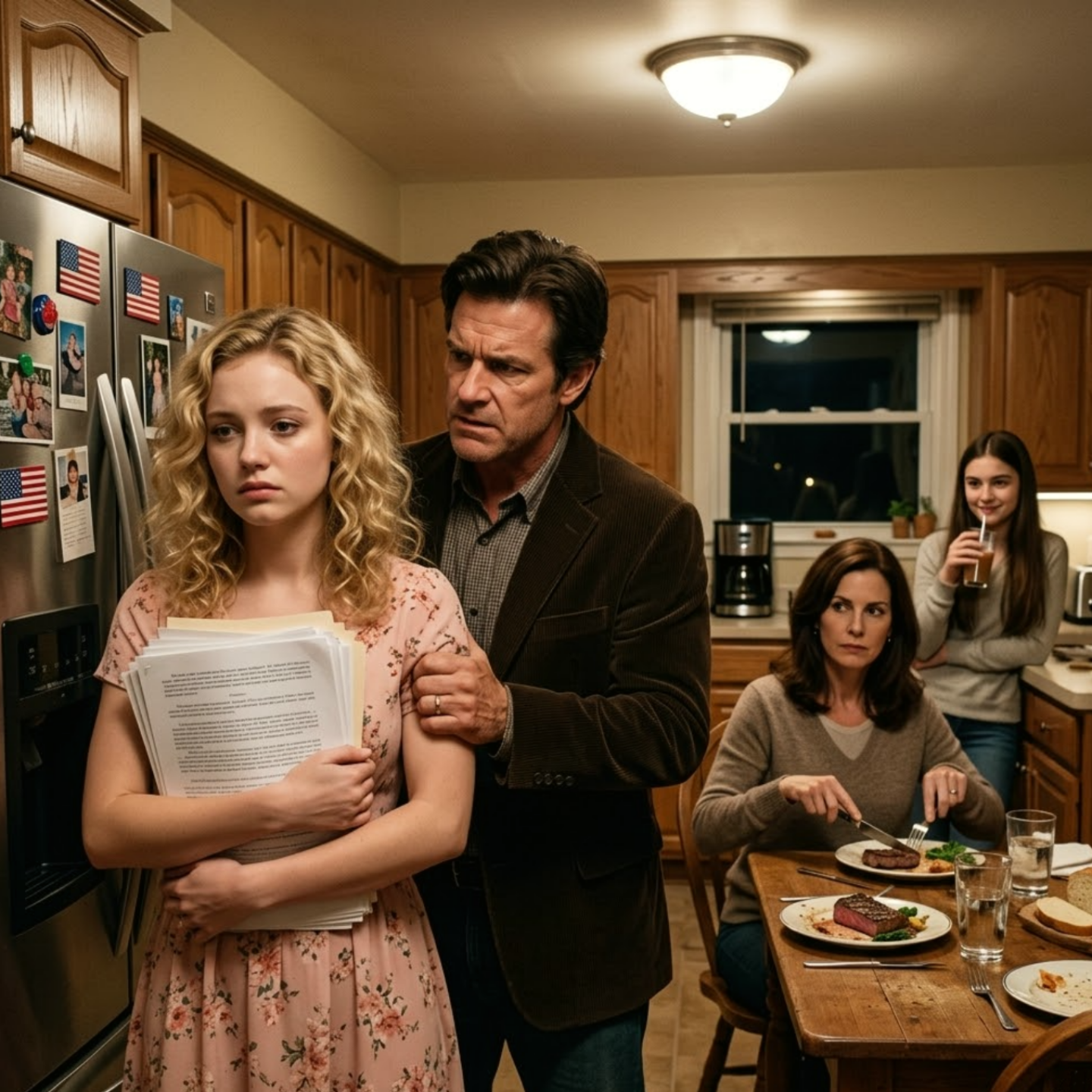
I thought I was only refusing to take my sister to the mall so I could keep my job interview, but that was the day I finally understood my place in the family. When my father said my sister’s future had to come first, I did what I had trained myself to do for most of my life: I went quiet. I stepped back. I tried not to make the moment uglier than it already was. I never imagined that choice would start a chain of events so precise, so merciless, that my whole family would lose the things they had always treated as permanent.
The glass cracked before I did.
It split in a crooked, glittering line behind my shoulder when my father’s hand drove me into the hallway wall. The family portrait shuddered in its cheap brass frame, tapping against the drywall as if even it wanted out of that house. The sound was sharp enough to slice through everything else, and then what came after felt worse than impact: silence. The kind that makes every ordinary noise suddenly obscene. The refrigerator humming in the kitchen. The heater kicking on. The distant clink of ice in someone’s glass.
“Her future matters,” my father said, loud enough for the whole first floor to hear, his voice carrying from the staircase to the granite island to the chandelier above the dining room table we only used at Thanksgiving. “Yours never did.”
The words stayed in the air like smoke trapped in a room with no windows.
We lived in a broad two-story colonial outside Chicago, in one of those suburbs where the lawns were cut in obedient lines and everyone pretended the right shutters and a white porch swing could prove something about the people inside. From the street, we looked like a family that mailed glossy Christmas cards every December, smiling in coordinated sweaters with a gold script font across the bottom. People driving past would have seen trimmed hedges, an American flag clipped to the porch post, a black SUV in the driveway, and windows that glowed warm at dusk. They would have assumed comfort. Stability. Success.
Inside, the rules were simpler.
Tessa shone. I absorbed.
That night, Tessa leaned against the marble kitchen counter chewing mint gum, one manicured leg crossed over the other, her iced coffee sweating onto a Pottery Barn coaster as if the whole thing were mildly inconvenient for her. My mother stood at the sink with both wrists in cloudy dishwater, her wedding ring catching the fluorescent light every time she lifted a plate. I was still on the floor when she let out a long sigh through her nose, the kind that always made it clear she was tired of me before I had even said anything.
“Why do you always start something?”
It wasn’t a question. It was family liturgy. A line worn smooth from repetition.
I didn’t answer. I didn’t defend myself. I picked up my keys from the hardwood, brushed a few tiny flecks of glass from the sleeve of my blazer, and pushed myself to my feet. My shoulder was already throbbing, but the pain felt far away, almost irrelevant compared with the shift happening somewhere deeper, somewhere I had kept sealed for years because opening it would have meant admitting the obvious.
That night did not invent anything. It confirmed it.
I had known, in one form or another, since I was eight.
That was the year I learned that anything belonging to me could stop being mine the second my sister wanted it. My birthday money had come folded into greeting cards from grandparents in Iowa and Indiana, ten-dollar bills tucked behind Hallmark messages, checks written in shaky blue ink by older relatives who still called the house phone and asked whether I was being a good girl. I counted the money three times before I walked into Target, palms damp around the red basket handle, and chose a toy I had wanted for months. It was small and bright and probably forgettable to anyone else in the world, but to me it meant something because I had bought it myself.
For one whole afternoon, it felt like proof that effort could turn into ownership.
Then Tessa saw it.
She wanted it immediately, the way she always wanted things without curiosity, without gratitude, simply with the conviction that wanting was reason enough. She cried like the world was ending, one hand fisted at her side, tears collecting on her lashes while she looked at me as if I had stolen from her. My father stepped into the living room, took in the scene with one glance, and held out his hand.
“Give it to her,” he said. “You’re the older one. Act like it.”
He never asked who paid for it. He never asked what it meant to me. He certainly never asked whether I thought it was fair.
I remember how slow my fingers felt as I placed the toy in his palm. The plastic slipped away from me with a strange, humiliating finality, like something sacred being confiscated by a god I had no power to challenge. Tessa stopped crying before the tears had even dried and skipped away with it. No one thanked me. No one said I was generous. No one looked back long enough to notice the silence that settled over me after she left the room.
That was the first lesson. It would not be the last.
By middle school, the favoritism had stopped feeling dramatic and started feeling structural. It wasn’t one spectacular cruelty; it was a hundred ordinary decisions stacked so neatly they became the architecture of our home. My report card from Lincoln Middle had all A’s, and I had carried it into the kitchen with both hands because some part of me still believed paper could argue where I could not. I laid it on the counter beside the Keurig and waited. In my head, I rehearsed the simplest possible reward: a nod from my father, maybe, or my mother turning and smiling as if she had expected no less and was secretly proud anyway.
Twenty minutes later Tessa burst through the back door waving flyers for her dance recital downtown, cheeks pink from the cold, talking too loudly about costumes and judges and some assistant choreographer who had complimented her lines.
Mom squealed. Dad clapped.
The flyers went on the refrigerator with two apple-shaped magnets from a school fundraiser. My report card slid sideways, then disappeared under grocery coupons and a Bed Bath & Beyond circular. Weeks later I found it bent at the corner with a pale coffee ring drying across the top like a watermark of indifference. I smoothed it as carefully as if I were touching something injured and tucked it into a folder under my bed. Holding it there, in secret, felt like preserving evidence that I existed, even if only in grade-point averages and teacher comments.
The same pattern repeated until I stopped being surprised by it.
In high school I got a part-time job at a diner off Route 34, the kind with cracked vinyl booths, laminated menus sticky at the corners, and a rotating pie case by the register that always smelled faintly of cinnamon and refrigerator air. I wore a pale blue uniform that trapped the scent of grease and burnt coffee no matter how often I washed it. Construction workers called me sweetheart. Truck drivers left quarters under their mugs. Sunday church families smiled at me with the same practiced warmth they used on hostesses and cashiers and women they would never have to know. I tucked my tips into a mason jar under my bed: wrinkled ones, damp fives, loose coins tacky with syrup from the lunch rush.
That money had shape and weight. It felt like oxygen.
College applications cost money. No one had offered to help. I didn’t ask because asking in our house meant you had already lost. So I counted quietly, shift by shift, tray by tray, building a future one tip at a time.
Then one Saturday morning I came home after an early shift and found the jar empty.
The room looked untouched otherwise. My blanket was folded. My desk was clean. The light through the blinds striped the carpet in neat, indifferent lines. For one irrational second, I thought I had moved the jar and forgotten. Then I walked to the kitchen and saw my mother at the sink rinsing dishes, as ordinary and unhurried as weather.
“Where’s my money?” I asked.
She did not turn around.
“Your sister needed new shoes for her competition in Milwaukee,” she said. “You’ll manage. You always do.”
That was the whole explanation. No apology. No request. Just a statement built on my predictability.
I stood there holding the edge of the counter so tightly my knuckles hurt. I knew the script by then. Arguing would make me ungrateful. Resisting would make me selfish. Crying would make me dramatic. Any pain I showed would become evidence of my flaw rather than theirs.
So I nodded.
I learned to disappear so smoothly that people mistook it for maturity. If Tessa needed a ride to rehearsal in downtown Naperville, I drove. If she needed cash for a last-minute costume or competition fee, I picked up an extra shift. If she bombed an audition, somebody else was blamed. If I forgot to refill the gas tank or came home ten minutes past curfew after closing at the diner, disappointment fell on me like a sentence already decided. Responsibility, in our house, was not the reward for being capable. It was the penalty.
There were nights I stood in the upstairs hallway listening to laughter drift out of the living room. Maybe they were watching a Netflix special. Maybe Dad had opened a bottle of red wine because Tessa landed another regional competition or got praised by some coach who mattered for exactly ten minutes and would be forgotten by spring. Sometimes I hovered there longer than I should have, waiting for someone to glance up and say my name, waiting to be folded into the warmth like it had simply slipped their minds.
Most nights my father looked toward the hallway and reached over to pull the door halfway closed.
Not slammed. Not theatrical. Just enough.
That was somehow worse. Violence leaves an obvious bruise. A half-closed door teaches you to doubt your own hurt.
By the time I graduated high school, I had absorbed one rule so fully it felt indistinguishable from truth: I was a supporting character in a story built around my sister, and my main value was knowing how not to interrupt it. When I got into Northwestern, I cried alone in the bathroom with the acceptance email open on my phone because I already knew how the announcement would go. Proud smiles, maybe, but only if it did not interfere with Tessa’s rehearsal calendar. My successes had to arrive quietly enough not to challenge the family hierarchy.
The morning of my job interview felt like rebellion before anything had even happened.
I woke before sunrise while the house was still heavy with sleep. The heating vents clicked softly. The hallway was dim. Outside, February had pressed a sheet of gray over the whole suburb, the kind of cold Midwestern morning that made the world feel metallic. I steamed my navy blazer in the bathroom, polished my flats with a tissue, and rehearsed answers under my breath while I pinned back my hair. Tell us about a challenge you overcame. Tell us about a time you handled conflict. Why do you want to work here? The irony of that last one almost made me laugh.
The interview was at a tech firm downtown, in one of those glass buildings near the river where ambition seems to live in the walls. I had applied without telling anyone. When the invitation email arrived, I had read it three times before I let myself believe it was real. I knew the address. I knew the train schedule. I knew exactly how long it would take if everything went right.
At 11:15, Tessa appeared in my doorway wearing oversized sunglasses indoors and carrying a drink in a clear plastic cup that probably cost more than an hour of my old diner wage.
“I need you to take me to Oakbrook Mall by noon,” she said.
I looked up from zipping my portfolio. “I can’t. My interview is at twelve-thirty.”
She blinked once, very slowly, as if I had answered in a language she considered vulgar.
“Then call them and move it.”
“I’m not canceling my job interview to drive you to the mall.”
The sentence left my mouth with the strange, electric feeling of stepping barefoot onto a frozen lake. I heard how calm it sounded and almost didn’t recognize myself.
Tessa lowered her drink and stared at me. She didn’t yell. She didn’t need to. Her power had never depended on volume.
“I’ll tell Dad,” she said.
He came up the stairs less than two minutes later, each step hard enough to sound deliberate. His jaw was set. His shirt sleeves were rolled to the forearms in that familiar way that always meant he had already decided the outcome and only needed me present for the performance.
“What’s this I’m hearing?” he demanded. “You’re refusing to take your sister where she needs to go?”
“I have an interview,” I said. “It’s important.”
He laughed.
There are laughs that mean delight, surprise, affection, embarrassment. My father had another kind entirely, the kind that turned a room cold. Then he said the sentence that had probably been true in his mind for years and simply had not been spoken out loud often enough for me to stop pretending otherwise.
“Her future matters. Yours never did.”
The shove came fast and ugly in its banality. No cinematic buildup. No raised fist. Just a burst of force from one body into another. My back hit the wall, the frame behind me cracked, and something inside me something that had spent two decades accommodating, explaining, smoothing, surviving shifted so completely I knew there would be no putting it back.
I didn’t scream. I didn’t threaten. I didn’t even look at Tessa.
I walked out.
The February air cut straight through my lungs when I stepped onto the driveway. The sky hung low over the cul-de-sac, and somewhere down the block a snowblower coughed to life. My hands were shaking, though not from cold. The house blurred behind me as I kept walking past the black mailbox, past the clipped shrubs, past everything that had looked respectable from the street for as long as I could remember.
Harper pulled up exactly on time.
Silver SUV. Engine idling. Window coming down to reveal the same steady brown eyes that had watched me cry in our freshman dorm at Northwestern and had never once told me I was being dramatic. She took one look at my face and something in hers sharpened without softening.
“What did they do?” she asked.
I got into the passenger seat and shut the door. “He tried to stop me from going. He shoved me.”
Her hands tightened around the steering wheel.
“He said my future never mattered.”
She did not gasp. She did not flood me with pity. That was one of the reasons I loved her. She never responded to my pain by making it about her reaction.
“Then we’re going to make sure no one ever says that to you again,” she said, and pulled away from the curb.
The drive downtown was almost unnervingly ordinary. Harper stopped at lights. She adjusted the heat. She handed me a bottle of water when she noticed my hands still trembling. At a red light near the Eisenhower, she reached over and smoothed my collar where my father’s grip had wrinkled it. The skyline rose ahead of us through the winter haze, steel and glass and certainty. She ran through practice questions in a calm, conversational tone, as if we were commuting to class instead of driving away from the moment my life had finally cracked open.
By the time we parked, my breathing had steadied.
The lobby of the building smelled like polished stone, expensive coffee, and the kind of climate control money can buy. Glass walls threw back slices of fluorescent light. People moved through the space with lanyards and confidence and takeaway salads in neat paper bowls. Nobody there knew my family name. Nobody there cared who my father was or what my sister wanted from me. That anonymity felt so clean it almost made me dizzy.
I belonged there more than I had ever belonged at home.
The interview lasted forty-seven minutes.
Three interviewers. Direct questions. Real answers. No one interrupting to redirect attention. No one pre-sorting my value before I spoke. I heard myself answering with a steadiness I had never seen in myself before. Years of being underestimated had made me observant. Years of needing to anticipate other people’s moods had made me sharp. Years of quietly doing too much had trained me to carry pressure without panicking. For the first time in my life, the survival skills I had learned in the wrong place sounded like strengths in the right one.
When I walked back into the lobby, Harper stood and smiled like she had never doubted the outcome.
“Told you,” she said.
My phone had turned into a weapon while I was inside.
You ruined everything.
Dad’s furious.
If I miss this meet-up because of you
Hope that stupid interview spits you out.
I stared at the messages until they stopped feeling like language and started feeling like weather. Then I typed a single line.
I’m not coming home.
Harper drove me to her apartment in Wicker Park, a third-floor walk-up over a quiet street lined with brick buildings, bare trees, and the kind of coffee shops with chalkboard signs and people typing screenplays they would never finish. Her place was small and warm and faintly smelled like laundry detergent and the curry place downstairs. She handed me a clean T-shirt and told me to take a shower.
In the bathroom mirror I saw the bruise starting on my shoulder, darkening beneath the skin like a fingerprint that had decided to bloom slowly.
For a moment I felt every version of myself at once: eight years old, giving up the toy; twelve years old, smoothing the coffee ring from a report card; sixteen years old, standing by an empty mason jar and learning not to ask twice. I stood there with wet hair and my hands braced on the sink and understood, with frightening clarity, that the shove had not been an exception. It had been the most honest thing my father had ever done. He had finally put physical force behind a family truth that had always been there.
When I came out of the bathroom, Harper was at the kitchen table with her laptop open.
“You need to see this,” she said.
The room tilted before I even sat down.
An internal HR chat. A recruiter memo. A voicemail transcription. My father had called the company. More than once. He had reported me as unstable, claimed I had attacked him, implied that hiring me would be a liability. In at least one call, he referenced his board position as if his influence were a credential that should matter more than my interview.
My skin went cold.
He had not just tried to stop me from leaving. He had tried to follow me into the one place he had never been invited and poison it before I could get there on my own.
“He crossed lines here,” Harper said, her voice clipped with focus. “Legal lines. Compliance lines. The kind people lose jobs over.”
She was already building a file screenshots of Tessa’s texts, timestamps of my father’s calls, a timeline of the assault, the interview, the contact, the interference. Harper had always been the sort of person who dealt with panic by becoming exact. Watching her work steadied me. There was no dramatic monologue, no revenge speech, no fantasy of public humiliation. Just evidence. Labels. Order.
We worked until after midnight.
We typed. We saved. We attached. We indexed. Harper drafted the complaint language with the same practical calm she used to help me study for finals. I added what I could remember, then went back and added more when memory sharpened. We included the texts. We included the voicemail. We included the fact that he invoked his role while trying to influence a hiring decision at a company where I was applying.
At 12:03 a.m., the email sat ready to send, addressed to HR compliance with the oversight committee at my father’s firm copied.
“You ready?” Harper asked.
I thought about the hallway. The cracked frame. The bruise. The years spent swallowing every injury until it became personality.
“Yes,” I said.
She hit send.
The first response came within twenty-four hours.
Under review.
Then another followed an apology from HR that did not sound mass-produced or defensive. They confirmed the interference would be investigated and assured me no further calls from non-applicants would be accepted in my file. Two days later, the company reached out to my father’s firm and requested clarification on why a senior adviser had repeatedly contacted them, misrepresented a candidate, and invoked his board position during the process.
Corporate language has its own kind of violence. It is clean, flat, and impossible to argue with once it has chosen its nouns.
By Friday, his firm had opened a mandatory review.
Advisory privileges temporarily suspended.
Suspended. One word, and suddenly the man who had ruled our house with certainty was being evaluated by people who did not care about his temper or his reputation at church or the size of his donations. I did not call home. I did not ask what he said when the notice arrived. I did not have to. My mother called me instead, and I could hear the panic under her control before she had even finished my name.
“Your father is in trouble,” she said. “Someone reported him. We need you to fix this.”
I stood by Harper’s living-room window staring down at Damen Avenue, where someone was walking a dog in a bright red coat through slush the color of old dishwater.
“I’m not fixing anything,” I said.
“You exaggerated,” she insisted. “Tell them you misunderstood.”
“I didn’t misunderstand.”
Her voice trembled then, but not with the thing I had once needed from her. Not remorse. Not concern for me.
“It wasn’t supposed to go this far.”
I closed my eyes. “I didn’t push it this far. He did.”
A week later, his contract was terminated for breach of ethical standards.
The same connections he had used as leverage all my life disappeared under the weight of one investigation. A title can look indestructible until somebody puts it in writing that it isn’t. My mother called again after that, sounding smaller than I had ever heard her.
“We don’t know what to do,” she said.
There had been a time when that sentence would have cracked me open. I had built whole years of my life around preventing my family from feeling destabilized by consequences they created themselves. But something in me had gone still.
“I’m not the one who did this,” I said.
Then I hung up.
A few days later, the tech company asked me to come in for a private meeting. The conference room overlooked the river, gray and cold beneath a lid of winter sky. They apologized again for what had happened. They told me they had reviewed the situation. They offered me the job full salary, benefits, relocation support, and written assurance that any future external interference would be treated as harassment.
It was not the offer itself that made my throat tighten.
It was the fact that someone in power had looked at what happened and named it correctly. Not drama. Not misunderstanding. Not family conflict. Harassment. Interference. Wrongdoing. My future mattered enough for strangers to protect it better than my family ever had.
I took the offer.
My apartment was small, sunlit, and gloriously unimpressive by suburban standards. Third floor. Radiator heat. Hardwood floors with a few scratches near the window. A narrow kitchen where the cabinets didn’t quite line up and the faucet squeaked if you turned it too fast. It was the first place I had ever lived that felt honest. Nothing about it was curated for appearances. No staged entryway table. No decorative bowl no one was allowed to touch. No rooms kept immaculate for guests while the people living in them learned to shrink.
The first morning I woke there, sunlight slid across the floorboards in a thin gold band. I stood barefoot in the kitchen with coffee in my hand and listened to nothing happen. No raised voices. No footsteps loaded with warning. No television blaring from downstairs because my father had decided the whole house needed his mood.
Just quiet.
My phone buzzed on the counter.
We need to talk.
Please.
I looked at the screen until it dimmed and then went dark. Silence was no longer the thing they forced on me. It had become something else entirely. Something chosen. Something with edges.
I opened my laptop to onboarding documents and welcome emails from coworkers who knew me only by my skills, my resume, and the impression I had made in a room with no family history attached to my name. None of them knew the hallway. The cracked frame. The years of being reduced to usefulness. They only knew the version of me that showed up prepared.
For the first time in my life, I was building something on merit instead of permission.
Weeks passed. Training started. Systems made sense. I learned the rhythm of the office, the timing of trains, the names of people who asked me to lunch because they liked my company rather than because they needed something from me. In meetings, I found myself speaking before I had rehearsed every sentence to death. It did not happen all at once. Confidence rarely arrives in a dramatic wave. Sometimes it sneaks in through repetition, through being treated as ordinary until your nervous system finally believes you are allowed to be.
One evening after work I walked along the Chicago River with cold wind coming off the water and the skyline reflected below me like a second city trembling under the surface. My phone rang. Dad.
I watched the screen vibrate in my hand until it stopped.
Then I blocked the number.
Freedom did not feel explosive. It did not look like a movie montage or a triumphant scream from a rooftop. It felt steadier than that. Smaller, too, in the best possible way. It felt like waking up and not bracing for impact. It felt like stepping into a building where no one expected me to apologize for existing. It felt like realizing that the sentence which had once defined me Yours never did had never been truth at all. It had been strategy. Control only works as long as you stay inside it.
Some doors do not slam.
Some doors disappear the moment you stop knocking.
The first time I slept through the night, it frightened me.
Not because I had a nightmare. Because I didn’t. I did not jerk awake at 3:12 a.m. to the phantom sound of my father’s footsteps in a hallway that no longer belonged to me. I did not wake with my jaw locked and my stomach already clenched around a mistake I had not made. I did not bolt upright because my body had mistaken silence for the pause before impact. I slept eight full hours in a room with thin curtains and a radiator that hissed like an elderly cat, and when I opened my eyes the sunlight was already there.
For a few seconds I lay still, almost suspicious of the peace.
Below my window, the city was beginning its morning in soft, indifferent fragments. CTA brakes sighed in the distance. A siren passed somewhere farther west. Somebody laughed too loudly on the sidewalk, the sound carrying up between brick buildings as if they had every right to joy before nine in the morning. My apartment was not fancy. It was a one-bedroom walk-up with scuffed baseboards, a closet door that stuck in humid weather, and a kitchen narrow enough that opening the oven blocked one cabinet entirely. But it was mine, and in that place quiet was no longer a punishment. It was room.
Harper’s mug sat on the counter beside a half-unpacked box labeled BATHROOM in her fast, slanted handwriting. She had insisted on helping me move because she knew me too well. Left to myself, I would have tried to do the whole thing alone out of habit, out of pride, out of that old reflex that said needing help was dangerous. Harper had shown up anyway with packing tape, a Subaru full of blankets, and the sort of loyalty that never announces itself because it does not need applause.
My phone lit up again.
Mom: We need to talk.
Mom: Please answer.
Mom: This isn’t fair.
Fair.
That word had spent years floating through our house like perfume over rot. Fair was what my father said when Tessa lost a solo she thought was hers by birthright. Fair was what my mother said when Tessa wasn’t invited to the right birthday parties or sat at the wrong lunch table or had to wear an off-the-rack dress to something where everybody else looked richer. The word almost never appeared in relation to me unless what they meant was that I should be fair to them patient, useful, forgiving, strategically silent.
I set the phone facedown and opened my laptop. My first calendar invite of the day blinked onto the screen: New Hire Orientation, 9:00 a.m., Central Time. The tiny administrative detail made my chest tighten in a way I could not explain. Central Time. I had lived my whole life inside that time zone, but for the first time it felt like it belonged to me rather than to the architecture of somebody else’s schedule. Not Tessa’s rehearsals. Not my father’s dinners. Not my mother’s social obligations. Mine.
I clicked Join.
The meeting populated itself with faces in little rectangles: a man in a quarter-zip sitting in front of a bookshelf full of leadership books he probably had not read; a woman in a bright kitchen with a cat tail crossing the screen every thirty seconds; a new engineer who looked barely out of college and kept muting himself too hard; someone drinking out of a Notre Dame mug. The HR rep smiled into the camera and said, “Welcome, everyone. We’re excited you’re here.”
When she said it, she meant it.
That should not have felt radical. It did.
By lunch I had a badge with my name on it and a temporary employee ID, and no one had once asked what my father did for a living. No one had tried to triangulate my worth through my family, my address, my sister’s achievements, or anything else adjacent to me. They looked at my work. They looked at my ideas. They addressed me as if I were the thing that had gotten me there.
I should have felt triumphant.
Instead I felt hollow for a while, because freedom does not automatically erase the reflex to flinch. A door can stop slamming and your body will still brace when the air shifts. The first week passed in that strange register between relief and disbelief. People asked what music I liked, what neighborhood I was in, whether I had tried the taco place downstairs, and then they listened to the answers as if they were ordinary pieces of knowing someone rather than trivia to file away until my usefulness changed. My manager assigned me a small starter project and said, “Take your time. Ask questions. You’re here for a reason.”
For a reason.
Not because I could smooth over tension. Not because I could absorb damage. Not because I could disappear quietly and keep somebody else comfortable.
Because I had earned a chair at the table.
On Friday night, Harper and I sat on her couch with takeout containers from a Thai place on Division Street that always threw in an extra sticky rice without charging for it, as if generosity were built into the order. I picked through drunken noodles while she watched me in the way only old friends can: without intruding, but with absolutely no chance of being fooled.
“You’re spiraling,” she said.
“I’m literally eating dinner,” I replied.
“You’re dissecting a basil leaf like it insulted you.”
I looked down. She was right. My jaw had been tight for days. The bruise on my shoulder had faded from deep plum to the murky yellow-green of something leaving, and that unsettled me almost as much as the injury itself. Anger had been carrying me forward. If it faded, what took its place? Would I go soft? Would I start second-guessing? Would old loyalty creep back in through grief dressed as compassion?
“I keep waiting for them to show up,” I admitted.
“They can’t just appear in your life and make the rules anymore.”
“They always have.”
Harper’s expression sharpened. “Not anymore.”