I will probably carry that image with me for the rest of my life. The shift in his face happened in less than a second, but it was as visible as weather rolling over water. Hurt gave way to stunned relief, like he could hardly believe someone had said out loud what he had perhaps been feeling for longer than I understood. Adults tend to assume children are protected by whatever we choose not to name. We think silence disguises favoritism, contempt, rejection. It does not. It only isolates the child who feels it.
My mother stood up abruptly, napkin falling from her lap. “If that is what you all think of me,” she said, her voice climbing into that theatrical register she used when she wanted to become the injured party before anyone could finish describing what she had done, “perhaps I should leave.”
No one begged her to stay.
That silence was the truest thing anyone at that picnic offered all day.
She looked around the table waiting, I think, for the old order to restore itself. She expected my father to say Linda, sit down. She expected Melissa to soothe. She expected me to backpedal. She expected the familiar rescue line to be thrown toward her the way it always had been. But all she found were lowered eyes, tight mouths, and the unbearable absence of agreement. Even Greg, who would have preferred to be anywhere else on earth, said nothing. There she stood in a county park pavilion under a paper banner that said FAMILY DAY, and for once nobody volunteered to carry her version of events back into safety.
Then Noah, in the quietest voice of anyone there, said, “I said sorry.”
It was such a child’s sentence. No defense in it. No accusation. Just a final offering from someone still hoping the normal rules of hurt and repair might apply if he used the right words. I think that, more than anything, is what condemned my mother in that moment. She had one last chance to choose mercy. She had one last clean door out.
Instead she looked at him, still angry enough to prefer pride over tenderness, and replied, “That doesn’t fix everything.”
Ella’s expression changed completely.
The heat went out of it. The shock went out of it. Even the fury seemed to settle into something colder and more permanent. It was not anger anymore. It was decision. She reached down, took Noah’s hand, and looked at me with a steadiness that made her seem, for one aching second, both older and younger than sixteen.
“Mom,” she said, “we’re leaving.”
The simplicity of it nearly undid me. Not we should go. Not maybe it’s time. Not let’s talk later. We’re leaving. A complete sentence. A boundary with no soft landing built in for the people who had earned it least. There is a reason controlling people hate plain language. Plain language does not leave them enough room to rearrange themselves as the victim.
So we left.
We packed up in less than two minutes. Not dramatically, which was somehow the most dramatic part. No screaming. No overturned chairs. No cinematic declarations. Just the ordinary sounds of a family deciding, for once, not to remain where they were being disrespected. I stacked paper plates. Ella folded the blanket. Noah held his soccer ball in one hand and my fingers in the other. I put the leftover fruit into the container I had brought from home because practical motions gave my body something to do while my mind caught up. The zipper on the cooler sounded unusually loud. A plastic fork snapped. Somewhere nearby, somebody’s dog barked twice and then stopped.
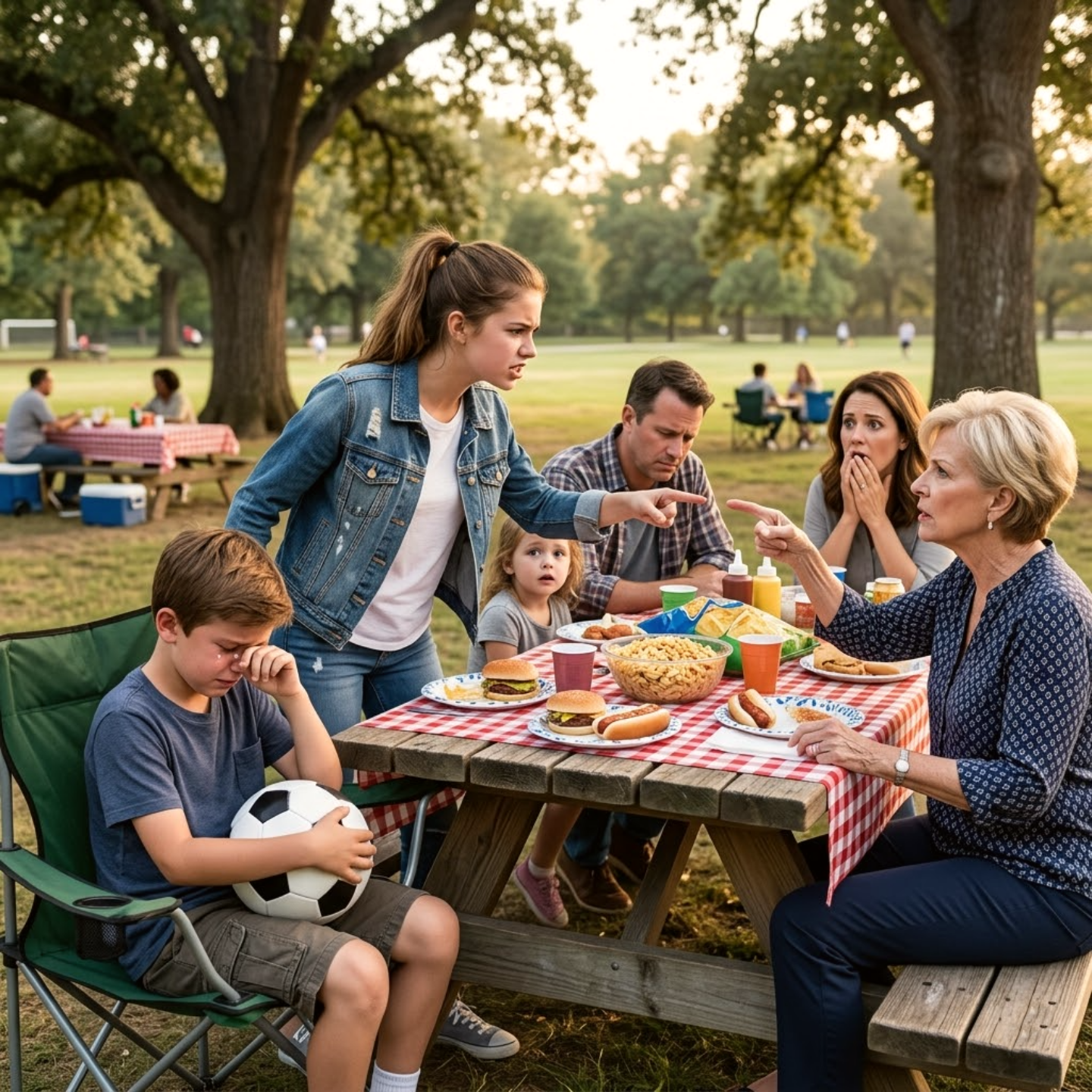
My mother stood a few feet away, rigid with outrage, as if the true offense of the afternoon was not what she had said to a little boy but the fact that it had finally cost her something. She had built her whole adult life on a quiet assumption: that other people would absorb the consequences of her moods. Watching us leave without asking permission, without apologizing, without performing regret for her discomfort, seemed to confuse her more deeply than if we had yelled. She knew how to answer anger. She had no real language for limits.
My father followed me toward the car. Gravel crunched under his sandals. The July heat, which had felt so manageable an hour earlier, pressed down now like an extra hand at the back of my neck. The parking lot shimmered in the sun. Minivans and SUVs sat baking in their spaces with windshield reflectors flashing silver. Noah got into the back seat without a word. Ella climbed in after him. I was halfway around the driver’s side when my father said my name in that hushed, pleading tone that had kept our family broken and intact for as long as I could remember.
“Rachel.”
I turned.
“Don’t make this bigger than it already is,” he said quietly.
I spun back so fast he actually took a step away from me. For years my father’s gentleness had functioned like camouflage. It let him look kind even while he continually chose the path of least disruption, no matter who got cut by it. In that parking lot, with the smell of hot pavement and mustard lingering on my hands, I saw him more clearly than I ever had.
“Bigger?” I said. “She told me not to bring my son next time. To his face.”
He opened both hands in that helpless gesture of his, the gesture of a man who had spent decades confusing noninvolvement with neutrality and neutrality with virtue. “She didn’t mean ”
“Yes, she did,” I cut in. My own voice surprised me again. No tremor. No apology. No little cushion of maybe. “The problem is not that no one understands her. The problem is that everyone does, and you still expect me to swallow it.”
He had nothing for that. Nothing useful, anyway. His mouth shifted as if he might say something about family, or stress, or how your mother is just upset. But there are moments when all the old language finally sounds as weak as it is. I got into the car and shut the door before he could try again.
The interior was oven-hot. Noah had already clicked his seatbelt. Ella sat beside him with her body angled slightly toward his, one arm stretched across the middle seat like a barrier he had not asked for but clearly needed. I started the engine, rolled down the windows, and backed out of the space without looking again at the pavilion. My hands were steady on the wheel. Inside, I was anything but steady. Shame, rage, relief, grief, all of it moved through me so fast I could barely sort one from the next. There is a particular kind of exhaustion that arrives when you stop pretending an old injury is minor. It doesn’t feel dramatic. It feels like finally setting down something heavy you had forgotten you were carrying.
For the first few minutes, no one spoke. We passed the baseball diamond, the church group, the playground with its crooked line of strollers. We drove under a row of maples and out toward the road that led back to our neighborhood of split-level houses, mailbox posts, and overwatered front lawns. I kept glancing into the rearview mirror, trying to decide which job was mine first: apologize to my son, explain my family to him, or let silence breathe until he chose to fill it. I could feel the old instinct rising in me, the instinct to rescue everyone at once by finding just the right wording. Some mothers become experts at lunch-packing, stain-removing, schedule-coordinating. I had become an expert in emotional cleanup.
Noah made it easier for me.
After a few minutes he asked, very quietly, “Did Grandma really not want me there?”
No version of motherhood prepares you for a question like that. People talk all the time about the hard parts of parenting, but they usually mean sleep deprivation or school meetings or the cost of cleats in the middle of soccer season. They do not mean the moment your child asks whether someone who was supposed to love him found him fundamentally unwelcome. They do not mean the split second in which you have to tell the truth without handing him a wound that will live too long under his skin.
I tightened my hands around the steering wheel. “Grandma said something mean and wrong.”
He looked down at the ball in his lap. “Because I messed up?”
“No,” Ella said immediately, before I could speak. “Because she was mean. Those are different things.”
I could have cried from gratitude right there at the stoplight. Instead I swallowed hard and nodded, even though Noah was looking at the ball, not at me. “Your sister’s right. You made a mistake. That happens. You said sorry. What Grandma said after that was not okay.”
He was quiet for another block. Then he asked, “Did I ruin lunch?”
There are questions children ask that reveal exactly how much more they have understood than the adults wanted to believe. He was not asking about the tomato anymore. He was asking about the whole architecture of blame. About whether one small accident from him could, in fact, spoil a room. About whether adults would let him carry the weight of their own ugliness because he was small enough to be made responsible for it.
“No,” I said. “You didn’t ruin anything. The people who were unkind ruined it.”
Ella leaned her shoulder lightly against his. “Also the burgers were already bad.”
That made him smile, just barely, and I loved her with such force in that moment it almost hurt. Not because she had saved the day in some dramatic movie way, but because she understood what children need after humiliation: not a lecture, not a forced silver lining, just the steady reassertion of reality.
By the time we turned onto our street, some of the tightness had eased from the car. Noah pointed out a man walking a beagle in a red bandana. Ella complained that the air conditioner still smelled weird when it first came on. Life, stubborn and practical, was already trying to stitch itself back together. That is one of the things nobody tells you about hard family moments. They rarely end with one grand emotional climax. More often they dissolve into errands, laundry, sandwiches, tired children, and the strange tenderness of ordinary tasks continuing anyway.
When we got home, I made grilled cheese sandwiches none of us really wanted. Not because anybody was hungry for them, but because warm food gives a hard evening shape. It says the day may have gone wrong, but we are still doing the next kind thing. I buttered bread, turned the skillet too hot, lowered it again, sliced apples, put out pretzels. Noah drifted in and out of the kitchen, gradually returning to himself by way of small observations. He told me about a bug he had seen near the picnic tables, a beetle with a shiny green back that looked, according to him, “like a tiny alien football helmet.” Ella pretended to be annoyed by how many details he included. Then she asked enough follow-up questions to keep him talking.
The house settled around us in the familiar sounds of late afternoon. The washing machine thudded in the laundry room. An ice cream truck played its warped little song two streets over. The dog next door barked when the mailman passed. I moved through the kitchen putting plates into the dishwasher and thinking, with a growing sense of nausea, not only about what had happened but about all the earlier versions of it. The comments I had brushed off. The winces in Noah I had told myself were imagination. The tiny asymmetries in my mother’s affection. How often had she done it? How many times had my son noticed and concluded, reasonably, that it was about him?
That is the cruelty of family patterns once they become visible. They do not illuminate only the present. They backlight the past.
After dinner, Noah went upstairs and eventually, through the mercy of childhood, became fully absorbed in showing me the weird little trading card collection he had organized by “coolness” instead of by team. The categories made sense only to him, which meant they made emotional sense in the purest possible way. By bedtime his laugh had returned. Not fully. Not as easily. But enough to let me breathe. I sat on the edge of his bed while he talked about summer camp and whether all praying mantises were green and whether he could maybe start taking his soccer ball to the park more often because the field there was bigger than ours. He yawned mid-sentence, flopped sideways against the pillow, and was asleep before I had finished pulling the blanket to his shoulder.
I stood in his doorway longer than I needed to.
Then I found Ella in the kitchen.
She was sitting on the counter with one leg tucked under her, drinking water out of a mason jar because she said regular glasses “felt too dishwasher-commercial.” The overhead light threw a warm yellow circle over her hair, and for the first time all day she looked her age again. Not the person who had stood in a public park and said what no adult there would say, but a sixteen-year-old girl in oversized socks and a faded college hoodie, tired enough to finally let the adrenaline leave her body.
“You’re mad at me,” she said.
I looked up from the sink. “No.”
She hesitated, turning the jar slowly in her hands. “I was disrespectful.”
That word hung there between us, old and loaded, inherited from generations of adults who had used it whenever a younger person told the truth too directly. I dried my hands on a dish towel and leaned back against the counter opposite her.
“You were protective,” I said.
Her eyes softened, but she still looked unsure. “I just couldn’t sit there.”
“I know.”
The kitchen was quiet except for the hum of the refrigerator and the faint, regular clicking of the ceiling fan. Through the window above the sink, I could see our backyard silvered by the porch light, the swing set Noah was technically too old for but still used when he wanted to think. I stood there looking at my daughter and realizing how much she had seen without my permission. Children do not need official briefings to understand family tension. They absorb it the way curtains absorb smoke. They know who they need to watch, who gets allowed to go too far, who becomes dangerous only when no one else is willing to be inconvenient.
Then, because she deserved the truth more than comfort, I added, “The part that hurts is that I could. I’ve been sitting there my whole life.”
That made her cry first.
Not loudly. Not in the cinematic way movies love. Quietly, angrily, like she hated tears on principle and considered them a design flaw. She tipped her head down and covered her face with one hand. I crossed the kitchen and pulled her into a hug, and for one brief, painful minute she let herself be sixteen instead of the person who had been bravest at the table. She leaned into me hard enough that I could feel how much control had been holding her upright all afternoon.
“I’m sorry,” she mumbled against my shoulder.
“For what?”
“For making it worse.”
I pulled back enough to look at her. “You didn’t make it worse.”
Her mouth trembled in that furious way people’s mouths do when they are fighting tears and dignity at the same time. “I made it impossible to ignore.”
I almost laughed, not because it was funny, but because it was so exact. “Yes,” I said softly. “You did.”
That was the gift, though I did not have language for it yet. She had made it impossible to ignore. And once a thing becomes impossible to ignore, you are no longer trapped in confusion. You are trapped in choice. Confusion had protected me for years. Choice was much scarier. But it was also cleaner.
The calls started the next morning.
Melissa called first, which did not surprise me. My sister liked to arrive in the aftermath looking like a mediator even when what she really wanted was the old emotional furniture put back where it had been. She began with a sigh that suggested she had been burdened by other people’s bad behavior since dawn.
“Mom is deeply hurt,” she said.
I stood at the kitchen counter in my pajamas, coffee turning lukewarm beside me, Noah upstairs looking for a missing shin guard and Ella still asleep. Outside, a lawn mower had started somewhere down the block. Ordinary suburban morning sounds, insultingly intact.
“I’m sure she is,” I said.
Melissa paused, as if I had skipped a required line in the script. “Rachel, things got out of hand.”
“No,” I said. “They got said.”
She exhaled hard through her nose. “You know what I mean.”
I did know what she meant. She meant that truth had become audible in a family that preferred injury to remain atmospheric. She meant that public consequences had followed a public cruelty, which was the one thing our family system was designed to prevent. Melissa and I were different in almost every way, but we had learned the same training: let Mom have the last word and maybe the room will stay useable. The trouble was that one sibling can spend so long adapting that she mistakes adaptation for balance.
“Did you call to ask how Noah is?” I asked.
Silence.
Then: “That’s not fair.”
I let that sit. Fairness is often what people invoke when they are asked a direct question they don’t like. It sounds principled and costs almost nothing. When Melissa finally spoke again, her voice had shifted into the coaxing tone people use with the family member they believe is hardest to manage only because she has started refusing old arrangements.
“Mom didn’t say it the way it came out.”
“She said exactly what came out.”
“She was frustrated.”
“He’s eight.”
A longer silence, this time irritated. Then the familiar pivot. “So what now? You’re just not going to talk to her over one bad moment?”
The phrase landed with a thud in my chest. One bad moment. That was how family history gets laundered. One bad moment here, one misunderstanding there, one awkward holiday, one joke taken wrong, one overreaction, one thing said in stress. Enough isolated “ones” and you can bury an entire pattern under the convenience of singular nouns.
“It wasn’t one bad moment,” I said. “It was one clear moment. There’s a difference.”
Melissa said something about everyone saying things they regret, something about how Mom’s generation was just more blunt, something about children these days being too sensitive. I let her spend herself. The older I got, the more I noticed how much of family conversation is just people exhausting themselves trying not to name the actual thing. Finally I told her I wasn’t discussing it further. She ended the call sounding offended, which I had expected. People who benefit from your flexibility often experience your limits as aggression.
My father called an hour later.
“Maybe we could all have dinner,” he said after barely two minutes of small talk. “Reset.”
That word. Reset. As if family pain were a router you could unplug and plug back in. As if what had happened were a temporary technical issue and not the clearest expression yet of a longstanding truth. I pictured him sitting at the kitchen table in the house where I grew up, turning his wedding ring around his finger the way he did whenever he was uncomfortable. He would have that weary look, the look of a man who considers himself the only adult in a room full of emotions, never mind that most of those emotions exist because he spent years refusing to confront the person who generated them.
“No,” I said.
He sounded genuinely surprised. “Rachel ”
“No dinner. No reset.”
“Your mother is upset.”
“My son is hurt.”
He went quiet. Then, gently, because that was his method, he tried to slide around the center again. “You know how she is.”
I was standing by the sink again, staring out at the little maple tree in our front yard. Noah’s bike lay tipped on its side near the garage. When I was a girl, that sentence had excused entire seasons of my mother’s behavior. You know how she is. It had been offered as wisdom, as realism, as something close to compassion. But over time I came to hear what it really was: a warning to lower your expectations of decency so someone else never had to raise theirs.
“Yes,” I said. “I do know how she is. That’s the problem.”
He tried another route. “She didn’t grow up with… all this language. Boundaries. Triggers. That kind of thing.”
I almost smiled at the absurdity of it. My mother did not need therapeutic vocabulary to understand that publicly humiliating a child was cruel. She needed only the most ordinary forms of empathy, and she had bypassed them willingly. People do this all the time with older relatives. They act as if meanness becomes culturally authentic if the person saying it remembers rotary phones.
“She doesn’t need new language,” I said. “She needs basic accountability.”
When he realized I was not going to move, his voice took on that injured patience he wore whenever he wanted me to feel unreasonable for refusing something he himself would never refuse. “I just hate seeing the family like this.”
There it was. Not I hate what happened to Noah. Not I hate that Linda said something cruel. I hate seeing the family like this. As if visible fracture were worse than the pressure that caused it. As if the crack was the tragedy, not the blow.
“Then you should have said something yesterday,” I told him, and hung up before he could offer another version of sorrow that did not cost him action.
My mother left a voicemail around noon.
I listened to it standing in the laundry room while towels tumbled in the dryer and the machine beeped because I had overloaded it again. Her voice was controlled, polished, every syllable arranged to sound dignified. If you did not know her well, you might have mistaken it for grace.
“Rachel,” she said, “I’m sorry for how the conversation was received. Things got emotional, and I think Ella’s outburst changed the tone of the day in a way that was unfortunate. I hope, when everyone has calmed down, we can speak like adults.”
I played it twice just to make sure there was no hidden sentence buried inside it. There wasn’t. No apology to Noah. No acknowledgment of what she had said. No regret except for being interpreted. The whole message was a master class in one of my mother’s favorite tricks: saying sorry in a way that kept the injury entirely located in other people’s reactions. She was not apologizing for the wound. She was apologizing that the wound had become inconvenient to her.
That message told me everything I needed to know.
So I called her back once.
She answered on the second ring as if she had been waiting with the phone in her hand. “Rachel.”
“There will be no visits,” I said, “no dinners, and no access to my children until you apologize to Noah directly and mean it.”
The inhale she made was sharp enough to hear. “I beg your pardon?”
“You heard me.”
“This is absurd.”
“No,” I said. “What was absurd was telling an eight-year-old not to come next time because he brushed your plate.”
“He was out of control all day.”
“He was a child at a picnic.”
“You always do this,” she said, her voice tightening. “You turn one small criticism into a moral drama.”
There it was again, the minimizing, the resizing of events once they no longer served her. I leaned against the washing machine and closed my eyes. It would have been easy, suddenly, to be pulled back into the old current, the one where I argued details while she controlled the frame. But part of boundary-setting, I was beginning to understand, is refusing to submit to someone else’s dishonest scale.
“This isn’t a debate,” I said. “It’s a condition.”
“You cannot keep my grandchildren from me.”
“I can keep my children away from people who are cruel to them.”
“He needs discipline, Rachel.”
“He needs adults who don’t single him out.”
“That girl spoke to me like I was trash.”
“That girl defended her brother when the adults at the table failed him.”
My mother made a sound between a laugh and a gasp, the sound of a woman who could survive being wrong but not being disobeyed. “I will not be extorted into some performance apology.”
“Then you’ve made your choice.”
I ended the call before she could reshape the conversation into something about my tone, my parenting, my ingratitude, my overreaction, my past, her sacrifices, or any of the other rooms she knew how to lead people into once the room of accountability became uncomfortable.
Afterward I stood there in the laundry room with the phone in my hand and my heart beating hard enough to make my fingertips buzz. I wish I could say I felt triumphant. I didn’t. I felt shaky, sad, and unexpectedly hollow, like I had finally yanked a splinter free and discovered the wound beneath it was larger than the splinter had ever been. That is another thing no one says enough about boundaries. They are not only empowering. Sometimes they are grief in a practical outfit.
Weeks passed.
Then more.
My father tried twice more, each attempt dressed differently but carrying the same request beneath it. Once he asked whether Noah would like the model train set Grandpa had found at an estate sale, as though gifts could bypass the moral conditions adults disliked. Another time he texted that your mother has been under a lot of stress lately, which I suppose was meant to sound explanatory. Melissa called once to say Mom was “still very upset” and to ask whether I really wanted to “do this long-term.” I remember standing in the grocery store near the cereal aisle while she said it, comparing generic oat squares and realizing with a kind of private astonishment that I did, in fact, want to do this long-term if “this” meant not delivering my children back into a room where contempt was normalized.
My mother did not apologize. Not really. She remained furious, which was her preferred substitute for remorse. Anger let her preserve the fiction that she was the offended party. Anger meant she never had to wonder what kind of grandmother looks at a small boy who has said sorry and chooses power over kindness anyway. I think, in her own mind, she considered herself punished enough simply by being challenged. Some people are like that. They experience accountability as abuse because they have mistaken exemption for love.
But something in my house had changed for the better.
Not overnight. Healing rarely arrives in dramatic cinematic sweeps. It tends to show up in small domestic evidence. Noah laughed more freely. He stopped scanning rooms quite so quickly when we visited other relatives. He no longer asked, before family events, whether Grandma would be there. He started inviting friends over more often and seemed less watchful in the presence of adults. It took me time to realize what I was seeing. A child who no longer expected the room to turn on him at any minute.
Ella changed too, though in subtler ways. Before that picnic she had developed a habit of entering family spaces like a security system already online. Her eyes would move first. Her shoulders would set. She would stay near Noah without seeming to. Afterward, that vigilance eased. Not entirely, because children who have had to become protectors do not lay the role down in one afternoon. But enough. Enough that I saw her sit through dinner one night with her legs actually stretched out instead of tucked and ready. Enough that she once let Noah annoy her for a full fifteen minutes before stepping in to manage him, which sounds small until you understand that overfunctioning children often mistake constant monitoring for love.
As for me, I felt different in ways I did not immediately know how to describe. Lighter, yes, but not in the cheerful self-help sense. More like my body had finally stopped bracing for a blow it had been trained to expect in every room my mother entered. I had not realized how much of my adult life had been built around anticipating her reactions, pre-editing my choices, managing introductions, monitoring conversations, guiding my children around the soft spots in her temperament as if cruelty were a piece of furniture we simply all agreed not to trip over.