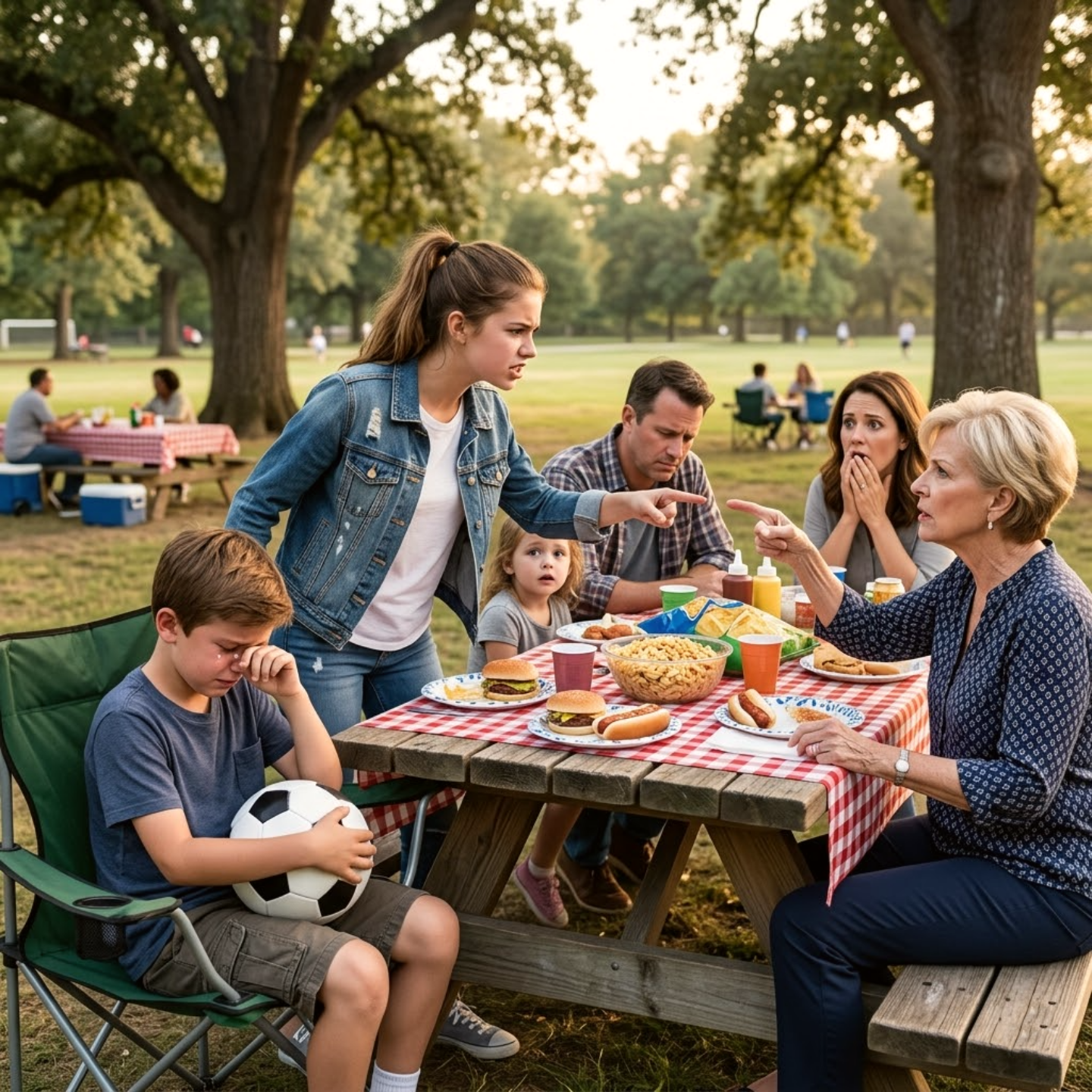
The picnic was supposed to be simple, the kind of plain American family Saturday that looks harmless from a distance. Folding chairs sank unevenly into the grass, grocery-store pasta salad sweated in clear plastic bowls, paper plates bent under hot hamburgers, and a red-striped cooler sat beside the pavilion like it had been invited to every family gathering since the late nineties. The county park was busy in that familiar, noisy way suburban parks always are once the weather turns warm enough for everyone to pretend they like each other outdoors. Somewhere beyond the trees, a Little League game was going on, and every few minutes a burst of cheering floated over from the baseball diamond. A church group had taken over the far picnic tables, a toddler was crying near the swing set, and the air smelled like charcoal smoke, sunscreen, cut grass, and sliced onions warming too long in the sun.
My mother, Linda Foster, had insisted on organizing the whole thing “for everyone,” which in her language usually meant for herself, with the rest of us expected to perform gratitude on cue. She had chosen the park, assigned what everyone was bringing, reminded us all twice what time to arrive, and texted that morning to say she hoped no one would “make it chaotic.” That was her favorite word when she meant children, feelings, or anything she could not control. Even when I was little, she had a way of making hospitality feel like an audition. You were welcome, technically, but only if you arrived in the right mood and took up the right amount of space.
I almost didn’t go. I stood in the kitchen that morning with my car keys in one hand and Noah’s missing sneaker in the other, and for a full minute I considered texting some excuse about a stomach bug or a migraine or one of the thousand small adult lies people tell to avoid the truth. The truth was that my mother exhausted me before I even saw her. The truth was that family gatherings had become less like reunions and more like silent negotiations, everybody adjusting themselves around Linda’s weather system and pretending not to notice when the temperature dropped. But my oldest daughter, Ella, wanted to see her cousins, and my son Noah had been excited all week in the wholehearted way only children can be excited. He had packed his soccer ball himself, tucked a juice box into the side pocket of his little backpack, and asked me twice whether Grandma would have chips.
Noah was eight then, all knees and elbows and bright energy. He lived as if the world had not yet explained its conditions to him. He laughed too loudly, moved too quickly, asked too many questions, and loved with a kind of unguarded enthusiasm that made some adults smile and others flinch. He could spend ten minutes describing the exact route of a beetle across a sidewalk and expect you to care because, to him, caring was the normal response to being alive together. He still believed he was welcome in every room he entered. He still believed affection, once named, remained dependable. Looking back now, that may be the part that hurt me most. Not only what my mother said that day, but the innocence it landed on.
Ella was sixteen, and if Noah entered the world with both arms open, Ella entered it as if she had already learned she might need to block a doorway with her body. She was not cold, though people sometimes mistook her reserve for that. She was observant. She watched first, measured the room, noticed who interrupted whom, who got laughed at and who got protected. She had my father’s stillness and none of his habit of surrendering it. By sixteen she already understood dynamics most adults spend a lifetime refusing to name. She loved her brother with the sort of fierce, practical devotion that rarely announces itself. She would roll her eyes when he talked too much, steal fries off his plate, tell him when he was being annoying, then stand between him and any real unkindness without hesitation, as if the role had been assigned to her years before she knew she could decline it.
Greg was already at the grill when we arrived, in cargo shorts and a baseball cap from a roofing company he had worked for ten years ago and no longer worked for now. Greg manned a grill the same way some men drive oversized pickup trucks: with a confidence completely unsupported by evidence. He poked at half-cooked burgers, forgot which ones were turkey, then insisted everyone stop “hovering” whenever Melissa corrected him. Melissa, my younger sister, had brought her usual blend of irritation and store-bought desserts. She could find something wrong with anything and often did with the efficiency of a person who believed commentary counted as contribution. Her son Mason climbed onto the cooler within ten minutes of arriving and nearly tipped the whole thing over. My mother laughed and called him “spirited,” like he was the lovable rogue in an old sitcom instead of a sugar-drunk nine-year-old standing on a container full of melting ice and Diet Coke.
My father was there too, of course. Frank Foster, polite as wallpaper, dressed in khaki shorts and the same calm, apologetic expression he wore to funerals, graduations, and arguments he intended to survive by not joining. He had spent decades in the posture of a man always trying to keep the peace, which sounded noble when strangers described it and looked much uglier once you realized peace, in our family, usually meant allowing my mother to say whatever she wanted while everyone else quietly paid for it. He was good with napkins, folding tables, and weather updates. He was less good with loyalty when loyalty required conflict.
At first everything felt normal enough, which for our family meant mildly strained, noisy around the edges, and punctuated by small moments of false cheer. The younger kids tore through the grass near the pavilion while the adults pretended not to notice how much tension everyone carried in their shoulders. Someone turned on a country playlist from a Bluetooth speaker, too low to enjoy and too audible to ignore. A pickup truck rattled past on the park road. Greg dropped a spatula. Melissa complained that the lemonade was too sweet. My mother complained that someone had bought the wrong potato buns. The sky was a clear Midwestern blue, the kind that makes every family dysfunction look almost wholesome under enough sunlight.
Noah spilled chips once while trying to sit and talk at the same time. He laughed at a joke nobody else had really heard, then laughed harder because he had to explain it. He bumped the edge of the card table while chasing Mason around it and sent three napkins fluttering into the grass. Nothing dramatic. Nothing malicious. Just ordinary little-boy behavior on a summer afternoon. The kind of thing families either absorb without comment or tease about gently and move on from.
But with my mother, “ordinary” had always depended on who was doing it.
When Melissa’s son climbed onto the cooler, Linda laughed and said boys would be boys. When Noah knocked over a plastic cup near the condiment tray, she clicked her tongue and muttered, “Of course.” Not loudly. Not enough to invite confrontation from anyone who wanted an excuse to miss it. Just enough for the words to land where she intended them to land. My mother had always preferred cruelty that could be denied afterward. She liked insults that arrived wearing respectable clothes.
I heard it. So did Ella. I could tell by the way her head turned, slow and slight, like a person hearing a smoke alarm in another room. But I told myself not to make anything out of it. I wiped up the spill, redirected Noah toward the open field, and gave him the gentle kind of correction mothers become fluent in.
“Watch your feet, buddy. Take the ball out there if you’re going to run.”
He nodded and bounced off, sunshine already reclaiming him. I told myself I had imagined the edge in my mother’s voice. I told myself I was tired. I told myself, as I had told myself for half my life, that it was easier not to translate her worst meanings too literally. Children of difficult parents get very skilled at this. We become subtitlers for the unbearable. We turn sharpness into “stress,” contempt into “her way,” public humiliation into “that’s just how she is.” We call survival maturity and mistake silence for wisdom because it is less frightening than admitting what has been happening in front of us all along.
By the time lunch started, the air had shifted in the way family air sometimes shifts before anyone names it. Nothing obvious, nothing anyone could point to in a sentence that would satisfy a neutral witness, but enough for the room inside your body to tighten. People moved around each other more carefully. My mother’s voice became brighter in a way that meant she was enjoying herself less. Ella stayed close enough to Noah to see him, not close enough to make it obvious. I had been around Linda Foster long enough to recognize the warning signs. She liked gatherings until she remembered they were not fully hers to control. Then she would look for a place to put her irritation. She was especially fond of doing it when she had an audience and could count on everyone’s old habits to protect her.
We were halfway through hamburgers and cold salad when it happened.
Noah had taken exactly three bites before remembering he was still a child in a park. He pushed his chair back and asked me if he could go play ball again after he finished. While he was standing there, restless and hopeful and trying to negotiate his freedom one foot already pointed toward the grass, he turned too quickly and brushed the edge of my mother’s plate. It was barely anything, just enough to make a slice of tomato slide off the bun and land in her lap with a soft red smack against her skirt.
Noah froze. The whole bright body of him stopped at once.
“Sorry, Grandma.”
The table went quiet in that sharp, embarrassed way families go quiet when everyone senses the moment before they allow a cruelty to happen. A breeze moved across the pavilion and lifted the corner of a paper napkin. Someone from the baseball field yelled, “Nice hit!” and the sound came to us strangely clear, like the world outside our table was still functioning according to reasonable rules.
My mother lifted the tomato with two fingers, dabbed at her skirt with a napkin, then looked directly at me and said, loud enough for everyone to hear, “Next time, don’t bring the kid.”
For a second I honestly thought I had misheard her. The sentence was so nakedly mean that my brain tried to protect me by offering alternatives. Maybe she had said something else. Maybe I had filled in the worst version because I was already tired of her. Maybe she meant it jokingly, though my mother had never once used humor to soften anything. But nobody laughed. Nobody smiled. Nobody said, “Linda.” Nobody even did that fake little half-chuckle families use when they are trying to sweep something under a rug before it has fully hit the floor.
No one said anything at all.
Not my father. Not Melissa. Not Greg. Not one adult at that table.
The first face I looked at was Noah’s. The confusion came before the hurt, and somehow that made it worse. If he had immediately burst into tears, maybe the moment would have been easier to answer. But instead he blinked, stood very still, and looked at me as if waiting for me to translate the world back into something that made sense. His mouth parted slightly. His shoulders pulled inward, just a fraction. He was still trying to decide whether he had misunderstood, whether maybe Grandma was talking about someone else, whether maybe there was a version of that sentence a child could hear and survive without changing shape inside.
I opened my mouth, but before I could say anything, I heard the scrape of metal chair legs dragging across packed dirt and grass.
Ella pushed her chair back and stood up.
She looked straight at my mother and said, in a voice so calm it chilled the whole table more effectively than yelling ever could, “Say that again.”
Nobody moved.
Even the kids in the yard seemed to dim around the edges of my awareness, as if the air at our table had changed in a way children could feel without understanding. Ella stayed standing with one hand resting flat on the back of her chair. Her face had gone still in that unnerving way truly angry people sometimes do when they have stepped beyond visible emotion into something cleaner. I had seen that expression on her only a handful of times before, usually when she thought someone smaller than her was being cornered and no adult in the room could be trusted to interrupt it in time.
My mother blinked, offended more than surprised.
“Excuse me?” she said.
Ella did not sit. “You heard me. Say it again. Say that my brother doesn’t belong here.”
“Ella,” I said automatically, because every child in my family had learned early that challenging an elder was treated as a greater offense than whatever had made the challenge necessary.
She did not even turn toward me. “No, Mom. Not this time.”
That was the exact moment the afternoon became irreversible.
It happened not because my daughter had raised her voice, not because my mother had been caught, not even because Noah had been hurt. It happened because Ella refused the role all the rest of us had been rehearsing for years. She would not rush in to smooth, dilute, reinterpret, or protect the adult who had chosen cruelty. She stepped out of the choreography. Once one person does that in a family, everyone feels the floor move.
My father shifted in his folding chair and stared at the table. Melissa suddenly found something urgent to do with a napkin that needed folding, refolding, and smoothing. Greg looked at the grill as if a row of burgers might save him from witnessing human speech. No one rushed to calm my mother because no one could pretend they had not heard her. The lie available to them now was smaller and meaner: not that it hadn’t happened, but that it was somehow still acceptable.
My mother set the ruined tomato onto the edge of her plate and lifted her chin. “I didn’t say he didn’t belong here. I said next time maybe you should leave him home if he can’t behave.”
Noah was standing beside me so still he looked held in place by shame. His shoulders seemed to have shrunk. His face was red in the way children’s faces go red when they are fighting not to cry in front of adults. That alone should have been enough to stop any grandmother worth the name.
Ella pointed at him. “He’s eight.”
My mother gave one of her thin little smiles, the ones that never reached her eyes and always reminded me of a knife laid neatly beside a dinner plate. “And that excuses everything?”
“No,” Ella said. “It means you don’t talk about him like he’s some stray thing Mom dragged in.”
That hit the table harder than my mother’s sentence had, maybe because it stripped away all the nice family wording and left only the shape of what had happened. My sister finally tried to intervene, but not in the direction that mattered.
“Ella, your grandmother didn’t mean it like ”
“She did,” Ella snapped, turning on Melissa with a sharpness that made even Greg look up. “She always does.”
The force of that word, always, rippled through me. Kids see patterns long before adults are willing to name them. They do not have our investment in denial. They are not yet attached to the family fiction that meanness becomes complicated if enough birthdays and casserole dishes surround it. Hearing Ella say it out loud, hearing my own daughter state with perfect certainty what I had spent years softening, made something inside me both ache and clear.
My mother set down her fork with careful control. “I will not be spoken to this way by a child.”
Ella took one step closer to the table. Her voice stayed level. “Then stop giving us reasons.”
I should have stopped it then, at least according to the old script. That is what the earlier version of me would have done. I would have told Ella to sit down. I would have said enough, we’re not doing this here. I would have apologized to my mother for the tone, then later apologized to Noah for the wound, as if fairness required symmetry. I would have translated the adult’s cruelty into something survivable and the child’s defense into something regrettable. I would have made sure the oldest, loudest person at the table kept her dignity at the expense of the smallest one there. That was the family trade. Protect authority, invoice the children.
But I looked at my son.
He was staring at the ground now, one hand clutching the soccer ball against his stomach like a shield. He was not crying yet, which told me how hard he was trying. The sight of that small, determined restraint went through me like a blade. Children who learn to make themselves smaller in front of adults do not usually learn it in one afternoon. They learn it moment by moment, gathering evidence. They learn it from who gets corrected, who gets defended, who gets called difficult for behaving like a person with needs. They learn it from which adults speak up and which adults lower their eyes and let the insult become part of the furniture.
My mother turned to me with open disbelief. “Rachel, are you going to let her speak to me like this?”
I looked back at her and said the words I should have said years earlier.
“Yes.”
The shock on her face was almost immediate, as if the first betrayal of the day, in her mind, was not what she had said to my child but the fact that I had failed to side with her once she was challenged. Her mouth parted. Melissa went still. Greg actually stopped moving long enough for the burger on the grill to blacken another shade. My father looked up then, really looked up, and I watched the recognition land that this was no longer one of those unpleasant moments that could be blurred by time if everyone just stayed seated long enough.
Because she’s right.
The words came next, and once they started I could feel that old, exhausted pressure inside me break the way summer storms break after a day of unbearable heat. “You have done this to him all day,” I said. “Not just today. Not just over a tomato. All day. And not only today, if we’re being honest.”
My voice did not shake. That surprised me. I had imagined this kind of confrontation before, usually late at night while replaying old family scenes in the dark, and in every version I was furious or tearful or both. But what came out of me at that picnic was something steadier and, I think, more frightening to her. It was clarity. Not the kind sharpened by performance, but the kind built by years of swallowing things until your body no longer cooperates with denial.
“You excuse every other child,” I said, and I knew I was no longer speaking only to my mother. “When Mason climbs on the cooler, he’s spirited. When Noah spills a cup, it’s ‘of course.’ When someone else is loud, it’s funny. When he’s loud, it’s a problem. You call it honesty, but it’s cruelty with better posture.”
My mother gave one hard, brittle laugh. “Oh, please. He’s too wild, and everyone sees it.”
“No,” I said. “Everyone sees that you dislike him, and no one says anything because they’re used to protecting your comfort.”
That last sentence was for the whole table. I wanted it to be. And it landed exactly where it should.
Melissa looked down. Greg stared at the burgers as if he could somehow overcook his way out of responsibility. My father’s face altered by a fraction, just enough to show shame, though not enough to redeem anything. There is a particular expression people wear when a truth enters the room they have spent years funding with silence. They do not look wounded, exactly. They look exposed.
My mother was losing the polished control she valued most. I could see it in the tightness around her mouth, the way she squared her shoulders, the way her eyes kept flicking around the table for backup that was not arriving. “So now I’m the villain because I expect basic manners?” she said.
Ella answered before I could. “No. You’re the villain because you wait until Mom’s son makes a normal kid mistake and then act like he ruins everything.”
Noah finally looked up at that.
Not at my mother.
At Ella.