My father started crying for real then.
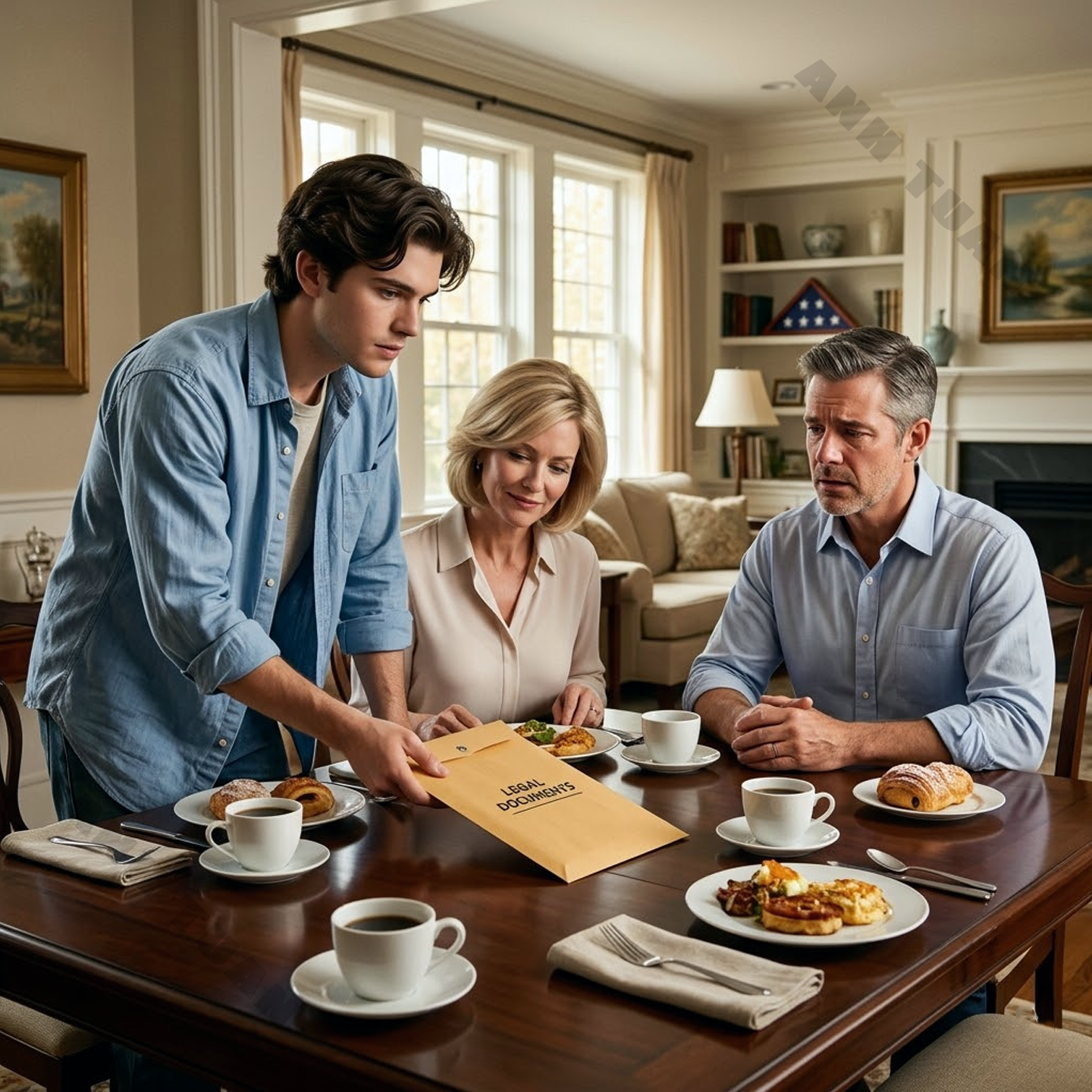
Not loudly. Not theatrically. Not with the broad, self-exonerating grief of a man eager to turn his pain into the main event. Just silent tears dropping onto the pages my mother had left behind, while the woman he had chosen stood beside him looking furious, cornered, and suddenly very alone. The sound he made was barely more than breath catching in his throat.
I stood there and realized my mother had not just left me money.
She had left me an exit.
I walked out five minutes later.
Not in triumph. Not even in relief, exactly. What I felt was stranger than both. It was the heavy, delayed shock of finally seeing something clearly that I had spent years trying not to name. There are truths in a family that everyone feels long before anyone says them. They move under the floorboards. They sit at dinner tables. They press against conversations from underneath. You learn to step around them, to call them personality, stress, timing, generational habits, anything but what they are. My mother had not merely distrusted Melissa. She had understood my father better than I ever had the courage to.
He was not evil.
That would have been simpler.
He was weak in the precise places where weakness becomes dangerous: around vanity, around guilt, around the need to be admired by the person nearest to him. He could watch a line being crossed and call it compromise. He could hear something unforgivable and rename it stress. He could fail you while convincing himself he was preserving harmony. There is a special kind of wreckage made by people who never think of themselves as villains because they never do the worst thing in one dramatic motion. They do it in installments. By hesitating. By allowing. By choosing ease over loyalty so often that eventually betrayal becomes a routine dressed up as diplomacy.
That kind of man breaks a family just as thoroughly as a cruel one.
I drove straight to the Hudson River, parked near a public overlook in Tarrytown, and sat in the car for almost an hour without turning the engine off. It was one of those clear autumn mornings when the river looks metallic and the far shoreline seems close enough to touch. Joggers moved along the path with headphones in. A woman in a puffer vest threw bread to gulls and got scolded by an older man walking a beagle. Ordinary life went on in its usual, indifferent way while my own felt newly split into before and after.
My mother used to bring me there when I was a kid, especially on weekdays in the summer when my father was at work and she wanted to invent a small adventure out of nothing. We would get bagels in town, sit on a bench facing the water, and make up stories about the people getting off the Metro-North across the way. She had a gift for that turning observation into intimacy, detail into understanding. She never rushed me through feeling something. She also never let me confuse feeling something with surrendering judgment. “You can love people clearly,” she once told me after I came home from college furious about something my father had said and immediately guilty for being furious. “In fact, that’s the only useful way to love them.”
I think about that sentence now more than I ever did when she was alive.
By noon Melissa had called twice. I let both ring out. The first voicemail was furious.
“Nathan, this is outrageous. You blindsided us with some cruel, distorted fantasy your mother cooked up when she was bitter and sick. Call me back immediately so we can discuss this like adults.”
The second voicemail, left less than an hour later, was so sugary it would have been funny if I had not been so tired.
“Hi, sweetheart. I think emotions are really high right now, and maybe we all need to sit down and find a fair solution. No one wants conflict. We’re family, and family works things out.”
That told me everything.
In one breath I was an ungrateful child poisoned by my mother’s bitterness. In the next, I was a reasonable adult invited to repair what they had broken. That is the thing manipulative people rarely understand: the speed with which they change masks is often more revealing than the masks themselves.
I blocked her after the second voicemail.
My father did not call until evening.
The light in my apartment had gone amber and thin by then, catching in the steam over a bowl of soup I was not really eating. When his name lit up on my screen, I considered letting it ring. Instead I answered and listened to the silence on the other end for a second before he spoke.
“Nathan.”
His voice sounded hollow. Scraped raw.
“I’d like to talk,” he said. “Without Melissa present.”
I leaned back in my chair and stared at the darkening window over the sink.
“Why?”
“Because I need to explain.”
That word almost made me laugh. Explain. As if coercion becomes noble when spoken softly over coffee. As if betrayal counts less because it arrives dressed as a conversation.
I set the spoon down.
“I don’t need an explanation,” I said. “I have one. Mom wrote it before you ever opened your mouth.”
He exhaled shakily, and for a moment I thought he might hang up. Instead I heard him swallow and continue.
“I never planned to force you,” he said. “I was going to ask. That’s all.”
I looked around my apartment then the chipped mug on the counter, the laundry basket by the bedroom door, the framed photograph of my mother on the bookshelf. Asking. The coward’s preferred synonym when he wants credit for not becoming more monstrous than he had time to be.
“You did ask,” I said. “And now you know the answer.”
He started crying again.
This time I believed the tears.
But my mother had been right: I believed the pattern more.
Over the next week, the whole polished structure of my father and Melissa’s life began to come apart the way elaborate things often do not with one loud collapse, but with a series of humiliating little failures that reveal how unstable everything already was. Once it became clear that my inheritance was untouchable, something in their marriage shifted almost immediately. Melissa had always loved my father best when he functioned as a reliable extension of her preferences: a wallet with a posture, a man who could still pass for successful if you kept him in good jackets and soft lighting. The moment the money disappeared from the future she had imagined for herself, so did a certain strain of softness she had spent years performing.
I did not see it firsthand at first. I heard about it from other people, which in some families is the same thing.
My cousin Sophie called me on Wednesday. Sophie was the daughter of my mother’s younger sister, lived in Larchmont with her wife and two boys, and had inherited every useful trait my side of the family valued good humor, sharp instincts, and the inability to pretend not to notice what everyone else was busy pretending not to notice. She worked as a middle school counselor and carried herself like someone who had spent years listening through noise until she found the actual injury underneath.
“I’m going to ask this once,” she said after hello. “Are you okay?”
“Yes,” I said, which was not entirely true and not entirely false.
“Good. Because apparently your father’s house sounds like a regional theater production of Who’s Afraid of Virginia Woolf.”
That startled a laugh out of me.
“Sophie.”
“I’m serious. Melissa apparently told Aunt Janine that Evelyn is ‘controlling the family from beyond the grave,’ which is such a specific complaint that I think we all need to admire it artistically before rejecting it morally.”
I rubbed a hand over my face and sat down on the edge of the bed.
“How does Aunt Janine know?”
“Because Melissa called her trying to recruit sympathy and instead accidentally found a woman who remembers every unpleasant thing she has ever said since 2019.” Sophie paused. “Nate, how bad was it?”
I told her enough. Not everything. Not Gavin’s warning about formal proceedings or private records. Not my mother’s exact words, because they still felt too alive in me to be repeated casually. But enough.
Sophie listened without interrupting.
When I finished, she was quiet for a moment, then said, “Your mom knew exactly who she was dealing with.”
“She did.”
“Did you know?”
The question sat heavier than I expected.
“I knew pieces,” I said. “I think I spent a long time refusing to put them together.”
“That’s how it works with parents,” Sophie said. “Especially the disappointing ones. You don’t get them all at once. You get them in doses until one day the pattern is louder than your hope.”
Sophie had always spoken like that plain enough to trust, sharp enough to keep. We talked for another half hour, mostly about practical things. Did I need anything from her? Had I told Gavin about the voicemails? Was my apartment secure? Did I want her husband, Daniel, to look over my lease just to be safe? She asked these questions the way my mother would have asked them, with concern translated immediately into logistics.
After I hung up, I stood in the shower longer than necessary and let the water go cold around me.
Grief changes shape after a death. In the beginning it is all impact hospital corridors, casseroles, paperwork, people speaking too gently. Later it becomes weather. It settles into your thinking, your habits, your choices. There are days it is only a faint pressure in the air. Then someone says one sentence at brunch and grief hardens again into something with edges. Not because the person you lost has become less gone, but because the world has just produced fresh evidence of why they mattered so much while they were here.
My mother had never loved drama. She loved accuracy. That was one of the things people often mistook for severity when they first met her. She was warm, but she was not sloppy with words or judgment. She did not call a selfish act complicated just because the person committing it had a difficult childhood or an expensive haircut. She did not believe in excusing patterns because someone could produce a tender moment on command. She had a dry laugh, a gorgeous singing voice she used only when she was alone in the kitchen, and a way of looking at people that made evasion feel childish.
When I was twelve, my father forgot to come to a school concert I had practiced for all winter. He had promised. He knew the date. My mother sat in the auditorium afterward helping me fold my black concert shirt into the little plastic garment bag from Target while parents all around us took pictures with flowers and balloons.
“He got busy,” I said, because that was what I had already learned to say.
My mother zipped the garment bag, handed it to me, and said quietly, “Maybe he did. But the truth is not damaged by being named correctly.”
At the time I thought she meant I should admit I was hurt.
What she meant, I understand now, was larger than that. She meant that softness without clarity eventually turns into permission.
I saw my father everywhere that week in little flashes that had nothing to do with him. In the architecture of old disappointments. In memories that had once seemed too ordinary to matter. The time he promised to help me move into my first college apartment, then canceled because Melissa had found last-minute tickets to a charity event in Manhattan that “would be good for networking.” The Christmas he spent half of dinner texting because Melissa was angry with him about a bracelet she wanted and did not receive. The years after my mother’s diagnosis when he became, not absent exactly, but strangely airless around her illness impatient with discomfort, eager for normalcy, drawn to whatever room in the house required the least from him emotionally.
The affair, if that is what it even was at first, began while my mother was still sick. No one ever said so directly while she was alive, but the timing eventually became obvious in the way ugly things do when enough little details begin to align. Melissa entered our lives first as a “friend from a fundraising committee,” then as someone who happened to call too often, then as a source of practical help my father seemed grateful for in ways that made my mother go very still around the mouth. My mother never turned the house into a courtroom. She never accused him in front of me. But she observed. She filed things away. She noticed who got more protective of their phone when a spouse became weaker. She noticed who came home energized from errands that should have been ordinary.
After my mother died, my father moved with embarrassing speed. Not instantly he was too invested in his own image to be that reckless but fast enough that anyone with a conscience would have felt the shame of it. Melissa was “official” within months. They married before the second anniversary of my mother’s death. The ceremony was small, tasteful, and in my opinion unforgivable. Melissa wore ivory, not white, as if the distinction made anything cleaner. My father called me beforehand and said he hoped I could support his happiness. I told him happiness was not the word I would have chosen. He said I was being unfair.
People like my father always think fairness is the problem when they are finally being seen without flattering angles.
By Friday, more information had begun to surface about their finances, not because either of them admitted anything voluntarily, but because financial distress leaves fingerprints all over social life when people have spent years building a public identity around seeming untouchable. The country club membership they flaunted at every opportunity was three months behind. A refinance application on the house had failed. Two vendor invoices from Melissa’s design business were already in collections. There was a home equity line involved somewhere. The black SUV carried a payment so absurd it would have felt satirical if it were not so perfectly aligned with Melissa’s instincts. I heard from a family friend that my father had quietly asked whether anyone knew a good tax attorney. I heard from Sophie that Melissa was blaming him openly now, saying he had “let Evelyn weaponize the estate.”
Imagine being jealous of a dead woman’s foresight.
Through all of it, my father kept trying to contact me. Never aggressively. Never in a way that would have allowed me the clean comfort of anger. That was not his style. He left voicemails that sounded like exhausted weather reports.
“Nathan, I know I don’t deserve much from you right now, but I’m asking for ten minutes.”
“I’ve been reading her letter every night.”
“I should have spoken differently. I should have shut it down earlier.”
“I’m not asking about the money. I’m asking about us.”
That last one irritated me most.
Us. The all-purpose refuge of people who want the emotional benefits of relationship without wanting the burden of accounting for what they have done to it. There had been an us for years. It had simply required more from him than he was willing to give.
Still, I did not block him.
I think some part of me knew that if I did, the story would settle into something too easy. My father would become a chapter I had closed instead of a problem I had finally understood. I was not ready to decide whether that distinction mattered, but I knew it existed.
On the following Monday, Gavin called and asked if I would be willing to meet with him in person. His office was in White Plains, in a building of smoked glass and brown stone a few blocks from the courthouse. He occupied the sixth floor in a suite that smelled faintly of paper, coffee, and old leather. Gavin had represented my mother’s family for decades. He was in his sixties, trim, silver-haired, with the kind of voice that made people either tell the truth or avoid him completely. He was not warm in an obvious way, but my mother trusted him, which was enough.
When I arrived, he motioned me into his office and closed the door behind me.
“How are you sleeping?” he asked.
It was such a practical question that it nearly undid me.
“Not especially well.”
He nodded, as if poor sleep were not an emotional failure but data.
“That’s normal,” he said. “You’re not just dealing with conflict. You’re dealing with confirmation.”
I sat down across from him in one of the dark green leather chairs. Through the window behind his desk, White Plains moved in miniature traffic lights changing, people with takeaway cups crossing Mamaroneck Avenue, a FedEx truck double-parked in shameless violation of reason.
“I keep thinking I should have seen it sooner,” I said.
Gavin leaned back slightly.
“Saw what?”
“My father. What he is. What he would do.”
Gavin took off his glasses, polished one lens with a folded handkerchief, and put them back on.
“Your mother did not prepare all of this because she expected you to foresee everything,” he said. “She prepared it because she knew you wouldn’t be able to, not fully. Children aren’t built to assess their parents impartially. That’s not a flaw. It’s how attachment works.”
The word children irritated me until I realized he did not mean immaturity. He meant the permanent role itself. You can be thirty-five and still have some young, irrational part of you hoping a parent will eventually become what you needed them to be.
Gavin folded his hands on the desk.
“Your father called me,” he said.
I looked up sharply.
“When?”
“Saturday. Then again Sunday. He wants a meeting.”
I laughed once, quietly and without humor.
“With you?”
“With both of us. If you’re willing.”
“And what exactly does he think that will accomplish?”
Gavin’s expression did not change.
“I suspect he doesn’t know. I suspect he is operating from genuine distress for perhaps the first time in years.”
I stared at the edge of his desk. The wood grain was dark and glossy, a little worn where hands had rested over time.
“Do you think he means it?” I asked.
Gavin was silent long enough that I knew he was choosing his words carefully.
“I think he is suffering,” he said. “Whether he means what he says will be determined less by his tears than by what he does next. Your mother understood that distinction very well.”
I looked down.
He continued.
“You are not obligated to meet him. But if you do, I recommend it happen here. Neutral space. No Melissa. No improvisation.”
I said I would think about it, though I already knew I would agree. Not because I was ready to forgive anything. Not even because I believed the meeting would repair something. But because there are moments in a life when the truth, once opened, should be taken all the way to its end. I had no interest in half-clarities anymore.
The meeting happened three days later.
My father arrived alone.
That mattered more than I expected.
He looked smaller in Gavin’s office than he ever had in his own home, seated beneath framed degrees and estate law certificates, in a room where status could not be conjured out of granite countertops and imported light fixtures. He wore a charcoal coat and a blue button-down without a tie. His face had changed in the ten days since I handed him the envelope. The lines around his mouth looked deeper. His shoulders seemed to have forgotten their usual performance of certainty. He stood when I walked in, then sat again almost immediately, as if unsure what version of dignity still belonged to him.
Gavin opened the meeting, then mostly let the silence work.
My father looked at me and said, “I’ve read her letter every night.”
I said nothing.
“I don’t know if that matters,” he went on. “It should. It probably doesn’t. But I have.”
He clasped his hands together so tightly the knuckles whitened.
“She was right about things I never admitted. Maybe not even to myself.” He swallowed. “I chose ease over loyalty too many times. I told myself I was keeping peace. I told myself things weren’t as bad as they looked. I let Melissa say things that should have been stopped. I let myself believe that asking you for the money was practical, not ”
He stopped.
“Not what?” I asked.
He looked at me then, fully, for the first time in that room.
“Not a betrayal.”
The word landed between us and stayed there.
He continued in a voice that kept threatening to crack without quite doing it.
“When your mother got sick, I was frightened in ways I didn’t know how to handle. Not just of losing her. Of becoming the kind of man people looked at with pity. Of being needed in a way that had no solution. Melissa…” He paused, as if even now he hated how pathetic the next sentence would sound. “Melissa was easy. Admiring. Light. She made me feel like I was still myself.”
There it was. Not an excuse. Something uglier, which is often closer to the truth. Not desire exactly. Not even love in the noble sense. Relief. Vanity. The need to be mirrored kindly while someone else was busy suffering honestly.
My father rubbed a hand over his face.
“By the time I realized what I was doing, I had already made a series of choices I couldn’t explain without sounding like exactly what your mother saw.”
“What stopped you from stopping anyway?” I asked.
He looked at the floor.
“Cowardice,” he said.
It was the first honest thing I had ever heard him say without qualification.
The room held still around that word.
He went on, more quietly now.
“I failed her. And I failed you.”
Something in me tightened hard at that. Not because it erased anything. It did not. One true sentence does not cancel years of dishonesty, any more than one apology rebuilds trust that has been spent down to nothing. But there is a particular loneliness that comes from waiting your whole life for a parent to name what they did without immediately stepping around it. Hearing him do it was not healing. It was simply real.
I let the silence sit there long enough to become uncomfortable.
Then I said, “What do you want from me?”
He did not answer right away. He looked suddenly exhausted, as if desire itself had become difficult to formulate.
“I don’t know if I get to want anything,” he said.
“That’s not an answer.”
He nodded once.
“I want a chance to earn some form of relationship with you. Not now. I know not now. But eventually. If that’s possible.”
Gavin had not moved in ten minutes. He sat slightly off to the side, hands folded, his face as unreadable as a closed file.
I thought about my mother’s letter. About the sentence that had lodged itself in me like a nail: If your father cries, believe the tears if you want, but believe the pattern more.
Patterns matter because they are accumulated truth. They are what people do repeatedly when they are not performing crisis, remorse, romance, or loss. My father’s pattern was not one of dramatic violence or obvious malice. It was worse in some ways and easier to excuse in others. He yielded at every important moment to the thing that cost him the least in the moment. He let the stronger appetite in the room determine the moral atmosphere. He called inaction neutrality. He delayed honesty until it became useless to anyone but himself.
I looked at him and said the only things that felt true.
“No access to the inheritance. Ever. No relationship with Melissa. No more guilt disguised as family duty. And if there is any chance of rebuilding something with me, it begins with distance, consistency, and truth over time. Not tears. Not promises. Time.”
He nodded like a man receiving a verdict he had already known before the trial began.
“I understand.”
“No,” I said, and even I was surprised by how calm my voice sounded. “I think you’re beginning to.”
He closed his eyes for a second, then opened them.
“That’s fair.”
We sat there a little longer. Not in reconciliation. Not in comfort. More like aftermath. When he finally stood to leave, he hesitated as if he wanted to say something fatherly, something restoring, something that might allow him to exit the room with a little more dignity than he had entered with. In the end he simply said, “Your mother was extraordinary.”
I looked at him and said, “Yes. She was.”
After he left, I stayed seated.
Gavin poured water from a glass carafe into two tumblers and slid one toward me.
“You handled that well,” he said.
“I don’t know if I handled it,” I said. “I think I just survived it.”
“That counts.”
I drank the water and stared out the window.
“Do people really change?” I asked.
Gavin gave the question the respect it deserved by not answering too quickly.