My stepmother asked me for the four hundred thousand dollars my dead mother left me as if she were asking for a cup of sugar.
She did it over brunch on a bright Sunday morning in late September, in the kind of dining room meant to suggest taste instead of money, though in that house the difference had long since disappeared. My father’s place sat on a quiet, tree-lined street in Westchester County, all clipped hedges, bluestone walkways, and maple leaves beginning to bronze at the edges. Melissa loved to talk about the house as if she had curated it from scratch, as if the white oak floors, the imported pendants over the kitchen island, the soft gray wallpaper in the dining room were evidence of a life built by discipline and vision instead of debt, appetite, and performance. Outside the windows, the backyard sprinklers clicked in clean silver arcs across the lawn. Inside, sunlight slid across the polished table and lit the gold rim of Melissa’s coffee cup.
She had made quiche, fruit salad, and those little rosemary potatoes she only served when she wanted to look domestic in an expensive way. My father sat beside her in a navy pullover, stirring his coffee with the same slow, mechanical patience he used whenever he wanted to appear calm before saying something ugly. He did not speak right away. He let Melissa set the tone, which had become his habit in that marriage. She was the one who entered a room with a smile and a story and a reason why something selfish was actually practical. He was the one who followed behind her, late enough to pretend the thought had not been his.
Melissa folded her hands as if we were about to discuss a family foundation.
“Nathan,” she said, “we’ve all had a difficult few years, and I think maybe it’s time we looked at things differently. More maturely. More as a family.”
The words floated there for a second, polished and scentless, like something pumped through hotel ventilation. I looked at her, then at my father. He kept stirring his coffee. The spoon touched the porcelain in soft little ticks.
Melissa smiled at me in the patient way people do when they think they are about to explain your own life to you.
“Your mother’s money,” she said. “The inheritance. Four hundred thousand dollars is a blessing, and blessings are meant to support a family, not just sit with one person.”
She said family in a voice that asked to be admired for its generosity.
I remember thinking, almost absently, that she had chosen the perfect hour for it. Late morning. Full stomachs. Soft light. No witnesses. She probably imagined that if she framed the theft gently enough, I might mistake it for love.
The truth was, I had known they were in trouble before she ever raised the subject. You can tell when a household that runs on appearances starts slipping. Not immediately, not from one dramatic collapse, but from the tiny humiliations wealthier people think no one else notices. The second reminder notice shoved halfway under a stack of catalogs on the kitchen counter. The way Melissa stopped talking about an upcoming trip to Napa and started talking instead about how overrated travel had become. The sudden irritability when a restaurant bill arrived. My father asking vague, casual questions about whether I had “done anything smart” with my money yet. Melissa mentioning equity the way some people mention weather, too often not to be worried about it. Even before that brunch, I knew the country club membership was behind. I knew the kitchen renovation had gone far over budget. I knew Melissa’s interior design business, which existed mostly on Instagram and mood boards, had been bleeding money for at least a year. I knew my father, who had always confused pride with competence, was the kind of man who would refinance the roof over his head before admitting he had made a mistake.
Still, even I had not expected this.
Melissa took a sip of coffee and continued, smoothing her words into something almost maternal.
“We’re at a point where a reset would help everyone. The market’s been strange, and there are some temporary pressures, but with your support we could stabilize things. Protect the home. Protect the family.”
Reset. That was the word she used. As if my mother’s final gift to me was some spare reserve account they could raid because their lifestyle had grown too expensive to maintain.
I looked at my father then, because in some corner of me I still believed there might be a line he would refuse to cross. He set his spoon down very carefully, finally lifted his eyes to mine, and said, “She’s your family now. Your mom would’ve wanted this.”
That sentence landed in the room with the ugly stillness of something rehearsed.
For a second, I heard everything with painful clarity: the sprinklers outside, the hum of the refrigerator, a dog barking somewhere down the block, the tick of the kitchen clock Melissa had bought from some boutique in Soho and insisted was antique. My father would not quite hold my gaze after he said it. That was the part I remember most clearly. Not the words themselves, though I have replayed them enough to know their weight by heart. It was the way he said them while already shrinking from them, as if he wanted the effect without the ownership.
I could have laughed in their faces. I could have told Melissa that if she wanted to “reset the family,” she should start by selling the absurd black Mercedes SUV she absolutely needed because her old Lexus had become, in her words, embarrassing. I could have reminded my father that my mother had left him plenty, more than enough for a decent life, and that he had burned through a painful amount of it trying to impress a woman who treated taste like a blood sport. I could have told them that my inheritance was in a protected structure precisely because my mother knew what both of them were capable of when comfort began to wobble.
Instead, I said nothing.
That silence was not fear. It was memory.
About six months before she died, when the air in her hospital room always smelled faintly of saline and lemon wipes and the machines kept count of things the body once handled quietly on its own, my mother had asked me to promise her something. She did not ask dramatically. That was never her way. Evelyn Rowe had been meticulous even in illness. If she felt pain, she organized around it. If she feared something, she wrote it down. She had spent the last months of her life the way certain people prepare a house before a hurricane not with panic, but with a calm so deliberate it made everyone else more honest around her.
“Nathan,” she said that afternoon, her voice thin but steady, “if anyone ever tries to make you surrender what I leave you, especially your father, I don’t want you explaining. I don’t want you arguing. I don’t want you bargaining because you feel guilty or because someone says the word family like it’s holy.”
I sat beside her bed, eighteen then and still naive enough to believe she was only speaking in cautious hypotheticals.
She reached for my wrist and squeezed, not hard, just enough to make sure I was listening.
“If that day comes, you call Gavin Cole. You follow his instructions exactly. Do not improvise. Do not defend yourself. Promise me.”
I promised.
At the time, I thought it was just another one of the careful protections illness had sharpened in her. My mother was kind, but she was not sentimental about human weakness. She loved my father once, deeply enough to marry him, raise a life with him, and spend years translating his silences into intentions kinder than the ones behind them. But by the end, she understood him in a way I did not. She knew what I only suspected: that weakness in a parent can do almost the same damage as cruelty, especially when it dresses itself in reason and calls itself peacekeeping.
The money itself had never felt abstract to me. It came from more than one source: the life insurance policy my mother had maintained for years, an investment account she had built with the kind of slow discipline people underestimate because it is unflashy, and proceeds from the sale of a small commercial property her parents had owned in Stamford decades earlier. But more than that, it came from intention. My mother had not stumbled into leaving me that money. She had carved it out. Protected it. Written it into place. She left specific provisions for my father too, because she was not vindictive, and because she believed people should be given the chance to reveal what they would do with what they had been given. She only made one mistake, if it can even be called that: she believed the truth would reveal itself gradually. In the end, it revealed itself over coffee and rosemary potatoes.
I left brunch half an hour later without raising my voice once. Melissa thought that meant the conversation had unsettled me in a useful way. My father looked relieved enough to irritate me. They mistook composure for uncertainty. That had always been one of the family’s favorite errors.
The drive back to my apartment took twenty minutes. I lived in a modest one-bedroom in White Plains, above a bakery and next door to a dry cleaner that still used a hand-painted sign. The building had uneven floors, a radiator that hissed through most winters, and windows that looked out over Mamaroneck Avenue, where people moved with the private urgency of people who did not imagine themselves characters in anyone else’s story. I loved it there. It felt proportionate. Real. The kind of place where no one would spend fifteen thousand dollars redoing a powder room just because a magazine had convinced them matte brass was out.
As soon as I walked in, I locked the door behind me, took off my jacket, and stood for a moment in the quiet. Then I went to the closet in my bedroom, knelt down, and pulled out the small fireproof box from the back shelf. My mother had given it to me in the final year of her illness, along with a ring of labeled keys and a look that told me not to make light of her caution. Inside were passports, trust documents, a USB drive, my birth certificate, and an envelope made of heavy cream stock with my name written on it in Gavin Cole’s neat block letters.
There was a second line written beneath it in my mother’s hand:
Only if Richard asks for Nathan’s inheritance.
I sat on the edge of the bed with it in my lap for a long time before I opened the box and took the envelope out. I did not open the envelope itself. I did not need to. My mother had been clear. If the moment came, I was to deliver it untouched.
That night I barely slept, though not for the reasons I would have expected. I was not anxious about confrontation. I was not even angry in the hot, immediate way I had been all afternoon. What I felt instead was the slow, heavy grief that comes when someone you loved is proven right about something you desperately wished they had exaggerated. I kept thinking about my mother in those last months, sitting up in bed with legal pads and folders spread over the blanket, already building shelter against storms she would not live to see. I kept thinking about the practical tenderness of it, how she had loved me enough not just to leave me something, but to imagine the exact shape of the danger that might someday come for it.
Around midnight I took the envelope from the box again and set it on the kitchen table. The paper seemed heavier there, as if some private density had settled into it. I poured myself a glass of water and stood at the sink looking out into the dark street below. Somewhere down the block a siren rose and faded. A car door slammed. The bakery sign buzzed blue and white over the sidewalk. I remember feeling, absurdly, calmer than I had in weeks. The waiting was over. The question had been asked. My mother had already answered it.
The next morning the sky was a pale, rinsed-out blue, and the kind of October chill that makes coffee taste sharper had finally arrived. I left early, before traffic had thickened, with the envelope inside a leather folio I had once bought for job interviews. My father worked from home on Mondays. Melissa usually went out late morning for Pilates or to “meet with clients,” which in her case often meant taking photos in cafés and calling it branding. My guess was that my father would be there. My hope, if I am honest, was that she would be too.
Their house smelled faintly of citrus cleaner and expensive candles when I walked in. Melissa was in the kitchen in cream-colored slacks and a silk blouse, tapping something into her phone. My father stood by the dining table with reading glasses in one hand and his car keys in the other, as if he had been about to leave but couldn’t quite commit to motion.
“Nathan,” Melissa said, looking surprised but not alarmed. “You’re here early.”
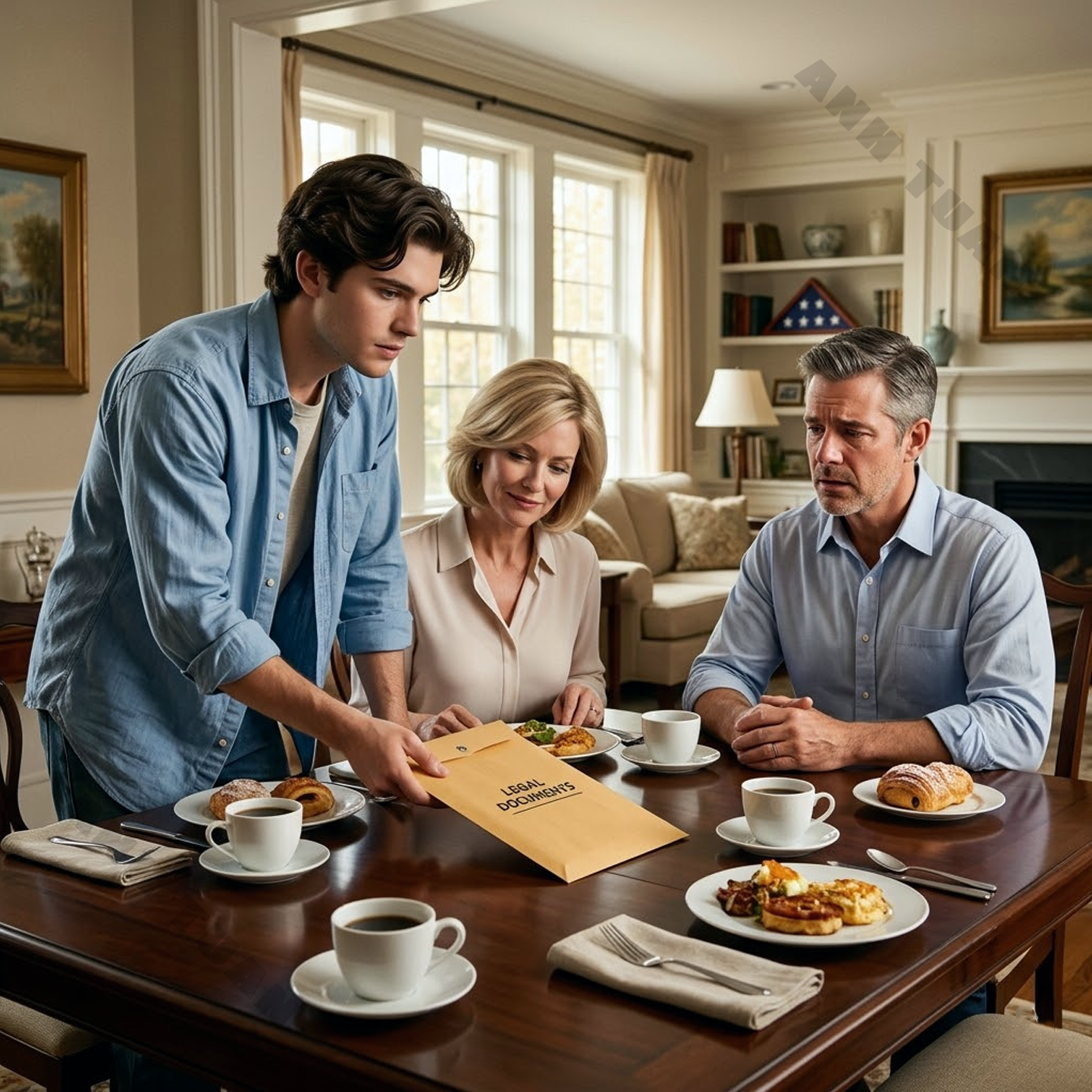
I took the folio from under my arm, pulled out the envelope, and placed it on the dining table between them.
“Mom already answered this,” I said.
My father frowned. Melissa glanced at the handwriting, then back at me.
“What is that?” she asked.
“A letter from Gavin Cole,” I said. “And something from my mother. You should read it.”
My father picked up the envelope first. Even then, I think some part of him assumed it contained a warning he could talk around, a legal technicality he could resent, a procedural inconvenience that would slow him down without actually stopping him. He slid his finger under the flap and unfolded the first page with the distracted impatience of a man expecting to be mildly annoyed.
I had never seen my father cry.
Not when his own father died of a stroke in Florida during a week of brutal summer heat. Not when I graduated from high school and my mother squeezed his hand so hard during the ceremony that he had to shake it loose afterward. Not at the hospital when my mother slipped into a coma the last time and every machine in the room seemed to take over the burden of saying what none of us could. Richard Rowe believed emotion was, at best, private maintenance and, at worst, a public defect. He respected control. Admired restraint. Spoke of “discipline” the way some men speak of faith. Tears, in his moral universe, belonged to people who lacked command over themselves.
So when I saw his eyes begin to fill halfway down the second page, I honestly thought for a second that I had imagined it.
Melissa noticed too. She moved closer, the phone forgotten in her hand, trying to read over his shoulder. My father pulled the document back instinctively, almost angrily, as if the paper itself had heat in it.
“What is this?” she demanded, sharp now.
I did not answer. I already knew.
The first page was Gavin’s. He had the particular talent some attorneys have for sounding calm while removing every available inch of wiggle room. He laid out the facts without embellishment. Evelyn Rowe had established an irrevocable protected trust for the sole benefit of her son, Nathan Rowe. The trust structure had been drafted with specific defensive provisions in response to stated concerns, documented during estate planning sessions, that Richard Rowe and/or Melissa Rowe might one day attempt to pressure, manipulate, or emotionally coerce Nathan into surrendering or redirecting funds. Richard had been provided for separately under Evelyn’s estate. Any request made of Nathan for access to the trust assets constituted a direct violation of Evelyn’s stated intent and would trigger the preservation of related documentation.
The second page included that documentation.
Years earlier, while my mother was still in treatment, Melissa had come by my apartment one afternoon with tulips from Whole Foods and a too-careful expression on her face. She stood in my kitchen, looked around at the cheap dishes in the drying rack, and said in a voice meant to sound practical that after “the inevitable,” it might be simpler if the remaining assets were pooled under my father’s household. She dressed it up in phrases about taxes and structure and stability, but she had not hidden the real shape of the thought well enough. I had told my mother about it later that week. She listened without interrupting, pressed her lips together once, and asked only three questions: exactly what Melissa had said, whether my father knew she had said it, and whether I had answered. At the time my mother gave no grand speech. She only nodded and wrote something in a small notebook she kept by her bed. Apparently she had heard everything she needed to hear.
Melissa took another step toward my father, anger rising fast enough to make her voice thin.
“Richard, let me see that.”
He did not.
He was already on the third page.
My mother had signed a notarized statement during the final revision of her estate plan. Not long, but devastating in the way only careful truth can be devastating. She wrote that if Richard ever asked me for my inheritance, it would confirm the worst thing she had come to understand about him near the end of her life: that he was more willing to betray his son than disappoint the woman he remarried.
I watched my father’s hand begin to shake.
Melissa reached for the papers again. This time he drew them farther away, not to protect me, not even to protect the letter, but because he was reading something that no longer belonged to anyone else in the room. His face had changed, the color draining out of it in uneven patches. The man who had spent most of my life convinced that composure could solve almost anything now looked as though language itself had turned on him.
“What is she saying?” Melissa snapped. “What did she write?”
Still he said nothing.
The next paragraph was worse.
My mother wrote that motherhood had taught her many painful truths, but none worse than realizing her son might one day need protection not from strangers, but from his own father’s weakness. She stated clearly that Melissa was never to have access, direct or indirect, to anything set aside for me. If Richard crossed that line, she wrote, I was to consider it final proof that sentiment could no longer substitute for character.
Melissa made a sound I can still hear if I think about it too long not quite a laugh, not yet outrage, but the crackling little intake of someone whose confidence has just run into a wall. Her face changed first. The brightness went out of it. Then came the anger.
“This is insane,” she said. “She wrote that while she was sick. She was paranoid.”
My father did not defend her.
That was the first real silence between them I had ever witnessed. Not the social kind. Not the irritated marital pause of two people deciding what version of themselves to present. This was different. It was the silence that arrives when one person is suddenly forced to look at another in a light neither of them can control.
He turned to the last page.
That one was handwritten.
Not legal. Not formal. Just personal, dated two months before my mother died, in the same clean, slanted script she used for grocery lists, birthday cards, and the notes she tucked into my lunch bag when I was too old for lunch notes and pretended to hate them.
She addressed it to me.
Nathan, if you are reading this, then I was right. I am sorry for the pain that realization will bring you. Do not negotiate. Do not explain. Do not give away your future to purchase peace from people who would sell yours for comfort. If your father cries, believe the tears if you want, but believe the pattern more.
That line emptied the room.
For the first time in my life, my father looked old. Not in the ordinary way men age, with looser skin and softer posture and gray taking hold at the temples, but in the deeper way shame ages a face all at once. His mouth opened once, then closed. He lowered the page halfway, looked at nothing for a long second, and whispered, “She thought that of me?”
I had been waiting years to understand that grief and clarity can occupy the same space in the body. They can. When I answered him, my voice came out quieter than I expected.
“No,” I said. “She knew.”
Melissa shot me a look so raw with contempt that under different circumstances it might have frightened me. Then she stood up so fast her chair scraped hard across the floor.
“This is abuse,” she said. “This is posthumous abuse. She wanted to poison you against us. She always hated me. This whole thing is manipulative.”
My father still said nothing.
Melissa turned to him.
“Richard, say something.”
He lowered himself slowly into the chair as if the air around him had thickened.
“She wrote all this down,” he said, though it sounded as though he were speaking mostly to himself. “She wrote all this down.”
Melissa’s composure shattered completely then. She started ranting, voice rising, hands flashing through the air. About bitterness. About unfairness. About how Evelyn had always resented her. About how no one leaves letters like this unless they want to destroy the people left behind. About how I was being childish and self-righteous and manipulated by a woman who had, according to Melissa, never gotten over not controlling everything.
That was rich, coming from a woman trying to take money from her husband’s dead wife’s son.
My father said her name once, quietly.
“Melissa.”
It was not loud, but it had a warning in it.
She ignored him.
“Tell him this is insane. Tell him she wasn’t well. Tell him this isn’t legally ”
My phone rang.
The timing was so exact it would have felt theatrical if it had not been so deeply in character for Gavin Cole. I took the phone out, glanced at the screen, and answered.
“Put me on speaker,” Gavin said.
I did.
His voice filled the dining room with the calm of a man who had spent decades watching rich people ruin themselves politely.
“Good morning,” he said. “Nathan, I trust the materials were delivered intact.”
“Yes,” I said.
“Mr. Rowe, Melissa,” he said, without asking permission to address them. “For the sake of clarity, every page you have in front of you is authentic, enforceable where applicable, and already duplicated in our records. The trust established by Evelyn Rowe is irrevocable. Nathan has no discretionary ability to redirect those funds to you, nor would any attempt to pressure him alter the structure.”
Melissa leaned toward the phone. “This is ridiculous. She made these accusations while seriously ill.”
Gavin did not raise his voice. He did not need to.
“Mrs. Rowe, Evelyn’s mental competence at the time of every revision was medically documented. In addition, her concerns were consistent across multiple meetings over an extended period. I would advise both of you to listen carefully. Any further attempt to pressure Nathan for access to the trust assets will be documented as financial coercion and responded to accordingly.”
The room went still again.
Then Gavin added, in that same measured tone, “I should also mention that Evelyn included a contingency clause. If either of you attempts to interfere with Nathan’s housing, employment, or reputation following denial of this request, certain private communications and financial records relevant to the estate may be released in formal proceedings.”
Melissa went white.
The expression on her face changed so quickly that for a second it was almost indecent to watch. Anger, calculation, fear, and something else recognition, maybe. The look of someone suddenly unsure how much another dead woman had seen.
“What private communications?” she asked.
“I’m sure you understand why I won’t elaborate,” Gavin said. “I recommend that all contact with Nathan remain respectful and limited. Nathan, if you need anything further, call my office directly.”
The line clicked off.