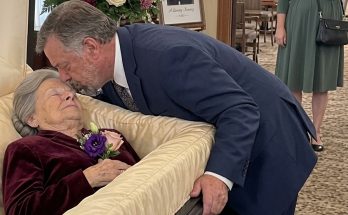
Grandpa died when I was thirty.
Peacefully, after a short illness.
No dramatic final speech.
No mystery will.
No fight over the SUV.
That was almost a gift itself.
We knew his wishes.
Mom knew her role.
Professionals handled administration.
Ava and I grieved.
The old family pattern still tried to return.
Grief makes people reach for familiar tools.
Mom began organizing everyone.
Funeral clothes.
Who should speak.
Where people should sit.
Which photos belonged in the program.
Most decisions were harmless.
Then she told Ava she should give me Grandma’s jewelry because “Amelia was closer to Grandpa.”
Ava stared.
I did too.
Grandpa had explicitly left the jewelry to Ava.
I said:
“No.”
Mom blinked.
“I’m just saying—”
“No. Grandpa chose.”
“But you have his camera collection and the cane.”
“Yes.”
“Jewelry might mean more to you later.”
“No.”
Ava looked at me.
“Thanks.”
Mom started crying.
“I’m trying to make this fair.”
There it was.
Even grief could not turn clear ownership into family inventory.
I hugged Mom.
Then said:
“Fair right now means following what he decided.”
She cried harder.
But accepted.
That moment proved why Grandpa had written things down.
Not because Mom was malicious.
Because grief made her impulse to redistribute stronger.
Clear instructions protected everyone.
The funeral was difficult.
I spoke.
So did Ava.
Mom.
Grandpa’s old friend Mr. Lewis.
No one mentioned the SUV in the service.
Thank God.
Objects should not become the summary of a person.
Afterward, I sat in the white SUV in the funeral-home parking lot and cried.
Not because of the car.
Because Grandpa would never again ask to borrow it correctly.
That was the detail grief chose.
Weeks later, his estate attorney gave me the note confirming the SUV gift.
I already had a copy.
He said Grandpa insisted another be in the estate file.
I laughed through tears.
Documentation to the end.
The camera collection came to me.
I had no idea how to use half of it.
I learned.
That became my way of staying connected to him.
Ava received the jewelry and recipe box.
She wore one bracelet at Christmas.
I admired it.
No score.
Mom struggled more.
Without Grandpa, the person who could stop her with one sentence was gone.
She called both daughters constantly.
Wanted to know plans.
Where we were.
Whether we had arrived home.
Old anxiety.
We responded with compassion and limits.
One check-in call most days during the first weeks.
Then fewer.
No permanent location sharing.
No keys.
Mom said:
“Your grandfather would want you to look after me.”
I answered:
“He would want us to ask what help you want and what we can give.”
She sighed.
“He made you all impossible.”
Maybe.
Grief also made me hesitate about selling the SUV again.
I had been ready before he got sick.
Now the thought felt disloyal.
I told Ava.
She said something wise.
“Grandpa didn’t give you a museum.”
Exactly.
Still, I waited.
Not because I owed the car permanence.
Because I was not ready.
Choice includes waiting for emotional reasons too.
The SUV became less practical.
I drove fewer miles.
A warning light appeared.
Nothing catastrophic.
Repairable.
I fixed it.
One more year.
At Mom’s house, we sorted Grandpa’s remaining personal items with the attorney’s guidance.
Mom wanted to keep everything.
Ava wanted fewer things.
I was between.
We each chose.
Donated.
Sold where appropriate.
No secret redistribution.
When two people wanted the same minor item not specifically assigned, we talked.
Once we flipped a coin over an old wooden toolbox.
Ava won.
I was disappointed for five minutes.
Then fine.
This would have been impossible years earlier.
We had learned that not every unequal outcome is injustice.
Sometimes someone wins a coin toss.
The real injustice had been taking a completed gift from one sister to solve the other sister’s problem without permission.
That distinction stayed clear.
On the first anniversary of Grandpa’s death, I drove the SUV to his cemetery.
Not because cars visit graves.
Because I had errands afterward.
I laughed at myself.
He would have liked that.
No pilgrimage.
Ordinary life.
I sat on the bench nearby and thought about the tracker map from my birthday year.
All those lines.
Ava’s miles.
My miles.
Grandpa’s appointments.
Weddings.
Funerals.
The car had carried a decade of family change.
I finally knew I would sell it.
Not that day.
Soon.
The gift had done its job.
Keeping it forever would not keep Grandpa.
Letting it go would not lose him.
After Grandpa died, the estate process also showed why grief and administration should be separated where possible.
Mom wanted to distribute sentimental items immediately.
The attorney recommended waiting until the initial inventory was complete.
Mom complained it felt cold.
I understood.
Sorting objects felt like love.
Inventory felt bureaucratic.
But the pause prevented mistakes.
A watch Mom assumed Grandpa meant for her had actually been specifically left to his brother.
A camera lens I thought belonged in my collection had been loaned from a friend years earlier.
If we had distributed by emotion, we would have created new problems.
The attorney’s process did not reduce grief.
It kept grief from becoming accidental appropriation.
That idea echoed the SUV conflict in a strange way.
Good intentions do not change ownership.
Even when someone is dead.
Even when everyone is sad.
We followed the documents.
When ambiguity existed, we discussed.
When the will was clear, we did not vote.
That clarity protected relationships at the exact time emotion made everyone more vulnerable.
After the funeral, Mom wanted all of us together every Sunday for a month. Ava could not.
I could do two. Instead of treating attendance as a loyalty test, we chose dates and added phone calls.
Grief needed connection, but connection still had forms. That helped Mom mourn without turning everyone’s calendar into evidence of love.
The first Christmas without Grandpa, Mom nearly gave me his old watch because “you were closer.” I reminded her it belonged to her under the estate distribution. She kept it.
A year later, she wore it happily. Following the plan had preserved something she might otherwise have surrendered in grief.
After Grandpa’s death, I sometimes opened the tracker app out of habit before remembering the SUV sat in my own driveway and the person most connected to its history was gone. Grief turned even boring technology into memory for a while.
Then that faded too.
During estate sorting, Mom sometimes caught herself saying “Amelia should get this because…” and stopped mid-sentence. The interruption was progress.
She would check the document, ask if the item was unassigned, then let us discuss. New habits often appear first as the ability to stop an old sentence halfway through.
Grief made me appreciate how useful those backups were. Mom missed one appointment with the estate lawyer because she could not face it.
The process did not collapse. Good planning makes room for people to be human.
We also chose not to keep every object Grandpa owned. Donations went to people who could use them.
Letting things circulate felt more consistent with his generosity than turning his house into storage for our grief.
Ava and I also gave each other room to grieve differently. She sorted.
I photographed. Mom cried.
No method became the family standard.
Click here to continue reading: PART 13: Seven years after my birthday, I sold the SUV by choice and learned that keeping Grandpa’s gift forever would have turned ownership into another kind of obligation
The tracker revealed Ava was not simply borrowing my SUV, and Mom had even changed insurance details as though my birthday gift were family inventory
Part 12 of 16