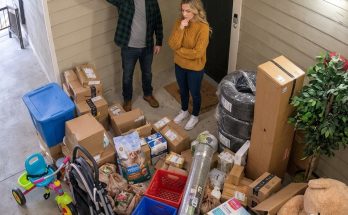
The last deliveries took more time than we expected.
One recipient was recovering from surgery and asked us to leave her parcel with a neighbor.
Another had traveled out of state to see family.
We didn't want to force either person to accept a gift on our schedule.
So we waited.
The apartment still needed attention, but the lease gave us enough time to finish.
On Wednesday, the woman recovering from surgery called.
Her name was Helen Price.
Mom had bought her a lightweight electric kettle with an automatic shutoff.
Helen explained that standing in the kitchen had become difficult.
She didn't want visitors that day, but she was happy for Rosa to bring the box upstairs.
I wrote a note to go with it.
I didn't sign Mom's name for her.
Her original card was inside.
Mine simply said that we were glad the kettle had found its way to her.
It felt important not to impersonate my mother's voice.
Later, Helen called to thank us.
She cried a little and said she had once brought Mom soup after a hospital appointment.
“Your mother didn't like anyone fussing,” she said.
“Neither did you, apparently,” I answered.
We laughed.
The next parcel went to Oliver, the little boy who loved the same books his father had read to him.
His family had moved across town.
His mother arranged to meet us in a public park.
Oliver was seven and immediately became interested in the stuffed fox.
His mother read Mom's note before letting him open the books.
She told us that Mom had sometimes read to him when his parents attended evening classes downstairs.
“She never acted like she was doing us a favor,” the woman said.
“She just liked the story.”
Oliver held up the fox.
“Did Evelyn make this?”
“No,” I said. “She picked it for you.”
He considered the difference.
“It's a good fox.”
I couldn't have asked for a better verdict.
The last parcel before Sophie's was for a man named Walter who had once helped Mom with a broken grocery cart.
It contained a new thermos and a packet of coffee from a local shop.
He worked outdoors and had mentioned his old thermos leaking.
When Ben handed him the box, Walter shook his head.
“I fixed one wheel. That's all.”
“She remembered,” Ben said.
Walter examined Mom's handwritten card.
Then he told us something surprising.
He'd met her again weeks later, and she'd insisted on asking how he was doing.
He had just lost his sister.
Mom stood in the parking lot and listened for twenty minutes.
“She didn't tell me it was going to be fine,” Walter said.
“She just said I must miss her.”
I nodded.
That sounded exactly right.
Afterward, Ben and I drove to his house.
Dad's toolbox was on a shelf in his garage.
He had cleaned the metal hinges and oiled the latch.
The little pencil still lay in the top tray.
Mom's chair had been moved into the corner of the living room.
Ben's wife had set a lamp beside it.
It looked comfortable there.
I sat down, testing the cushions.
“You can take it whenever you like,” Ben said.
“Not yet.”
We talked about the boxes.
Not the physical ones, which were almost gone.
The memories we'd been carrying from one person to another.
Ben said he had thought his main job as a son was to solve problems.
When he couldn't repair Mom's health, he'd felt he had failed.
I told him I'd treated every visit like a task that needed to be fitted into a crowded calendar.
We hadn't been bad children.
We'd been busy adults, sometimes thoughtful and sometimes distracted.
Our mother's final letters did not make us perfect.
They allowed us to be ordinary people who had loved each other.
Ben pulled out the folder from the estate attorney.
We had a plan for the remaining belongings.
A local donation center would collect the usable furniture after the family had selected keepsakes.
A few items would be offered to neighbors who had expressed interest, without making anyone feel obliged.
Mom's financial records were being handled through the proper estate process.
We would keep a reserve for final expenses until the bills were settled.
Nothing about the packages had compromised that.
Before Sophie opened her gift, I asked her to sit with me in Mom's bedroom.
The dresser had been cleared except for a small mirror and a photograph of Mom as a teenager.
Sophie had seen the photograph many times.
She picked it up and studied the face.
“She looks like she's planning something,” she said.
“Your grandma always looked like that.”
“Was she happy when you were growing up?”
The question surprised me.
I considered the years I could remember.
There had been good days and hard ones.
Mom sometimes worried about money.
She and Dad argued when he worked too many hours.
She could be impatient when the house was noisy.
But she also sang while cooking and danced with Dad in the kitchen when a favorite song came on.
“I think she had a full life,” I said.
“Not a perfect one.”
Sophie nodded.
“I'm glad.”
“Why?”
“Because when I think about getting older, I don't want to believe I have to choose between caring for people and having a life of my own.”
I looked at her.
She had said something I'd spent the last few weeks learning.
“Neither did Grandma,” I answered.
Sophie put the photograph back.
“Did she ever tell you what she wanted to do when she was young?”
“She wanted to travel. She loved looking at maps.”
“Did she go anywhere?”
“Not as much as she'd hoped.”
Sophie was quiet.
I told her about the weekend Mom and Dad took us to the lake in a borrowed car.
Dad got lost twice.
Mom insisted the wrong road had better scenery.
We spent the afternoon eating sandwiches by the water and returned home sunburned and happy.
Sophie smiled.
“That sounds like an adventure.”
“It was.”
I realized I'd been telling the story as a compromise because we couldn't afford a longer trip.
But to my childhood self, it had been a wonderful day.
I didn't need to recast every happy memory as evidence of hardship.
Mom had made good things out of what she had.
That did not mean the hard things hadn't hurt.
It meant both were true.
After we left the bedroom, Sophie helped me carry a box of kitchen tools to the car.
She asked whether I wanted to keep a small bread knife with a loose handle.
“No,” I said. “It's not safe.”
She looked amused.
“Grandma would probably have said you could fix it.”
“Grandma would also have said not to cut your fingers.”
We put it in the pile for safe disposal.
Keeping memories did not require preserving every worn-out tool.
At the end of the afternoon, Sophie said she was glad we had waited before opening her parcel.
“It made me feel like I was part of what you were doing,” she said.
“You are part of it,” I told her.
“Not just because you're Grandma's granddaughter.”
She hugged me.
The apartment was almost empty.
But we were still finding ways to speak more plainly to one another.
On the drive home, I told Sophie about Helen's kettle and Oliver's fox.
She listened with interest but didn't ask whether every recipient had cried.
I was grateful.
Some had smiled.
Some had accepted gifts with embarrassment.
Some had wanted privacy.
A few hadn't been able to say much at all.
I had begun to understand that the purpose of giving wasn't to produce a dramatic reaction.
It was to offer something thoughtfully and let the other person decide what it meant.
Sophie told me she had recently helped a coworker move furniture.
The coworker had thanked her with a homemade lunch.
She said she'd almost refused because she felt awkward accepting anything.
I told her about Margaret's words, though at that point we hadn't yet discovered the name.
“Maybe people like being able to give something back,” I said.
Sophie nodded.
“I think so.”
We stopped for groceries on the way home.
She chose ingredients for a simple dinner.
I reached for a more expensive package of prepared food, then hesitated.
Mom would have compared prices.
Sophie noticed and laughed.
“You can buy it if you want, Mom.”
I put it in the cart.
I could be careful with money without making every purchase into a test of loyalty to her habits.
At home, we cooked together and talked about things unrelated to Mom.
Sophie had plans for a weekend hike.
I had a difficult project at work.
We complained about traffic.
The ordinary conversation helped.
Grief had occupied so much of our attention that remembering we still had lives felt almost disloyal.
But Mom's final preparations had been made because she hoped there would be ordinary days ahead.
I was beginning to believe we could live them.
The following afternoon, Sophie joined us at the apartment.
Her sealed gift was wrapped in brown paper, with a little ribbon threaded through the knot.
It contained a set of embroidered kitchen towels and a handwritten recipe book.
Mom had copied recipes from cards that were stained, torn, or fading.
There were notes in the margins.
Less sugar if Sophie's making this.
Use the good butter.
Ben likes extra pepper, though he pretends not to.
Sophie turned the pages slowly.
Then she found a note inside the cover.
You don't have to love cooking to remember me. Make what you like and change what you don't.
Sophie laughed through tears.
“Grandma really did know me.”
She preferred takeout and wasn't shy about it.
For a moment, the three of us stood around the recipe book, pointing at familiar dishes.
Then Sophie remembered the envelope Mom had given her.
She took it from her handbag.
It was addressed to her, but on the back Mom had written: After Claire and Ben understand.
Sophie looked at us.
“Do you understand?”
I thought of all the people we had met.
“More than we did.”
She opened it carefully.
Inside was a photograph of Mom as a young woman standing in front of an unfamiliar house.
On the back was an address and a sentence.
This is where I learned that kindness is something people can teach one another.
Beneath it was a name none of us recognized.
Mrs. Bellamy.
And a request.
Before you open the last box, please find out what happened to her.
Click here to continue reading: PART 11: A Photograph Leads Us to the Woman Who Once Helped Our Young Mother
The Blue Bowl That Made Me Understand Why Mom Had Ordered Twenty-Eight Packages
Part 10 of 12