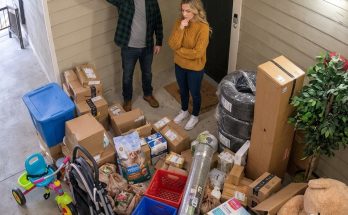
Rosa Alvarez didn't come inside immediately.
She looked at the boxes as though she recognized something fragile among them.
“Would you like tea?” I asked.
She shook her head.
“Your mother made tea every Thursday. I don't think I can sit at her table yet.”
Ben pulled a chair into the hallway so she could rest.
Rosa lowered herself into it with one hand on his arm.
She told us that four years earlier, after her husband died, she had stopped leaving the building except for groceries.
Mom began appearing at her door with library books.
At first she pretended she'd borrowed too many.
Then she admitted she simply wanted company.
“Every Thursday,” Rosa said, “she'd knock at ten. If I wasn't dressed, she sat and waited while I found my shoes.”
Mom would take her to the community room where several residents met for coffee.
Sometimes they read together.
Sometimes they sorted donations for a neighborhood pantry.
Sometimes they sat quietly because someone needed a room where no one expected them to be cheerful.
“She was our organizer,” Rosa said. “But she never called herself that.”
I remembered Mom saying she was busy on Thursdays.
I'd assumed she meant her senior center luncheon.
“Why didn't she tell us?” I asked.
Rosa tilted her head.
“Didn't you ask?”
The question wasn't unkind.
That made it worse.
I looked at the marigold seeds on the table.
Mom had once kept flowers on her own balcony, until the winter wind damaged the railing.
The building manager took months to repair it.
Rosa told us she'd missed the color.
Mom had remembered.
When we finally invited Rosa inside, she stopped by the cardigan on the chair.
“That's the one I helped her mend.”
She touched a sleeve lightly.
“Her hands were stiff that afternoon. She kept saying she could manage.”
Mom had mentioned aching fingers.
I had told her to speak with her doctor.
I hadn't known she needed help threading a needle.
Rosa sat at the kitchen table while Ben made coffee.
I asked whether Mom had discussed her health.
“A little,” Rosa said. “She knew she was getting tired. She said there were matters she wanted in order.”
“Did she say she was dying?”
“No. She said doctors were still trying to understand her breathing trouble.”
That matched what we knew.
Mom had been hospitalized after sudden complications from a chronic heart condition.
She had been weaker for months, but no physician had promised us an exact outcome.
I had no reason to believe she knew a date we didn't.
Still, she'd written birthday cards in advance.
Rosa turned the cup in her hands.
“People prepare when they're frightened,” she said. “Sometimes they do it so their children don't have to.”
We opened three more parcels with her.
One contained wool socks and a thermal mug for a night security guard.
Another held a replacement power cord for the community-room radio.
The third contained a large packet of index cards and a modest label maker.
There was a note for Rosa attached to the label maker.
For the pantry shelves. You know where everything belongs better than I do.
Rosa laughed once, a surprised little sound.
“That woman.”
Then she wiped her eyes.
“She could never leave a cupboard unlabeled.”
Ben placed the label maker beside her gloves.
“Was the pantry Mom's project?”
“It belongs to all of us. Your mother just helped it work.”
Rosa explained that the apartment building had a modest common room, and the neighborhood association rented a small storage closet downstairs.
Residents brought in unopened groceries and hygiene supplies.
Volunteers assembled bags for people who needed help between paychecks.
The project wasn't a registered charity.
It was a practical arrangement overseen by the association, with clear rules about donated goods and privacy.
Mom kept the sign-up sheet.
She checked expiration dates.
She made sure nobody had to explain their finances in front of strangers.
“She said asking for toilet paper shouldn't feel like confessing a sin,” Rosa told us.
I could hear Mom saying it.
Ben rubbed his face.
“Did she pay for all of this?”
“Some things,” Rosa said. “Not everything. She was careful. We all are.”
That answer relieved us.
A pile of packages was one thing.
A secret financial disaster would be another.
We had not looked at Mom's bank account yet.
Neither of us wanted to discover she'd used money she needed for rent or medical care.
Rosa seemed to read our faces.
“Your mother talked about budgets more than anyone I know.”
She raised an eyebrow.
“Once she made me return a perfectly good coat because the store charged the wrong sale price.”
Ben smiled.
“She once drove across town for a three-dollar refund.”
“She told us that story,” Rosa said. “Several times.”
For a few minutes we laughed together.
It was the first laughter in that apartment since her death that didn't immediately make me feel guilty.
Rosa had to leave before noon.
She promised to help us identify recipients if we needed her.
Before she went, she took my hand.
“Please don't think your mother had a different family down here,” she said.
“You were the people she spoke about most.”
“Then why do I feel like I knew only half of her?”
Rosa squeezed my hand.
“Because she had a whole life. That's a good thing, Claire.”
There was a moment after Rosa left when the apartment became very quiet.
I stood in front of the refrigerator and tried to remember what Mom had put there during my childhood.
School photographs.
A calendar from the local bakery.
A shopping list with an extra line for whatever Ben and I requested at the last minute.
She had always made space for our lives on that door.
I looked at her present calendar.
Thursday had been circled in blue ink for nearly every week of the preceding month.
Beside one Thursday she'd written R – appointment, bring soup.
Beside another was a note to call the library about a large-print book.
There were also ordinary reminders about her own medicine and bills.
The page showed neither sainthood nor secrecy.
It showed a person with a schedule.
That was almost more surprising to me than the packages.
After Dad died, I had worried that her days were empty.
I'd called to fill the silence, sometimes while folding laundry or driving between errands.
She often ended those calls before I did.
I used to wonder whether I had annoyed her.
Now I considered that perhaps she had somewhere to be.
Ben found a photograph of her at the community-room table.
She was wearing a ridiculous paper crown left over from someone's birthday party.
Her mouth was open in a laugh.
Neither of us had taken the picture.
I held it under the kitchen light.
“I've never seen her laugh like this,” I said.
Ben glanced at me.
“She laughed like that at Dad's birthday when he dropped the cake.”
I remembered the cake landing sideways on the carpet.
I remembered Mom laughing so hard that she had to hold on to the doorframe.
It was the same laugh.
I'd known it all along.
I was only startled to find someone else had witnessed it.
I slipped the photograph back into the frame.
Later, I checked the apartment's mail slot.
There were two advertisements and a reminder about the building's routine fire-alarm inspection.
I put the advertisements in recycling and wrote the inspection date on Ben's list.
The practical tasks kept tugging us back from the past.
We had groceries to remove from the refrigerator before they spoiled.
We had plants that still needed water.
We had to decide whether the neighbors wanted her extra folding chairs.
When I watered the fern by the window, I noticed a new frond unfurling.
Mom had worried about that plant every time she traveled.
I touched the soil and decided it could come home with me.
Not because it held an explanation.
Because it was alive, and someone needed to keep watering it.
That evening I wrote Rosa's name in my own address book.
For the first time in years, I made a note about one of Mom's friends instead of only about one of Mom's appointments.
It felt like an overdue correction.
I picked up the coffee cups after Rosa left and found she'd placed her biscuit wrapper neatly in the recycling.
It was such a small courtesy.
I remembered Mom scolding us for leaving crumbs on the table when we were children.
She would have liked Rosa very much.
Of course, she already had.
After she left, I walked into Mom's bedroom.
The bedspread was tucked tight.
On the dresser stood a framed photo of Ben and me as children, standing under a sprinkler.
I was missing a front tooth.
Ben wore a bathing suit he'd refused to take off for a week.
I could remember the day, but I couldn't remember the last time I'd asked Mom what she enjoyed when we weren't around.
I sat on the edge of her bed and called Sophie.
She answered during her lunch break.
“Did Grandma ever tell you about a pantry?”
“Yes. She talked about it all the time.”
I blinked.
“She did?”
“She said Mrs. Alvarez ran the labels and that a guy named Isaiah fixed the shelves.”
“Why didn't you mention it?”
Sophie sounded genuinely puzzled.
“I figured you knew.”
That hurt more than I expected.
I had spent years organizing visits around work, traffic, and the next appointment.
Sophie had sometimes stayed longer because she liked listening to her grandmother's stories.
There was no accusation in her voice.
Just a fact.
She had heard things I hadn't.
After we hung up, I returned to the living room.
Ben was sitting among the boxes with a yellow envelope in his hand.
He held it out.
“For both of us,” he said.
Inside was a list in Mom's handwriting.
There were twenty-eight numbers.
Beside most of them was a name.
Beside number twenty-eight, there was only a sentence.
When you know who I was without you, open this together.
Ben stared at the page.
I stared back.
Our mother had left us a map of the people she loved.
And somehow the last stop was us.
Click here to continue reading: PART 3: The Gifts Begin Finding Their Owners and We Discover How Widely Mom Was Loved
The Blue Bowl That Made Me Understand Why Mom Had Ordered Twenty-Eight Packages
Part 2 of 12